
Today’s Quick Tip is for intermediate and “pro” guitarists who are always looking for more cool ways to embellish basic chord shapes and spice up their rhythm playing.
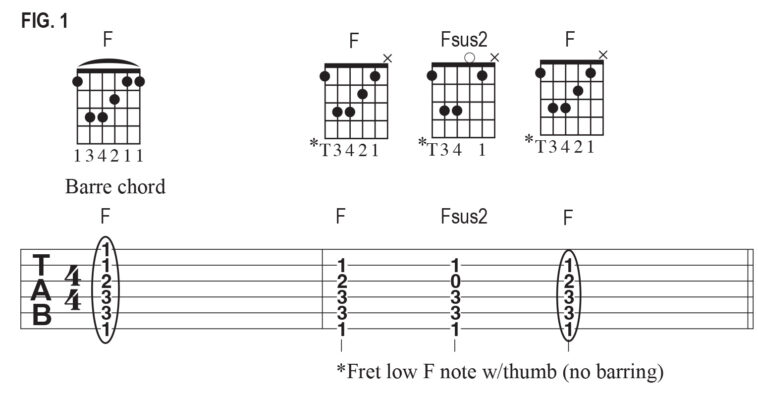
Instead of always playing a low F chord as a standard 1st-position barre chord across all six strings, consider not barring it and instead using the 6th-string thumb fretting technique to form the shape illustrated in FIGURE 1.
Doing this offers you two benefits:
1) It’s often more convenient and comfortable to not have to rotate your wrist to form the full F barre chord shape when playing a progression of mostly open chords.
2) As shown in the example, this non-barre fingering allows you to easily toggle between F and Fsus2, which is a beautiful and very musical way to embellish an F chord, in the same way many players do with C and Csus2 (see FIGURE 2).

Countless guitarists have used this technique and the F-Fsus2 embellishment to decorate and add melodic interest to their chord playing.
A well-known example can be heard in the intro and verses to Californication by the Red Hot Chili Peppers, where guitarist John Frusciante creates a melodic chord riff by first using his open B string to play Asus2 to Am, then uses his open G string with the thumb-fretted F grip to play Fsus2 to F.
Another noteworthy example can be found in the intro and verses to Fleetwood’s Mac’s Go Your Own Way, where guitarist Lindsey Buckingham, using a capo at the 5th fret, plays the Csus2 to C then Fsus2 to F, using the shapes illustrated in FIGURE 2.
As I demonstrate in the video, by using the thumb-fretted, non-barre F grip, you can embellish the F chord with pull-offs and hammer-ons to and from the open G string to A at the 2nd fret to create elegant-sounding, James Taylor-like sus2 decorations to your chordal accompaniments, in the same way many players will often do with D and Dsus2 or with A and Asus2.

Note that, by not barring the 1st string in the thumb-fretted F or Fsus2 grip, you can add an open high E note to it to sound a beautiful, full-sounding Fmaj7 voicing, or Fmaj7sus2, as demonstrated in FIGURE 3. Or you could barre only the B and high E strings with your index finger to get a full F chord, with the same six notes as the conventional barre chord.
Keep in mind that sometimes the chord you are to play in a given song is simply F and not Fmaj7. So be mindful not to gratuitously add that “color” tone where it’s not needed or wanted.