
Whether as a solo instrument or the centrepiece of a band, the acoustic guitar continues to be one of the world’s most popular instruments, in just about any style you could name.
This example piece is played unaccompanied (Blackbird-style foot taps are optional, of course), so you’re responsible for holding the whole thing together. If you take a look at the transcription, you’ll see this isn’t a hugely complex exercise, but keeping the alternating bass clear and regular is crucial, so tapping your foot (audibly or not) is a good idea.
I chose to use a pick-and-fingers approach, as this got more definition out of the all-mahogany Martin I used for the recording, while keeping the sweet treble response. Depending on your guitar and/or preferences, you could also try a thumbpick or simply fingerstyle.
Latest Videos FromGuitar World
Breaking the example piece down into its component chords, we have versions of D7, D5, F6/9 and G5 in the first section. F6/9 is a chord that will likely raise questions. This version of F uses the open third and fourth strings, so we have a G (9th) and a D (6th) respectively. As with all unusual chords, there are multiple angles from which this could be described theoretically.
The simplest seems to be F6/9, rather than F6sus2, which is also correct – though neither of these names addresses the fact that the 3rd (A) is omitted! Also of note is the Em9 in the next section, which takes an influence more from the English-style folk of John Renbourn or Bert Jansch than American bluegrass, but it’s a nice chord.
As with any new piece, it’s best to take things slowly and patiently while the muscle-memory/conditioned reflex develops.
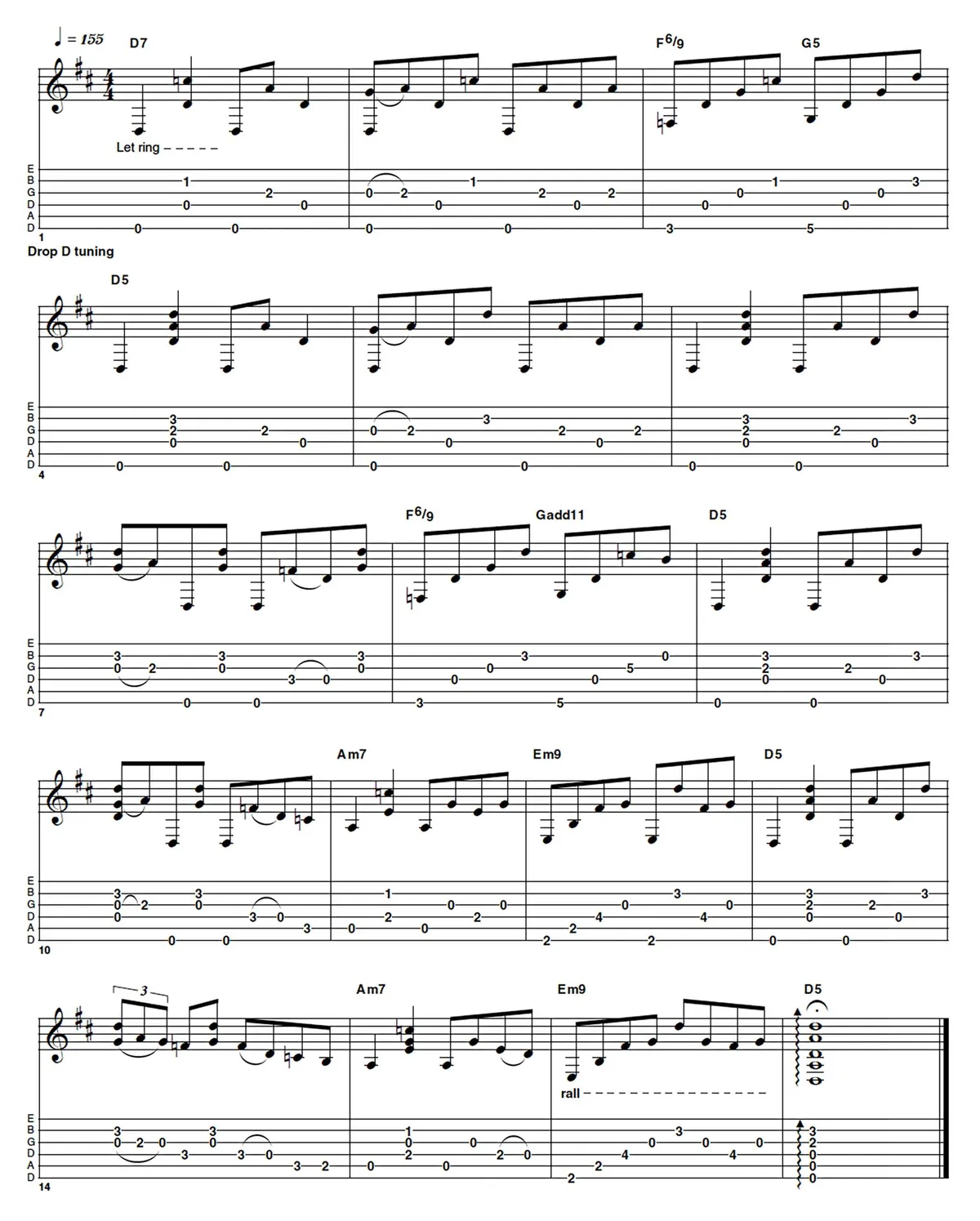
First, note that this is in drop D tuning, meaning that the low E is lowered by a tone. The overall feel of this piece owes a little something to 4 + 20 by Crosby, Stills, Nash & Young. Sometimes the bass alternates between octaves, usually wherever we’re playing any kind of D chord.
This changes to root and 5th for virtually everything else. One notable exception (which escaped our notice until transcribing this…) is bar 7, where the low D swaps to beats 2 and 3 of the bar.
This must have helped with playing the doublestops above! It can be helpful to separate the bass notes and chords/doublestops at first, then build up to some of the more complex moments such as in bar 14.
This is the only other time we break the rhythmic pattern of the bass. Lastly, be sure to slow down in the last two bars for a grand finish.
Hear it here
Crosby, Stills, Nash & Young – Déjà Vu

4 + 20 is the best style-match for the example piece, with its alternating bass fingerstyle pattern, even though this was played in an open tuning (similar to open D). You’ll hear the same alternating bass pattern (albeit strummed) in Teach Your Children, which is completely driven by the acoustic guitar.
Elsewhere, the acoustic’s presence is very evident in the title track. As an extra bonus, try to imagine waltz-style Country Girl without the strummed acoustic!
John Renbourn – The Best of John Renbourn

This collection of tunes allows us to hear not only the inestimable John Renbourn but also his collaborations with Bert Jansch and the group they went on to form, Pentangle. Be sure to check out Can’t Keep From Crying, Lord Franklin and – with the disclaimer that it may be intimidating on the first listen – I Know My Babe.
If this collection should make you curious about what else Mr Renbourn was capable of, then we urge you to check out Faro’s Rag from 1976’s The Hermit as well.
Alison Krauss & Union Station – Paper Airplane

If you like great acoustic, bluegrass and blues playing, we’re confident you’ll love this album. Check out the title track, followed by Lay My Burden Down; this flatpicking style could be played hybrid or with fingers only, but the accuracy and attack from the pick is hard to beat.
Another version of the alternating bass style drives album closer, My Opening Farewell. Also, listen out for some exemplary slide/resonator playing from the great Jerry Douglas.