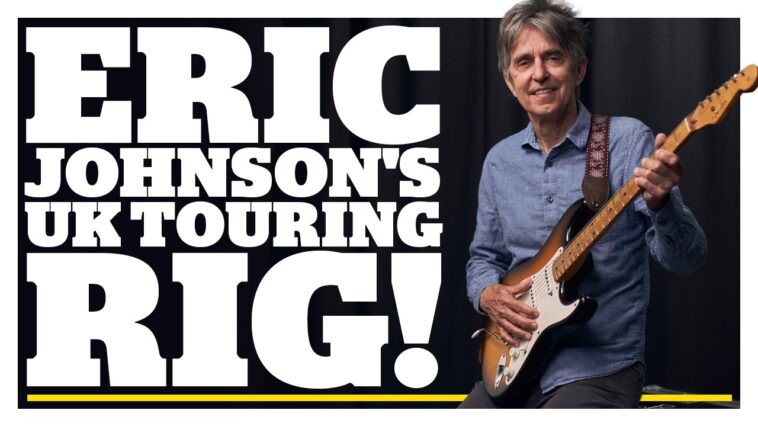
It’s been 13 years since Guitarist stood onstage with Eric Johnson for a tour of his rig. And we muse that it had probably seen some changes since that time.
“Not as many as you’d think,” he says with a laugh, explaining that he actually ships his USA rig across to Europe, rather than hiring backline on this side of the Atlantic.
“Yeah, it’s pretty extravagant,” he continues. “I’m going to go home broke because I shipped everything over here, so I’ll be eating bread and cheese for the next year or two, but that’s okay, at least I’ll have my sound, I guess.”
Latest Videos FromGuitar World
Known for his connoisseur-level guitar tone, we were surprised to find that the actual sum of parts doesn’t comprise anything that might be described as ‘exotica’. We were even more surprised to find that Eric has been experimenting with digital amps. But the 21st century hasn’t quite found its way onstage with the Tonemeister General quite yet…
Could you give us a guided tour of your live rig?
I use three different sounds: the guitar goes into two A/B boxes; the first A/B selects whether it’s going to be lead or it’s going to be a choice of rhythms. So it comes out for the lead, goes into a wah-wah, and then it goes over to an Echoplex and a Tube Driver, and it comes out of that and goes into a Marshall [JMP] head connected to the bottom [Marshall] cabinet. I can then switch to a second A/B box, which will give me a choice of rhythm.
The first is a clean rhythm, which goes into a loop box for the Deluxe Memory Man, which goes into another Echoplex and a TC Stereo Chorus. That goes into two [Fender] Deluxe Reverbs.
If I choose the other type of rhythm, I can switch this second A/B box and get a dirtier rhythm, which goes into an [Ibanez TS808] Tube Screamer, an [Arbiter] Fuzz Face, and an MXR Digital Delay. That goes into a Two Rock Classic Reverb amplifier, which goes into the top Marshall cabinet.
So it’s really just a matter of having three different sounds: one clean stereo rhythm, one dirty rhythm with fuzz, or a lead with the tube overdrive. Pretty much the same as it’s been for years, although the particular amps might change, but the general structure and architecture stays the same.
It’s really just a matter of having three different sounds: one clean stereo rhythm, one dirty rhythm with fuzz, or a lead with the tube overdrive
A lot of players have a single amp setup and use pedals for a clean boost, crunch and a lead sound. When did you discover the three-amp system worked for you?
Well, one thing is the gain structure of the amps. I was able to get a better lead tone out of a high gain or a higher gain amp like a Marshall. And I was able to get a better rhythm tone out of a lower gain amp like a Fender.
Also it’s the way the tone controls work on the amp. The tone controls are in a different place in the schematic on a Marshall than they are on a [Fender] black-panel, so it affects the sound.
So to try to get that clean country tone, or Wind Cries Mary kind of tone, the black-panel Fender works for that. But the Marshall works better for that blues-rock thing, so I just had to part it out because I could never figure out a way to make it work just using one amp and getting all those sounds. I wish I could do that. I think they actually call that the Neural DSP [Quad Cortex], don’t they?

Have you experimented with digital amps?
A little bit, yeah. The Tone Master by Fender and the Neural [Quad Cortex]. Still messing with it. I’m trying to decide whether to try to replicate my sound or to just go with it in a different sonic direction. I think at this juncture it seems that its strength is to use it as its own tool instead of trying to make it sound exactly like a vintage amplifier, you know?
What about guitars?
I just use my ’54 Strat, and I have one of my EJ rosewood [fingerboard] Stratocasters with me. But the Strat is the main thing I use for most of the show. I also brought a Custom Shop Les Paul along for a few songs.

Do you have very specific setup requirements for your Strats?
I like the fretboard a little flatter with bigger frets, and I hook [the lower] tone control up to the bridge pickup. The neck and middle are the old pickups, but I replaced the bridge pickup with a HS2 DiMarzio. But I don’t hook up the bottom coil, I just leave it single coil, so it has a little bit more gain than a regular Fender pickup. The action is not too low, but kind of low; so that it doesn’t fret out, you know?
It’s been refinished and [the neck] was already flattened before I got it, which is perfect because nowadays you don’t want to touch it anymore. But in the old days it didn’t matter. I mean, I used to find [’50s Strats] for 400 bucks and you could do whatever you wanted. But it’s kind of become a stigma now. This is the only ’54 I have and it’s a good guitar, although it’s not particularly original, but it does the job.
What about the profile of the neck? Is it a soft V?
“It’s not too sharp, which I like. It’s kind of rounded, that’s really my favourite neck. They’re smaller than they were in the later ’50s, but they’re thicker and rounded, which I find to be kind of nice because with the smaller neck you can do different [chord] voicings and stuff like that.
What gauge of strings do you use on your Strat?
I just use a stock 10 through 46: 0.010, 0.013, 0.017, 0.026, 0.036, 0.046. I was using a little bit thicker [gauge] but it kind of got to where I thought these were more balanced.
You actually started on piano. How do you think that influenced your guitar playing?
It was in a pretty major way because I kind of assimilated all the nuances and technique of piano and so when I started guitar, I wanted to get those chord voicings. So it’s almost like your principal language in a way, whether you got real good at it or not, you think that way, and so I transferred that to guitar, and it helped me not be too myopic about how I looked at chord voicings or tone.

I like the sound of the piano because it’s a lot of note and not a lot of attack. Usually on a nice piano, and similarly with some of my favourite guitar players, there wasn’t a lot of noise or attack. It was just the blooming of the note, like Wes Montgomery, or in particular steel-guitar players. They get this sound where it just jumps out because of their picking.
Do you think it’s true that guitar players learn chords and scales using patterns or diagrams, whereas a keyboard player would learn the same information from a more musical perspective – note names, key signatures and so on?
That’s true, and I think most guitar players are still somewhat trapped in patterns. But I think the less you are, the better, obviously. We’re all trying to get out of that and become more liquid and just be able to play melodically.
When I started playing guitar and didn’t know how to play, one of the first things I did was teach myself by sitting at the piano with the guitar in my hand and taking the notes and moving them over [to the guitar].
So what I had to do with this strange way of learning guitar was learn all the notes on all the frets; that’s one of the first things I did. And I think it helps if you look at a string on a fret, and you immediately know what note it is. So that you’re not so bound by those patterns.
Guitarists can find it very difficult to break away from shapes and patterns…
One of the first things [to do] is just sit down and learn – to where you [can do it] without thinking – to look at any fret on any string and know what note it is. It is a daunting task, but it’s totally doable. And then, once you get it, it’s like breathing. We don’t think about breathing, we just do it, and it really helps free you up and not be so stuck on the pattern thing.

In the past you’ve said that your style is a mixture of diverse influences, from Eric Clapton’s period with John Mayall to jazz players such as Wes Montgomery. How did that come about?
“You know, when I was really young, my dad loved music so much he just played all these records of all these different styles. And I saw how much it made him happy. [I thought] “Oh, there must be something to this music thing”. Then you start listening to different music, which continues to this day.
I mean, you can find stuff in any style of music. It’s just incredible, and I think it kind of broke the conceptual mould for me. I realised I just like the sound of the guitar, whether it’s Chet Atkins or Jimi Hendrix or Django Reinhardt or Wes Montgomery or Jerry Reed.
With all these musicians there’s something there, so I think that’s what prompted me to keep the door open and stay a student of the guitar and learn from everybody. And you never really arrive on your journey because you go back to the ’30s and ’40s and listen to all the sax players or keyboards, all different instruments, and you go, “Oh well, I’m not doing anything new!” I should have started when I was two years old if I wanted to catch up with these people, you know?