Kim Thayil and Jimmy Page know that imperfection can be an important aspect of guitar playing with emotion. They understand that something technically incorrect can be something different when executed correctly. Learning the basics and practicing technique is essential, but once you know the rules, you have the power to twist and bend them in your own unique way.
The idea of making a mistake on purpose can be applicable to all aspects of your playing – vibrato, timing, even the notes you play. Amongst the guitarists who execute this are Alex Lifeson, Jimmy Page, John Frusciante, Jimi Hendrix and Kim Thayil.
For a specific example, Kim Thayil of Soundgarden is known for bending to notes outside the key he is soloing in. Although this is harmonically incorrect, it did help shape his sound and the overall grunge movement during the early 1990s.
Another time period to demonstrate this is the early blues sound of the late 1800s-1920s. This is where history began to see an alternative guitar style develop. Bending notes, loose time and sliding inbetween pitches were some of the first signs that guitar players were developing their own musical vocabulary.
Fast forward to the birth of rock music in the early 1960s–1970s. Its purpose seemed focused on feelings of exhilaration. Feedback, aggressive string bends and unpredictable improvisation would become the new standard among rock guitarists.
The story of Tony Iommi of Black Sabbath is an amazing ode to what embracing imperfection can result in. During a work accident, the Black Sabbath guitarist cut off the tips of his fingers, forcing him to alter his approach to the guitar. His solutions to his injury – very thin strings, drop tunings, and simple riffs – would double as the foundation of heavy metal.
History has proven that when a guitarist leans into imperfection, the result can be nothing short of revolutionary. Through this article, you will learn alternative techniques and philosophies that will hopefully inspire your own unique approach to guitar – and who knows what that could lead to…
Example 1. Imperfect vibrato (3:05 in the video)
Imperfect vibrato refers to an alternative vibrato style that was popularized by BB King and then developed later by guitarists like Kim Thayil. The approach produces a tight, fast vibrato that can sound a little frenzied, blending vertical and horizontal finger movement, sometimes without the thumb on the back of the neck.
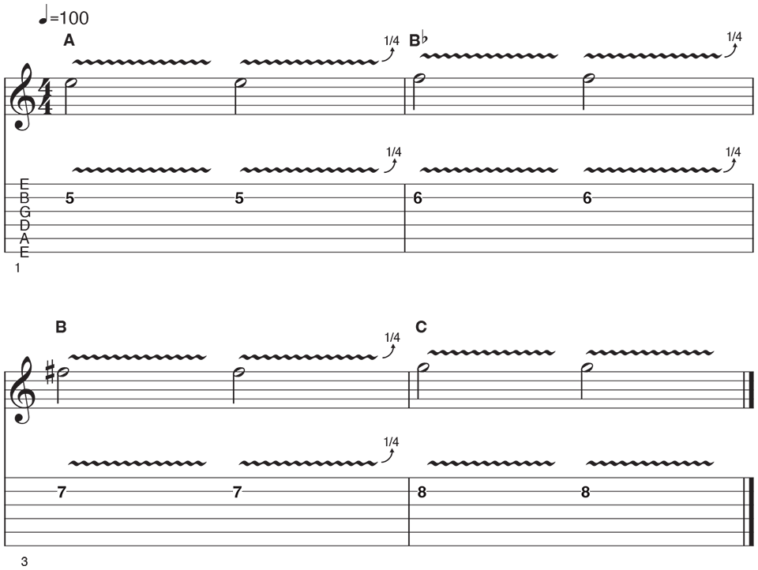
To customize this vibrato, consider how to marry the vertical and horizontal motions. For example, you could use horizontal (along the string) motion before pulling the string downward at the end of the note, creating a sharp, inbetween note (think either side of a 1/4 tone bend).
Since many listeners can detect a stylised note/unique note during melodic phrasing, this subtle sharpness can prove expressive without being too jarring.
Example 2. Hitting the wrong note with pizzazz! (5:48 in the video)
Playing wrong notes when soloing is often to be avoided but it can have merit. Importantly, they can be turned into a moment of interest, rather than a glaring mistake that makes you embarrassed. There’s truth in the saying ‘you’re only a half step away from the right note’ meaning you can use these brief ‘wrong’ moments to provide anticipation before resolving to a note within the key you’re playing in.
A guitarist who executes this wonderfully is Kim Thayil. When soloing, he bends to notes outside of the key, plays incorrect passing notes, and even performs small licks in entirely different keys.
But (at least to my ears), it all sounds amazing due to his ability to resolve each phrase with confidence and build motifs throughout his solos. In this example, you are going to practice these three approaches to hitting the wrong note with pizzazz.

Example 3. Quickly Resolved Chaos (7:40 in the video)
For this example, you are going to hit all of the open strings then resolve with a bend. Your goal should be to make the open strings sound as chaotic as possible, creating a stark contrast to the single-note bend.
This technique was often used during Jimi Hendrix’s live performances (and later by Gary Moore), putting audiences in a trance due to how unique it sounded. It’s the equivalent of a vocalist gulping in air (the noise) before blasting out a strong sustained note (the resolution).
A tip to guarantee you maximize this approach is a strongly distorted guitar tone – the louder and messier, the better.

Example 4. 1-3-5 will keep you alive (10:22 in the video)
To be wrong well, it’s important to know what correct is. When soloing, you can play wrong notes that don’t sit well against a chord (or chords) as long as you resolve to strong notes that are from the key you’re playing in. This way, the imperfections will sound calculated.
The correct notes can most easily be played using the root, third, or fifth note of the chord (or probably the key) you’re playing in.
Welcome to the notion of “1-3-5 will keep you alive.”
These three notes are the foundations to every chord so will always be safe to play. For example, if you’re playing over a C major chord, the notes C (the 1 or the root), the E (the 3rd) and the G (the 5th) are the required notes to hone in on.
Below shows one way to ascend the fretboard while playing the 1-3-5 of a G chord. These notes being G (root), B (3rd) and D (5th). If you spend time knowing the fretboard then beauty can be aligned to your playing’s developing anarchy.
Enjoy making your mistakes on purpose!