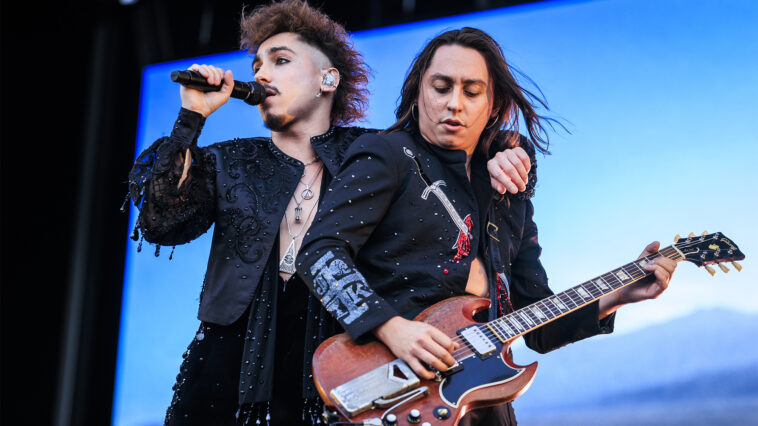
While promoting the debut album from his other band, Mirador, last year, Jake Kiszka promised that “there are some really interesting things that Greta Van Fleet is working on, really exciting things on the horizon.”
Then, in early May, the band alarmed fans with a cryptic social media post: “Thanks for the wild ride. Love, Josh, Jake, Sam & Daniel.” With nearly three years gone since its last album, 2023’s Starcatcher, and a lengthy stretch off the road, the message looked ominous. But Greta Van Fleet wasn’t breaking up. A few days later, the band was teasing new music with posts declaring, “We’re back, baby!” and “The trouble’s begun,” leading up to the release of its fifth album, Palace for the People.
Speaking via Zoom from the band’s current home base of Nashville, Kiszka explains that the original post was simply a lyric from the album’s first single, “Play Your Games.” “It was a bridge between comic relief and an accidental flub,” he says. “We thought it was really appropriate. Obviously it stirred the pot and garnered some attention. We’re full of surprises, y’know?”
The time away was intentional. After nearly a decade of rapid success, Kiszka says, the band needed time to process what it had experienced. That reflection helped shape Palace for the People, a 13-track album that expands Greta Van Fleet’s classic-rock and blues roots with global influences, strings, horns, percussion and orchestration. Working with new producer Mike Elizondo, the band has made its most expansive record yet — and will take it on the road in 2027 for the Into the Beginning tour, which launches February 3 in Savannah, Georgia, and runs through July 31, ending in the band’s home state of Michigan.
There was some concern from fans, even before the “wild ride” post, about what was going on while Greta was out of sight. Was there cause for that?
It was really interesting, because we were considering the lives we’d lived, what we’d done and gone through, and the world that we traveled.
I think we’d gotten home from tour, and it wasn’t two months before we all called each other. It was kind of like we were trained to do that in so many ways. That was the beginning of the conversation; we were calling each other, and it was only natural — “Let’s get together. Maybe we should do a record or something…” I think the concept of the record came together rather immediately.
Which was?
The record title came to the fore before we recorded everything. It was born from playing an iconic London venue, the Alexandra Palace, located upon this beautiful little hill. The locals somewhat affectionately nicknamed it “the palace of the people.” Josh caught on to that quite quickly, realizing we were playing a piece of history.
A lot of artists went through those halls before us — the White Stripes and all that — before moving on. It was a transition moment for us, too, in that the next time we’d be playing in London, we’d be playing the O2 Arena.
So we had that in mind when we started thinking about our next album. We knew that philosophically it was going to reflect the people, places, cultures, philosophies and ideas we’d encountered, along with the experiences we’d gathered over the last decade. It was that philosophy through which to create the music: How can we bottle that and express it with care? From the outset, we knew it was going to be ambitious.

You were also recording and touring with Mirador. How did that band allow you to expand, or diverge, from what you did in Greta, and what did you bring back to Greta from that experience?
That’s a good question, and I don’t entirely know. I began exploring open tunings prior to Mirador, but that group gave me a chance to delve into alternative tunings because we were pulling from some very ancient roots of music. In some ways, this record does that as well, in perhaps a broader sense.
But I also think Mirador’s music is so forceful and rudimentary. It really gets back to the bare bones of music, and rock and roll in particular. There’s some added aggression to these new tracks, and I probably wouldn’t have gone that far if I hadn’t been involved in Mirador. I pushed the volume up, pushed the gain and dug in a bit more. I think that’s territory I’ve always been hesitant to go too far into.
I don’t want to be aggressive for the sake of being aggressive; the light makes the heavy heavier, and the heavy makes the light lighter. That’s how I really think about things. But on Palace for the People, there’s a dimension that’s perhaps wider than we’ve heard Greta play before. Something like “Boughten Bliss” is so delicate, vulnerable and sensitive, while “Dreams You Hold” is a stark contrast. It’s really aggressive and heavy. I think there were moments with Mirador when I went a bit more aggressive and a bit heavier than I would have before.
What are some of the specifics about how point A took you to point B on Palace?
Interestingly enough, “Heya” must’ve been started around COVID time. We knew we were going to be doing a record kind of like this at some point, so I was already in that mindset.
We were called to do a private show in Hawaii, of all places. Everything was so shut down and quarantined that I ended up spending most of the time in my hotel room with an old [Gibson] L-00 acoustic.
I remember thinking about these very interesting field recordings from the 1930s I’d heard from Alan Lomax — stuff from northern Europe, Poland and the mountain regions, where those musical traditions were so preserved that you’re hearing something probably 2,000 years old. It was weird. They were just vocals, and they sounded a lot like Josh singing. It was really goosebump-inducing ’cause I could hear this sort of human history in that.
So I would just play guitar against the recordings. I thought, That’s an interesting exercise — what could I find? Where are these vocals going, and what is that gonna make me play? I ended up in an open G-minor tuning, and the foundation of the guitar parts for “Heya” pretty much came from that.
That was my first time using that sort of free-form experimentation. I would’ve never written something in an open G-minor tuning.
And then “Lost in the Golden” sounds very Middle Eastern. That came about backstage while we were warming up. I think it was Daniel who came in and said, “What is that? That’s really strange.” Again, that was just an open G-major tuning, but, y’know, playing these strange chords pushes you more into that territory. It forces me to play in a way I wouldn’t normally, and then you start breaking the cycle and getting into uncharted territory.
Open G tuning is what John Lee Hooker would have used. “Lost in the Golden” doesn’t sound like Hooker at all, but for the solo section I actually pulled his lines into it, so that section, as a standalone, becomes a blues solo inside the context of something that’s very Eastern.
That’s an example of how a lot of this stuff gets tossed around, turned over and toiled with until it bends and breaks into something different, something original. Something avant-garde, really.
What other crazy open tunings did you use?
“Heart in the Beat” is a full step down from standard. There’s a Drop D tuning, which is a pretty typical alternative tuning as well, for “Call My Own.” “Boughten Bliss” was a strange tuning, too. I can’t remember what it was off the top of my head [laughs], but “Tear It Down” is capo one in standard because Josh wanted to sing it slightly higher.
What did you use for guitars this time?
There was a lot. We co-produced the record with Mike Elizondo, and Mike has a lot of guitars at his studio. I probably used more guitars on this record than on any I’ve recorded before, including previous Greta records and the Mirador record.
Of course, my number one, the beloved ’61 Les Paul, was used in some way on a lot of the tracks. Usually I would use one guitar to track, then pull in different guitars for the dubbing process. I might use one of Mike’s early-’60s or late-’50s Telecasters, or my B-Bender Tele that I use onstage. It’s a bit of a Frankenstein, with old T-Top humbuckers. I just love that guitar. When I’m not sure what guitar I need, I usually pull that out.
Here’s an interesting gear story: We were tracking “Born Into This,” the last track on the record. It was recorded live in one take; the only overdubs I did were on the choruses. That’s purely a live performance ’cause it kind of needed that. It needed to feel unhinged and a little bit untampered with.
We had this expression pedal that added delay when I pushed down. I think it was wired backward because when I pushed it down, the delay sounded backward. But it was so cool and interesting that I was like, “Y’know what? Leave it. This is actually more interesting.” So when you hear all the weird, spacey guitar sounds on that song, it’s because there was a delay pedal that wasn’t working right.

What led you to work with Mike on this album?
Greta is a very tight-knit group. It’s the three of us brothers and Daniel, and we all grew up together and have played our whole lives. So there’s a language there — a vernacular, a shorthand. For anybody to come into that chemistry is very challenging. The idea was that this record was so ambitious we needed somebody with an external perspective to help us capture it, rather than produce it ourselves.
We met with Mike, and it was immediate. He fell right into that chemistry. We had a lot of the songs already written, so from the onset, that first day, within a couple of hours, we looked at each other and knew Mike was the guy. He was really able to adapt to our process, how we work and our very tight-knit nature. He’s a musical tapestry; his knowledge and the database that lives in his head are incredible. He’d listened to a lot of the records we’d listened to.
Another thing that was really impressive, and important to this record, was that Mike grew up in Los Angeles and played all kinds of music. L.A. is such a multicultural hub. He was playing Cuban music in a bodega, working on rap records in a back-house studio or playing jazz with Greg Kurstin, whom we worked with on The Battle at Garden’s Gate. And if you look at his credits, he’s worked with everyone from Fiona Apple to Eminem. We knew he’d be able to help us capture the beautiful cultural influences that were crucial to this record.
How is this music going to be to play live?
Oh — exceptional. There was a great deal of thought behind how these songs would translate live, which I don’t think we’ve ever done in the past. On the very first Greta Van Fleet record, it was obvious how that was going to go. It was very stripped: guitar, drums, bass, vocals.
With this record, there are so many elements and so much complexity in the songwriting, but we’re always asking ourselves, “How are these gonna translate onstage, and what can we do to make these more devastating in a live sense?”
It’ll be brilliantly fun. Probably more than ever, I’m excited to play these songs live. There are crazy, frenetic production elements we’re developing now. We’re designing a lot of the stage stuff and rebuilding the live guitar rig, so there’s a lot that’s new on the horizon. We’re pushing into visual and sonic territory we haven’t explored before. It will be very interesting.