MusicRadar’s got your back
Our team of expert musicians and producers spends hours testing products to help you choose the best music-making gear for you. Find out more about how we test.
What is it?
Despite proudly displaying ‘Nu:Tekt Synthesizer’ along its bottom edge, the latest addition to Korg’s range of build-it-yourself gadgets is not another sound-generating device. Rather, the NTS-4 is a compact desktop mixer designed to act as a hub for synths, drum machines and modular gear.
The NTS-4 fits into the same lineage of cheap and fun music making devices as Korg’s Volcas and Monotrons. It’s small, lightweight and easy-to-use, trading some of the depth and flexibility of higher-end mixers for an emphasis on accessibility and hands-on creativity.
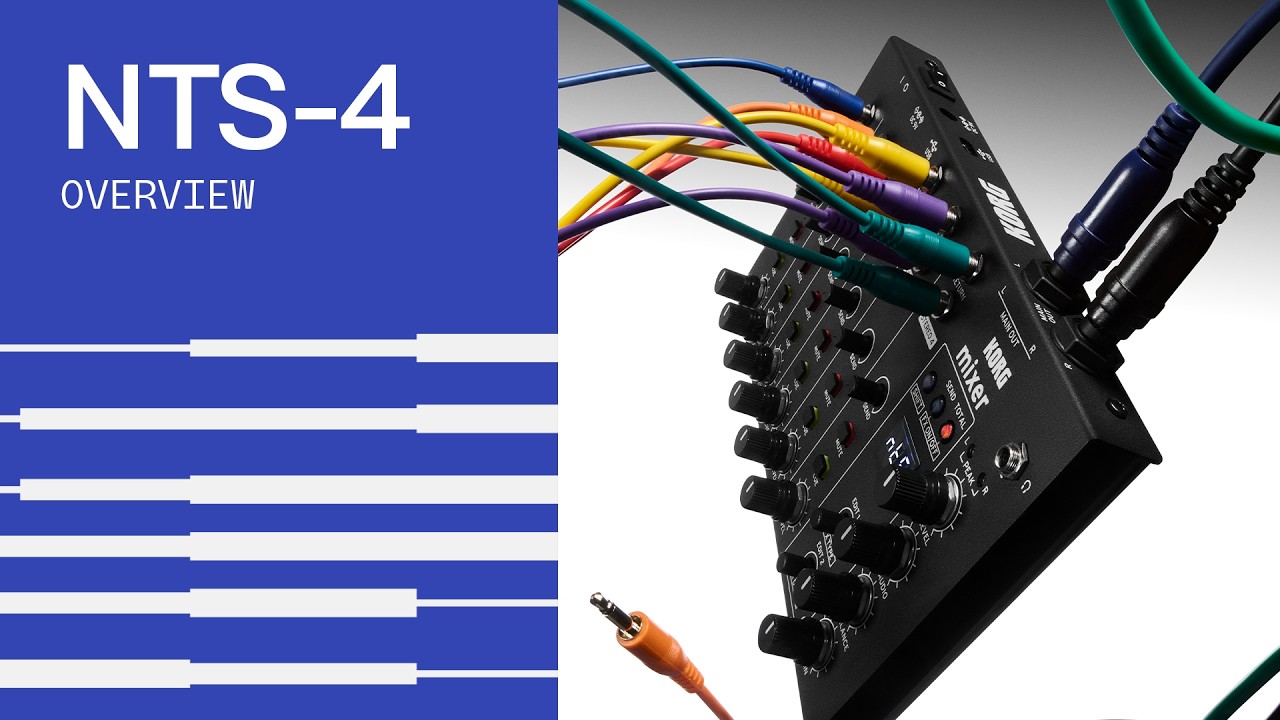
That said, there’s a surprising level of versatility crammed into a device with a footprint roughly the size of a DVD case. It features six input channels, four of which are stereo and two mono with individual pan controls, each fed by a 3.5mm input jack. Its rear panel has a stereo pair of 6.3mm jacks as a main output – the only ‘full sized’ connection on the whole device – joined by a USB-C port used for power, audio and MIDI.
On the top panel are further connections providing a headphone output, MIDI out and stereo send and return connections – all via 3.5mm jack.
Each mixer channel comes equipped with a level control, mute, cue and send rotary. As well as its external effects loop, the NTS-4 has a digital effect engine that can apply processing to both the send/return and master output.
Pricing
Launch price: £199 / $249 / €219
Performance
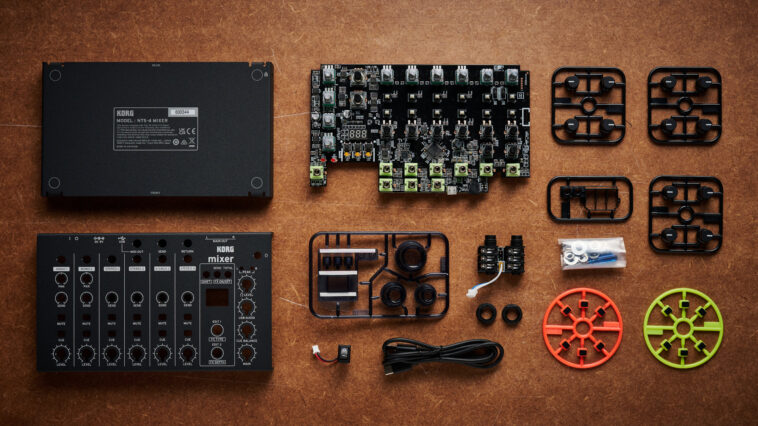
Like other Nu:Tekt devices, the NTS-4 ships as a simple kit that users piece together themselves. This DIY aspect is mostly a novelty; the pieces clip and screw together in a matter of minutes with no soldiering required, meaning that the process provides no real insight into the electronics under-the-hood. There is something pleasantly therapeutic about the process though, and it arguably creates an increased sense of ownership. In any case, the finished product feels reassuringly solid inside its robust metal enclosure.
The NTS-4 isn’t Korg’s first attempt at a desktop mixer. Back in 2018 the company released the Volca Mix as a companion to its popular synth and drum machine range. That mixer had a few neat Volca-centric tricks up its sleeve – namely the ability to power and sync multiple Volcas from a single hub – but its fiddly controls and lack of MIDI or USB connectivity left it feeling like something of a missed opportunity.
Although it’s not pitched a part of that same range, in several ways the NTS-4 comes across like a more successful attempt at achieving what the Volca Mix tried to do. Obviously those Volca-specific features are gone, but in their place are functions that more broadly suit the cheap-but-creative desktop music making ethos that the range epitomises.
That emphasis on ‘desktop’ gear – ie compact synths, drum machines, samplers, Eurorack rigs – is evident in the NTS-4’s choice of inputs, all of which are line/modular level, with no options for mics or instruments. While that results in a lack of flexibility, it also makes the NTS-4 feel more focused on its target demographic.
Perhaps the most useful aspect of the mixer in this regard is its USB-C connection, which can be used simultaneously for power, MIDI and audio streaming. Although hardly revolutionary on a device like this, those simple interface capabilities mean that the NTS-4 can act as an incredibly useful bridge between your DAW and a small scale hardware setup.
The effect routing capabilities are a major plus point on this front too. While the range of internal effects is neither the most extensive or most characterful you’ll find in a hardware mixer, they generally sound great – particularly the reverbs – and provide plenty of functionality for manipulating or mixing sounds.
More exciting is the inclusion of a fully stereo send and return loop, which makes the NTS-4 great for pairing with hardware effects, Eurorack modules or running sounds through the audio input of your favourite hardware synth.
The DJ-style cue functionality is a nice touch too. Thanks to those effect capabilities, it’s not hard to image the NTS-4 as a neat little hub for live performance. By having the option to cue channels via the headphone output, separate from the main outputs, it gives performers the ability to configure, shape and adjust sounds before bringing them into the main mix.
A few of the issues we had with the Volca Mix do remain though. The most significant is the fiddly controls. While some of the NTS-4’s rotaries benefit from sizable, solid-feeling caps, others – most notably those controlling send levels – are the same pokey controls found across the Volca range. It’s a bit of a shame when it comes to the effect sends, as these are the mixer elements you’re most likely to ‘play’ expressively when performing with or recording sounds.
It’s also worth bearing in mind that the NTS-4’s use of a single 3.5mm input on each channel, for both the mono and stereo tracks, is likely to require the use of a fair few adapters or stereo splitter cables in order to properly interface with the rest of your synths and drum machines.
Verdict
In the grand scheme of mixers and interfaces, there’s a lot that the NTS-4 doesn’t do – there are no preamps, mics or instrument inputs, no channel EQs, limited analogue outputs, only one stereo channel of audio streaming via USB. In short, it’s unlikely to replace your 32-input rack interface any time soon. Neither is it the cheapest option, if you’re simply in the market for something compact with a few input channels there are plenty of cheaper, more basic mixers out there.
But for a device that’s small enough to stash into a pocket of your laptop bag, Korg’s mini mixer is surprisingly capable. What’s more, the functionality that is included here feels perfectly pitched at the sort of casual, hands-on production setups that this mixer would slot right into. Now if only Korg would release a few new Volcas to go with it…
Hands-on demos
Soma Laboratory
Alternatives
Specifications
|
Price |
£199 / $249 / €219 |
|
Key features |
Output jacks and connectors Input jacks Other jacks and ports Built-in effects Display Power supply No-load power consumption Dimensions (W x D x H) Weight Included items Accessory (sold separately) |
|
Contact |