
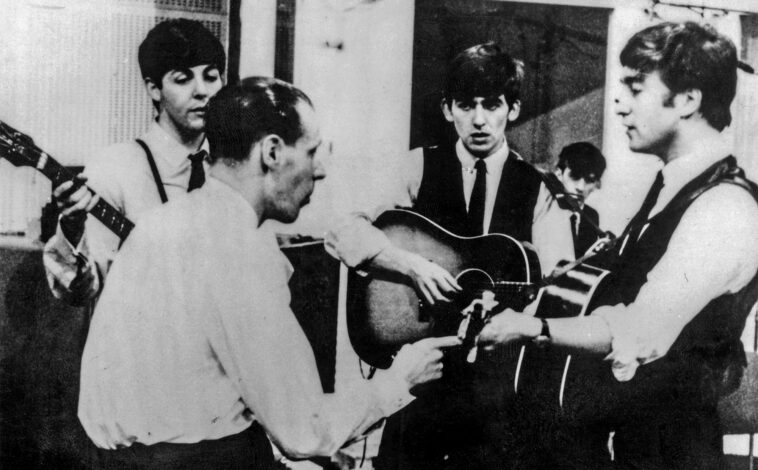
For Beatles fans, the forthcoming expanded edition of Rubber Soul promises a wealth of new discoveries, from revealing session outtakes to the previously unheard John Lennon composition “Little Girl.” But the most important story surrounding the album isn’t what listeners will hear in the vault recordings — it’s what happened inside Abbey Road Studio Two during the autumn of 1965.
The sessions marked the moment when John Lennon, Paul McCartney, George Harrison, and Ringo Starr stopped accepting the technical limitations imposed by EMI Studios. Instead, they began demanding that the recording process itself become part of their creative vision—a philosophy that would lead directly to Revolver and Sgt. Pepper’s Lonely Hearts Club Band.
By late 1965, the Beatles had become students of sound. Between tours, they were listening obsessively to records coming from America. Motown singles leaped from radio speakers with deep bass and crisp percussion. The Byrds’ jangling Rickenbackers electric guitars shimmered with remarkable brilliance. Compared with these productions, the Beatles felt their own records reflected EMI’s conservative engineering philosophy more than the sound they heard in their heads.
For years, EMI’s procedures had emphasized technical accuracy and consistency. The company’s recording standards had been developed during an era dominated by classical music and traditional pop. Engineers were expected to produce clean, balanced recordings while staying within carefully defined operating practices.
It wasn’t a willful arrogance, it was just that we felt we knew better.”
— Paul McCartney
The Beatles had reached the point where those rules were getting in the way. Paul McCartney later recalled the constant tug-of-war between the band and EMI’s engineering staff during the Rubber Soul sessions:
“EMI had very firm rules about that, which we always had to break,” he told Mark Lewisohn in The Complete Beatles Recording Sessions. “It wasn’t a willful arrogance, it was just that we felt we knew better.”
McCartney was particularly unhappy with the muffled sound of his bass guitar on the group’s recordings. He’d been told it was necessary to keep the bass low to prevent needles from jumping out of the groove of the vinyl record. But he noticed the records from America had full, prominent bass and suffered not in the least.
“‘What do you mean we can’t have bass?,’” he recalled asking in one conversation with Abbey Road’s staff. “‘I was down the disco last night and I heard a record with that kind of bass!’”
The engineers would respond by citing company policy.
“‘Well, our rule book says…’”

The Beatles had little patience for rule books.
“‘They’re out of date, come on, let’s move!’”
One of the defining moments came during the recording of “Nowhere Man.” The Beatles wanted the electric guitars to be dazzlingly bright, with far more treble than EMI normally permitted. Norman Smith, the band’s recording engineer since 1962, turned the high-EQ potentiometer all the way up.
They were secretly glad because they had been the engineer who’d put three times the allowed value of treble on a song. I think they were quietly proud of all those things.”
— Paul McCartney
It still wasn’t enough.
“‘But that’s all I’ve got,’” McCartney recalled Smith replying. “‘I’ve only got one pot and that’s it!’”
The Beatles’ solution was simple.
“‘Well, put that through another lot of faders and put full treble up on that,’” McCartney replied. “’And if that’s not enough we’ll go through another lot of faders.
“‘Try it for us. If it sounds crappy, okay, we’ll lose it. But it just might sound good.’”
Often, it did. McCartney believed Smith and his fellow engineers quietly enjoyed breaking the rules alongside the band.
“You’d then find, ‘Oh, it worked!’ and they were secretly glad because they had been the engineer who’d put three times the allowed value of treble on a song. I think they were quietly proud of all those things.”

That spirit of experimentation transformed Rubber Soul into a turning point in the Beatles’ career. The studio became a laboratory, and the band began taking creative control of the recording process itself. No longer was the control room simply documenting performances. Musicians, producer and recording engineers had become collaborators, working together to create sounds that had never before been heard on a pop record.
When Geoff Emerick succeeded Norman Smith as the Beatles’ principal recording engineer in 1966, he inherited a band that no longer viewed the studio as a place with limitations. Working alongside producer George Martin, Emerick embraced the same willingness to challenge EMI convention, helping the Beatles realize increasingly ambitious ideas on Revolver.
Microphones moved closer than the rule book allowed. Tape machines were manipulated in novel ways. Artificial Double Tracking, tape loops, extreme compression, and radically reimagined instrument sounds became part of the group’s expanding sonic vocabulary.
By the time work began on Sgt. Pepper’s Lonely Hearts Club Band, experimentation had become the norm rather than the exception. The studio itself was now an instrument—every knob and every tape machine another means of expression.
And it all began during the Rubber Soul sessions, when four musicians decided they would no longer accept limitations.
As listeners explore the newly released outtakes and alternate performances — including the long-awaited unveiling of “Little Girl” — they’ll hear more than songs in progress. They’ll hear a band discovering that the recording studio could be as creative an instrument as a guitar or a piano.
That’s the true legacy of Rubber Soul. It wasn’t simply the bridge between Beatlemania and psychedelia. It was the moment the Beatles stopped recording records and started inventing them.