
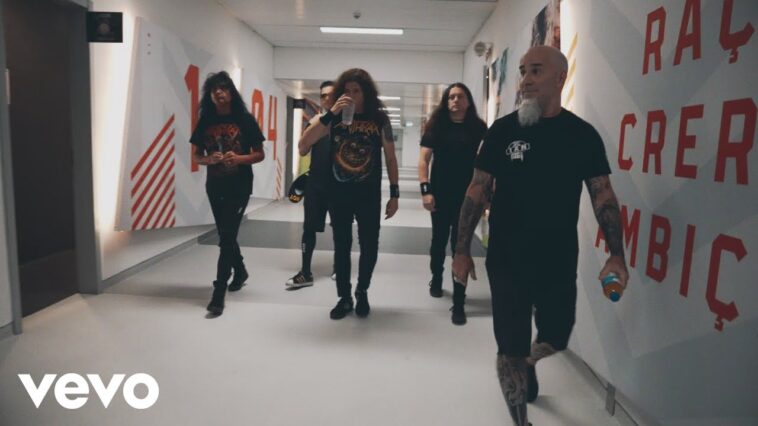
Soon after Ultimate Music Cruises Inc. announced that thrash titans Anthrax were headlining their 2026 four-day cruise, 70,000 Tons of Metal, fans scrambled for tickets, paying thousands of dollars for cabins aboard the ship, hoping the two sets the Big Four band played would be highlights of their lives.
Maybe they were, but for Anthrax guitarist Scott Ian and drummer and songwriter Charlie Benante, the cruise was one of the lowest points of the year.
“It was everything I didn’t want to do, and I got talked into doing it,” griped Benante back on February 5, a few days after returning to his home near Chicago. “I ended up getting sick and burned. I was so pissed.”
Latest Videos FromGuitar World
The ship set sail from PortMiami on January 29, and right before their show that night in the indoor theater, Benante was waiting backstage to go on when a smoke machine in the truss overhead malfunctioned, spilling hot oil.
“At first it was like, ‘What the hell?’ but before we could get out of the way, it spewed out more. A chunk of it hit my left arm, and I got a second-degree burn.”
“It took layers of skin off and damaged the ‘Not Man’ tattoo,” Ian says from a Zoom call at his L.A. home.
That’s when ill winds really started to blow – literally. As the ship sailed back from the Bahamas to Miami, it passed through a winter weather system and was confronted by freezing temperatures and gale-force winds. That’s when Anthrax played a full outdoor set on the pool deck while far less-established European bands, including Dark Tranquillity and Eluveitie, stayed warm in the theater.
“We had to play in below-freezing weather,” says Ian, standing and shifting from side to side to find a comfortable position. “They would not move us into the theater, and during the show I was jumping around and I threw out my back because of the cold weather. That boat and that promoter can go to hell for making us play in the cold.”
Clearly, Ian is annoyed that Anthrax were the biggest selling point of the cruise by far, yet it seems they were subjected to defective equipment and dangerous weather conditions.
He’s even more upset about his back pain. He has worked on it for the past few days to no avail and thinks he might need an MRI. He winces and explains what happened during a flight to Argentina for a show with cult experimental band Mr. Bungle right after the 70,000 Tons debacle.
“I had to fly to Buenos Aires, and I was in so much pain,” he says. “Any move I made was just lightning bolts. It took me 25 minutes to get out of my seat and go pee. And then I just stood next to my seat for two hours until I had to sit down for landing because I knew sitting down was going to destroy me again. And it did. All because of that fucking boat.”
The cruise confirmed the band’s determination to never again get stuck on a sinking ship. During their 45-year career, Anthrax have worked with labels that didn’t support them, management companies with which they weren’t in sync and booking agents that landed them on head-scratching bills. Now, as they ramp up their schedule for their first album in 10 years, the band are working with a completely new support team.
“We cleaned house, business-wise,” Ian says. “It was a long time coming, and we made the changes we needed to make going into this album cycle. It took a while to finalize everything, so we couldn’t put the album out until we knew we had the right people and the right plan because what if this is the last record we ever make? We have to give it every chance to succeed.”
In the months since the nightmare boat trip, Ian’s back has healed. The band has opened arena tours for Megadeth and Iron Maiden, headlined dates with Testament and Municipal Waste and played major slots at festivals in the U.S. and Europe.
In a metal scene that is embracing thrash at a level not seen since the late ’80s, Anthrax are in a position to retake their place near the top of the metal hierarchy. And Cursum Perficio could be the record that will take them there.
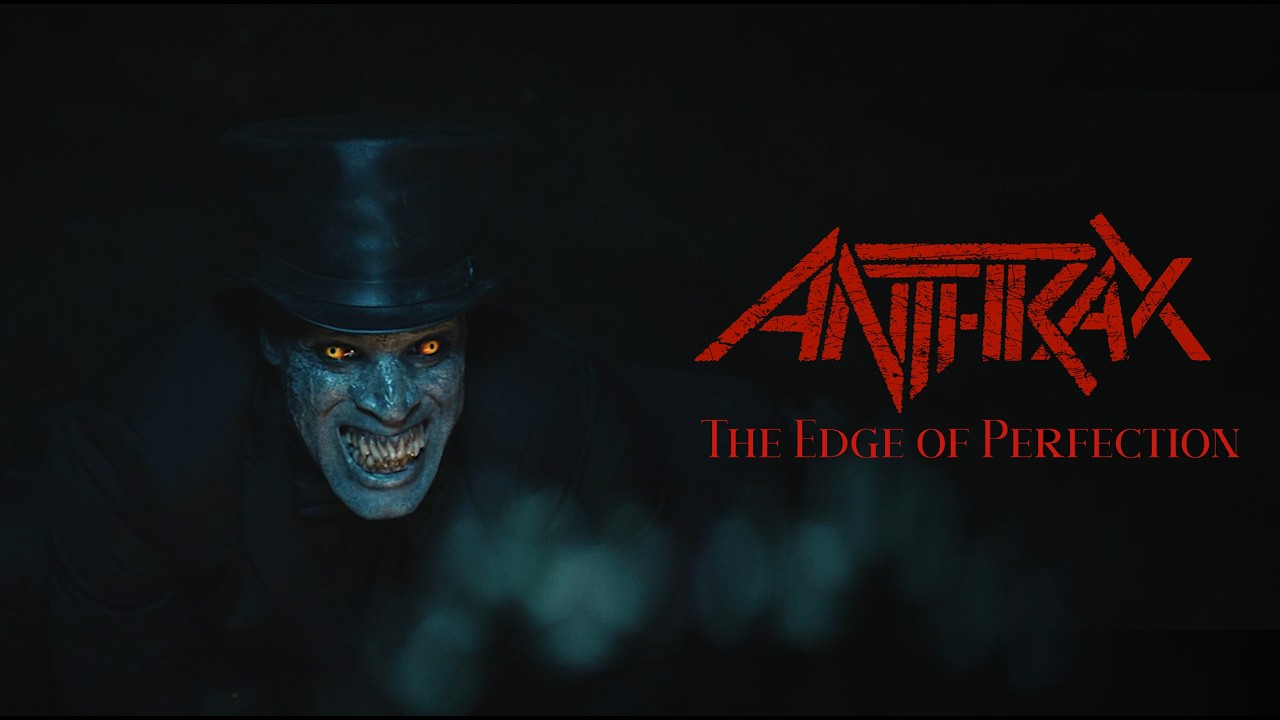
The album, their most exciting and energized release since 1987’s Among the Living, blends barreling speed, nuanced melody, angular precision and creative experimentation into 11 fierce and often furious tracks.
There are the militant chugs and skewed, precision riffs of album opener The Long Goodbye; the AC/DC-meets-Pantera groove of Infectious; the moshpit geometry and stagedive propulsion of NYC 93; and the minor-key tremolo-picking and blastbeat rhythms of Edge of Perfection.
In a strikingly candid conversation triggered as much by pain (physical and emotional) as by a desire to speak truth to power, Ian and Benante address the seemingly endless wait between 2016’s For All Kings and 2026’s Cursum Perficio, how playing with other bands helped them up their game, the band’s unconventional approach to songwriting, their rehearsal and studio gear of choice, Ian’s new signature guitar and the very real possibility that Cursum Perficio will be Anthrax’s final studio release.

The new album has been called your best release since Among the Living…
Scott Ian: Well, first of all, we weren’t out to make Among the Living II. It’s not a top-to-bottom, ripping thrash record because that’s not who we are. We’re a thrash band for sure, but it’s a different kind of album because we’ve never repeated ourselves.
I think it’s in the vein of our last couple of albums, but it’s more intense and more riff-oriented. And certainly, it’s heavier than For All Kings. There’s more intensity on this album than we’ve had in a long time. But I think it’s also the best thing we’ve done in a long time.
Charlie Benante: I wanted every song to be individual. I wanted to have different moods, different sounds, stuff we’ve never done before. I’m not saying this is going to be our last record, but for me, right now I don’t want to write another record. So, if this turns out to be our last album, I’m really happy with it.
And I’ve nitpicked the shit out of the songs so much because every time I hear a new album come out from a band, I feel like they’re phoning it in. They’re like, “That’s good enough.” I didn’t want this to be good enough. I wanted it to be as good as we could possibly make it.
Did you enjoy the creative process, or was it like having a root canal without anesthetic?
Benante: If I could do it again, maybe I’d do it differently. We did six songs first and then we took a break, worked on those songs, and then I went and recorded the next six or seven songs. But I’ve always said I’d rather be in the studio than be on tour because I love creating.
Ian: Doing this album was totally enjoyable because the material was so good. It was so exciting to work on these songs, and that’s what keeps my head in the game. Every time we would get another step further with it, I’d be so psyched. The only way it would ever be like pulling teeth with Anthrax is if I thought the songs were bad because then, what are you doing? It’s pointless.

Charlie, by now most fans realize you write almost all the songs on guitar and then record full demos before the band works on them. Was there a time when that wasn’t as well known?
Benante: There was, and it’s so weird that 40-something years later I’m starting to get recognized for it. I don’t want to say it was a dirty little secret. Insiders knew, but on the outside, I wasn’t really allowed to talk about it in the interviews.
Scott had nothing to do with that, but some of the other guys felt discredited that the drummer was writing all the songs. The problem with that is I don’t think it ever dawned on them the effect that it had on me – that I could never speak about it or talk about it.
Did that make you angry or resentful?
Benante: It was frustrating because Scott and I always did the bulk of the writing and the bulk of the work. I watch the Go-Go’s documentary [2020’s The Go-Go’s] at least once a year because I relate to it so much. At one point the band wants the two primary songwriters to give up the credit and divide it evenly within the band, and when they’re talking about it, I go, “That’s exactly how I feel.”
But at the end of the day, my attitude is still all about Anthrax. If I have to take a backseat for it, I’m doing it for the betterment of the band itself. I’m just happy that after all this time, the creativity still comes.
What was the timeline for Cursum Perficio?
Benante: For me, it’s probably been going on since about 2015. I’d make demos and send them to the guys. And then around 2018 we got together in L.A. and started to create the album. Then during Covid I kept coming up with riffs and making demos, knowing that eventually we’d make songs together again.
Sometimes it’s cool when Scott does a variation of the riff to modify it. I’m always open to that because these guys have to interpret it, too
Charlie Benante
Ian: Honestly, this record really started being made after the pandemic. That’s when we became serious and came up with the album you hear. There are other songs that were there early on that never made it. We tracked drums for three and guitars on a song with a working title of Bond.
I thought it was a killer song, but it never went anywhere. Sometimes that happens. The thing is, people think we’ve been away for 10 years. We spent three years on a touring cycle on For All Kings, then Covid hit, so 2020 and 2021 were out. It was more like a solid three years of in-and-out writing and recording sessions to make this record.
Was there a point where everything clicked into place?
Ian: Charlie sent me a demo for Edge of Perfection, and that’s when I knew we were going to make a great album. It’s the best song we’ve ever written. Even if the rest of the record was shit – which it’s totally not! – I knew we would have had our best song on there. And from that point, everything else came into place. To me, a lot of it is very much a love letter to Anthrax fans.

Do Charlie’s demos closely resemble the final recorded tracks?
Ian: All the parts are there. I always joke around that I’m the editor because his demos will come in, and I’ll start listening to the arrangements, and I’ll go, “This verse is 30 lines long now and we need to cut it down. And we need a pre-chorus here.” But a lot of the ideas on the demos are very fully realized, so it’s just a matter of getting into the room and making everything work.
Benante: Sometimes it’s cool when Scott does a variation of the riff to modify it. I’m always open to that because these guys have to interpret it, too. In the past, I would feel like, let the song be what it wants to be. Don’t stifle it. But I think now we’re pretty much all on the same page.

Do you work on the longer, more complex songs or the shorter, simpler pieces first?
Benante: I just start writing songs without any limitations, but I’ll know where the record is going after the sixth song is written. And once I get that vibe, boom, the next five or six come out and they don’t sound anything like the first six.
Ian: After we had the first batch of five or six songs, which included Edge of Perfection, I remember saying, “We’ve got a lot of these epic six-minute songs. I would really like to write some three-and-a-half, four-minute thrash songs, too.” Because I felt like it, and so did Charlie. That’s when we did stuff like NYC 93 and It’s For the Kids.
It’s For the Kids came out of different musical ideas from me, Charlie and Frank. Then, I sat in the house, plugged in a guitar, took all of our parts and put together an arrangement, [and my son] Revel engineered it in Logic on his Mac, and it totally worked.
Like several songs, It’s For the Kids features some crazy, galactic-sounding guitar effects.
Ian: A lot of the weird stuff was me in the studio just wanting to create something nobody’s ever heard on an Anthrax record – or maybe on anyone’s record – before. I was looking for sounds that are fun and make me laugh. I wanted to make these little segues, so one song would go into the next.
I used a bunch of pedals, including the Old Blood Noise Endeavors BL-44 Reverse; Beetronics Zzombee Filtremulator; TC Electronic Chorus, Pitch Modulator & Flanger; Gamechanger Plasma distortion; some Death by Audio stuff; and the Strymon Cloudburst ambient reverb. I used the Cloudburst for the clean intro on Edge of Perfection and in the bridge section of Infectious.
You said Edge of Perfection is your best song. Which one is your favorite?
Ian: NYC 93, maybe, because it’s the most personal. It’s a snapshot of me in New York City, talking about being there at that time and my experiences, and how fun and how crazy it was. It really captured the mood I was in writing this record.

The Long Goodbye is a tribute to your father, who died after a long battle with dementia.
Ian: That was one of the last few tracks we worked on. Charlie had this demo, and something about it reminded me of Persistence of Time [Anthrax’s 1990 album]. I started calling it Persistence of Memory, literally after the Salvador Dalí painting, because your memories are what really keep things alive.
Charlie and I were talking, and he said something about where the time went, and it struck me hard. I started writing words about my dad and losing him. At the last minute, I changed the title to The Long Goodbye, because it was a key lyric in the song.
It was something that someone had said to me while my dad was in the throes of it – that it’s the worst because the person has been gone for years, they’re not even there anymore. He didn’t know who I or my brothers were for years.
That must have been awful.
Ian: It was so strange. We’d sit there and think, “Who does he think we are?” It’s just this paradox that is unfathomable. At one point, we were visiting and I was playing guitar in the house. He goes, “Oh, you play guitar. My son plays guitar. He’s in a big band. Have you ever heard of Anthrax?” They tell you not to remind or correct people when they’re like that because it confuses them, but my brother Jason couldn’t help himself.
We walked into the den and my dad was pointing at a picture of me from Sound of White Noise [1993] that was inside a gold record plaque on the wall. He goes, “That’s my son right there.” Jason points at me and says, “Dad, that’s Scott; that’s him.”
My dad turned around and looked right at me, but he just couldn’t make the connection. There was no ability for him to connect that the guy standing in his house was the son in the photo. He just turned to me and said, “If you keep practicing, maybe someday you’ll have one of these on your wall.”
I can’t even imagine. On a much less horrible note, Infectious feels like a real celebration.
Ian: It came out so great. It’s like a doomy Back in Black – a solid four-on-the-floor with this great riff. My rhythm playing usually sits on top of the beat. It’s part of the Anthrax sound. So, it was a learning process in the studio for me to get behind the beat to get the right Malcolm Young-style groove.
That took me a minute because it would always sound right to me, and then producer Jay Ruston would say, “You’re still a little bit on top of it. Pull it back.” Then, it feels like I’m lagging behind, but it didn’t take long before I got it right and then it was so great.
Benante: We love AC/DC. We don’t sound like AC/DC, but, oh my god, we want to be AC/DC.
What was the hardest song to play?
Ian: Watch It Go. That beat and groove Charlie’s playing has a weird count, and the guitar picking is relentless. We rehearsed a lot, and we did a lot of pre-production on it so we could play it as a band, but it was not easy.
The song has a guitar part reminiscent of Pantera’s Primal Concrete Sledge.
Ian: We definitely had the riff before Charlie was playing in Pantera, but we didn’t have the riff before Pantera wrote Primal Concrete Sledge. That part is definitely a nod to Dime. I have no problem paying tribute to our buddy. Obviously, Charlie’s in that band, so I think it’s okay.
Did touring with Pantera have any impact on these songs?
Benante: There’s probably a song or two that’s influenced by me being in Pantera. When Dime and Vinnie were around, we were really close.
We talked about music all the time. Me and Dime used to have these 2-in-the-morning calls about bands we loved – like King’s X. Darrell used to snap his finger and say, “watch it go,” and that always stuck with me. It was just going to be the working title of the song, but Scott liked it and it stuck.

Charlie, what did you use to record the demos?
Benante: I used to use a Vox AC30 a lot. I cherish that amp, but in the past couple of years, I’ve used the Line 6 Helix or AmpliTube. The HeadRush is another one. I can just dial in my own sounds and they’re. And I know the tone is going to be exactly what I want because I made it.
What guitars did you use?
Benante: I have two EVH Stars. One is in standard tuning, and the other is tuned down a half step because sometimes I’ll hear a riff in my head and it will sound too happy in standard tuning. I also like to sit around at home or on tour with my Taylor GS Mini and mess around.
Scott, what have you been playing?
Ian: A bunch of my Jackson X King Vs. And also my new Jackson signature. We did a limited edition of my original Not Rhoads that I got back in ’82 that I ordered through Sam Ash on West 48th Street in New York. It was custom-shop built, and there’s a picture of it on the back of Spreading the Disease.
It’s a white Randy Rhoads and it has an anarchy sign and says “not” on it. There’s just one little difference. It used to say “NYHC,” and now it says “SINY” because I don’t want to make any claim to the New York hardcore logo. This is my thing – Scott Ian New York. I played it on the video for It’s For the Kids.
What about amps?
Ian: Just my Marshall JCM800 with the TC Electronic Boost in front of it. It’s the same tone I’ve been using forever, and it’s balanced with the EVH 5150 because the EVH supply has a bottom end I can’t get out of the Marshall. You’re hearing the mids from the JCM800 on top, and it’s a really clean tone compared to just plugging into an EVH.

Cursum Perficio features guitar rhythms in various voicings besides power chords.
Playing a lot of crazy cover songs like Olivia Newton John’s Hopelessly Devoted, I’ve learned grown-up chords
Scott Ian
Ian: Being around the guys in Mr. Bungle for six years has opened my caveman world. Outside the basic realm of major and minor, I didn’t really know a lot of other stuff. Getting to play with them has definitely made me a better player. And playing a lot of crazy cover songs like Olivia Newton John’s Hopelessly Devoted, I’ve learned grown-up chords.
I still don’t know the names of most of them, but I know how to play them, and I’m moving them around the neck now. Also, I learned a lot of cowboy chords playing on and off with [my wife] Pearl [Aday] over the years. Any time you dip your toes into another genre, it’s only going to make you a better musicIan.
Cursum Perficio is Latin for “I complete my journey.” That supports speculation that the album will be your last studio release.
Benante: I felt like our journey has come to an end. As I said earlier, this may be the last record that I want to write for the band, and I just had this whole idea of the journey being over. Then there was this Marilyn Monroe documentary I was watching, and one of the tiles in her house said Cursum perficio, and it translates to “I complete my journey,” so that became the album title.
The artwork features characters from the covers of the band’s other albums, which supports the idea that this record is an amalgamation of some of your best moments.
Benante: That’s pretty much what I wanted to do, and it came together like the album title. I was looking to capture the look of those old Harry Houdini posters. Then, I’m watching a six-part documentary series on [magicIan] David Blaine, and in the first episode this piece of art comes up, and it’s exactly what I wanted. I paused the credits, found the artist’s name, and we contacted him. He ended up doing the cover.
Scott, what does the album title and artwork mean to you? Does it seem like this is the band’s final chapter?
Ian: It’s up to Charlie whether he wants to write more Anthrax songs. I could keep going. But you know what’s crazy? We’re going to tour this album for about three years, and by the time we’re done, we’ll be three years away from our 50th anniversary.
I’m not saying for sure, but that would be a cool time to say sayonara and do a big world tour. I’m very much of the mind that you always want to go out on top like George Costanza. But, you know, if Cursum Perficio turns out to be our final statement, I’m really happy with it.