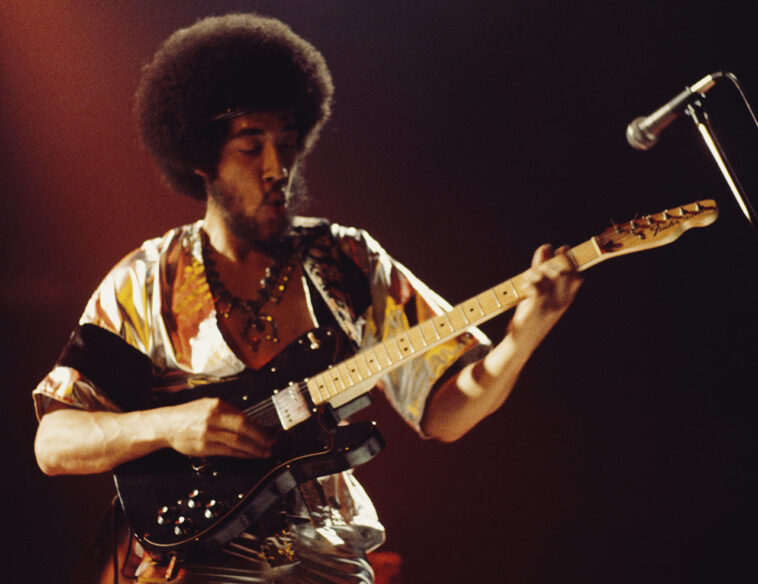
As a teen, Leo Nocentelli lent his licks to Motown’s biggest and brightest stars. In his 20s, he formed funk legends The Meters. Beyond that he’s worked with Albert King, Paul McCartney, Etta James and Peter Gabriel.
He wrote hits including Sophisticated Cissy and Cissy Strut – but he took little to no credit. “I did what I had to do,” he says. “But I don’t owe nobody nothing. I really didn’t owe nobody from Jump Street. I did it because that’s the way my heart is.”
He believes his appeal – for big names in rock, soul and blues to the countless hip-hop producers who have sampled him – is simple.
Latest Videos FromGuitar World
“I was able to adapt,” he says. “It didn’t matter the genre. It could have been Coltrane; it could have been Miles Davis; it could have been anybody. Everyone who hired me knew I’d adapt.”
Nocentelli is likely one of the most widely recorded and sampled players of all time. “I’m like the guy from that movie,” he laughs. “I’m a guy that happened to be at a certain place at very historical times, so I’d call myself the Forrest Gump of the music industry!”
What got you started on guitar?
My dad played banjo in a band in Donaldsonville, Louisiana. He grew up in New Orleans, met my mom, and didn’t do any more gigs. He kept after me to try and play ukulele, and I started hearing some things. I graduated to six-strings and started picking out things that were interesting to me.
I don’t know where it came from, though. It’s just what was in me. Regardless of genre, I was attracted to things, and I really wanted to play them when I heard them. Everything from Bach and Beethoven to country sounded interesting.
By 13 you were working on sessions for Otis Redding, The Supremes, The Temptations and more.
I just played for different people who were looking for music. I just happened to be 13! My first major recording was for Allen Toussaint with an artist called Lee Darcy he was producing. That started me in the recording industry.
What gear were you using for Motown?
I used a big hollowbody guitar, because when I started out, I wanted to be a jazz player like Wes Montgomery or Kenny Burrell; but then I got caught up in playing different genres. To survive in New Orleans – and to survive, period, as a Black guitarist – I had to learn how to play different genres.
How did you come to play for the Temptations and the Supremes?
I got a call one day to take a trip to Motown in Detroit. This guy named Joe Jones had a deal with Barry Gordy to bring four artists there, and I was one of them. Motown and Barry Gordy loved the band, so we started playing behind a bunch of acts that had no names at the time. They’d pay us $12 a side, and we’d be playing behind acts that became The Moonglows, The Temptations, and The Supremes.
What was the first Motown hit you played on?
It was Where Did Our Love Go, Baby by the Supremes. Nobody knew it was a bunch of New Orleans musicians – and then everyone in Motown was tripping out about this new band from New Orleans. This was before James Jamerson and all that. So you might say that New Orleans was more Motown than Detroit was at first!
In the mid ’60s you joined the army. But you kept on doing sessions during your breaks, leading to the formation of The Meters.
I was drafted but I went voluntarily. When I got there, I ran into a few musicians in Fort Riley, Kansas, and they asked me to do some gigs. I started playing guitar around there, and when I came back, The Meters started to happen.
You penned two hits: Sophisticated Sissy and Sissy Strut.
I not only had a big hand in those – I had the whole hand! Of course, those songs couldn’t have been manifested, even though I wrote them note-for-note, without the individuals in the band. That’s why I gave them credit and didn’t take it all for myself.
Do you regret not taking more credit?
After a while I thought, ‘I should take credit for writing.’ The problem was I felt like I should give them something – so I did. I gave them six or seven different albums’ worth of songs that I wrote. They used to come into the studio and wait for me to play the song, and then they’d put their expertise on it. I didn’t start taking credit until later.
I was honored to be sampled by Naughty by Nature, Snoop Dogg and all that. But LL Cool J didn’t want to pay
What was your primary guitar with The Meters?
All those early albums were done with my Gibson ES-175. But after we signed with Warner Brothers and started Cabbage Alley, I started using a Fender Starcaster. They didn’t make many of them back then, so I was really the only notable one playing one. I actually started getting some recognition for playing one.
What led to The Meters hooking up with Dr. John for In the Right Place?
I played on a lot of Allan Toussaint’s productions; I really did all of them. He had us fly down to Miami to Criteria Studios, where we did that album. I didn’t really have too much of a hand in deciding anything – Dr. John told me what to play. But it was a fantastic experience.
In 1975, The Meters attended an infamous boat party hosted by Paul McCartney. What was that like?
We had a lot of fun! Paul came down to New Orleans to record an album called Venus and Mars, and I played on a couple of songs. He asked us to do the going-away party on the Queen Mary, and we played live.
Everyone was there from Yul Brynner to Fred Astaire – he was dancing to Cissy Strut – and even Michael Jackson from The Jackson 5, who was dancing right in front of the stage to us. To be witnesses to all that, man, to be involved, was just amazing. I got to be really good friends with Paul, who showed his admiration for me and The Meters.
He was a fan of blues and R&B – no doubt, man. There’s actually a couple of photos of Paul, me and Linda, and a couple of other big stars. I think in one of the photos he’s actually passing me some weed!
You went on work with everyone from Albert King to Etta James to Peter Gabriel. What do you think all these artists liked about you as a player?
That I managed to come up with something unique when I’d play. On that Albert King record [New Orleans Heat] he recorded one of my songs.

Were you caught off guard when hip-hop artists started sampling The Meters’ songs in the ’80s and ’90s?
The first thing I thought was, ‘How much money am I gonna make from it?’ I wasn’t thinking, ‘Wow! They must really love the way I sound.’ I eventually did make some money. That was the slickest thing that ever happened to me on a business level.
A lot of those samples were used without clearance, right?
Yeah. I was honored to be sampled by Naughty by Nature, Snoop Dogg and all that. But then you had LL Cool J, who didn’t want to pay nobody. We wound up suing him, and the court granted us a win. That’s when I really learned how much money you could make. Then everybody started sampling The Meters, man – but they were doing the right thing and paying us.
I don’t hustle for gigs. I don’t look to be booked because I don’t really want to be booked
In 2021 your unreleased solo album from 1971, Another Side, generated a lot of attention. Are you working on new music?
Yeah, and it’s got a lot of people on it. I’ve got Peter Gabriel, Stanley Clarke, Harry Connick Jr. and a lot of other people. It’s called Leo with The Project, and man, it’s killer. There’s no category you could put it in. I’m expecting it to be nominated for a Grammy, man. I can’t wait for the public to hear it.
Do you still play guitar every day?
No; I’m kind of really sick and tired of it. I dread doing it every time I have to, you know? I don’t feel the same way about it. I’ll play, but I don’t play with the passion I used to. I can still play at the same level, or close to it, but I don’t have anything to prove as a player. I am who I am.
Is there a future for The Meters?
It was eight or 10 albums, and I was always there until four o’clock in the morning, editing stuff and getting no credit. That’s not where my head’s at anymore. As for live gigs, I’m not really for that either. I wouldn’t care if I never did it again.
We’re starting to get revisited again; we did two sold-out shows in New Orleans at Jazz Fest, and there’s one at the Orpheum Theater that’s gonna be totally sold out. But I don’t hustle for gigs. I don’t look to be booked because I don’t really want to be booked.
Do you have advice for young players?
Learn the business. No matter how good you are, get paid for it. Otherwise you could end up being broke. It’s a cesspool of a business, man. Everybody is grabbing at you and taking advantage, so please learn the business. They’re cold-blooded, and only care about what they’re gonna get from you.