![Array]](https://backingtracksfullcollection.com/wp-content/uploads/2026/05/Array.svg.svg+xml "“I had to make sure he had all the tones he needed – the intro to Ain’t Talkin’ ’Bout Love is like taking a flint and stone to make a spark”: How a glam-metal guitarist built Joe Satriani an amp that captured Eddie Van Halen’s tone 18")
If Joe Satriani asks you to build an amp to make him sound like Eddie Van Halen – specifically the Eddie we hear and see in Van Halen’s Live Without a Net (1986) – it’s a request you’d better take seriously.
This is exactly what happened to Dylana Nova Scott, founder/owner of Minnesota-based 3rd Power, who was entrusted with handling Satch’s tones on this year’s Sammy Hagar-fronted Best of All Worlds tour. Together they created the DRGN 100 Custom Shop head, packed with a whole range of new features to bring the legendary tones of Van Halen’s 1968 Marshall Super Lead (serial number 12301, to be precise) into the modern age.
The results were so impressive, Satriani continued using the amp in the Satch/Vai band, which then led to Steve Vai switching over to 3rd Power cabinets. For Scott, who rose to fame in the late ’80s as the lead guitarist in San Francisco hard rockers Vain, it’s been a true labor of love – helping one of the world’s most respected living guitarists pay tribute to one of the world’s most sorely missed.

Then there are other 3rd Power designs like the Dumble-inspired Aurora 35 and the Fender-golden-era-rivaling Lyra, housing the sounds of a 1962 brown-panel and a 1965 black-panel in one box.
Here’s the story of how a glam-metal guitarist ended up becoming a specialist builder for the likes of Satriani, Lenny Kravitz, Joe Walsh and many more.

What made you want to start an amp company?
I’m a player myself. That’s what drives the amp company. You can design a tone in isolation to sound good, but there can be a moment when that isolation blows up. That’s where 3rd Power comes in. We live in between the artist and the audience, sitting in a very sacred place.
It’s the moment the lights come on and the audience is screaming. I also know what it’s like when the lights come on and everyone is silent because you have to prove yourself. My job is emotional translation. Whatever comes out of that quarter-inch jack needs to hit the audience.
Where did you learn how to build amps?
I’m self-taught, but I guess I’ve always been a tone-chaser tinkering with gear. I took electronics and computer programming in high school. As a recording artist, I started paying attention to the engineers working around me.
In between tours, I was working at a music store where DigiDesign specialists would train us. I also spent time with legendary sound guy Chip Davis, watching how he would analyze rooms.
He would clap and listen to the reflections, asking me if I could hear the flange coming out of the corner. Then I got into wireless systems, which led to me working at Sennheiser and eventually Line 6. But I started to become more interested in tube amps at a time when everyone else was converting to digital. I was the person listening to records while reading The History of Marshall: The First Fifty Years.

It clearly paid off. Joe Satriani is a big fan.
Joe has said a lot of wonderful things. Yes, I’m a nice person, but he’s not using my stuff because I’m nice. On our first call, he said he’d been talking to Edward’s techs, Zeke Clark and Tom Weber, describing the sound he was looking for.
He asked what I meant and I answered, “Joe, none of us need to see you play note for note; we need you to interpret the essence of the moment while honoring the king”
The 5150 tour was actually Ed’s last tour with the famous Marshall. He had all the candy, but it hadn’t moved into the more modern Van Halen tone. On that tour, they played the old catalog next to the new catalog, and it all translated because the energy was right.
After that, the rig changed and maybe the old songs didn’t sound right – this is according to Sammy – so Joe had to be very specific. Ed’s own techs said the only person that could help was this girl outta Nashville called Dylana Scott. Joe called me and said, “Apparently I should be talking to you.”
What were the main considerations when designing the DRGN 100?
I said, “Let me build the perfect racecar for you to drive.” Did he want more horsepower at this turn or better traction over here or extra acceleration back there?
I’m a big fan of his work, so I also explained that I didn’t want to watch him play a covers set. He asked what I meant and I answered, “Joe, none of us need to see you play note for note; we need you to interpret the essence of the moment while honoring the king.”

Obviously I had to make sure he had all the tones he needed – the intro to Ain’t Talkin’ ’Bout Love is like taking a flint and stone to make a spark.
It’s a two-hour set with moments that also sound creamier. This amp was designed to lift Joe up the whole way through, so that even someone in the last seat of the arena would feel the buzz and stand up.
Some of your other designs, like the Aurora 35 and the Lyra, are completely different.
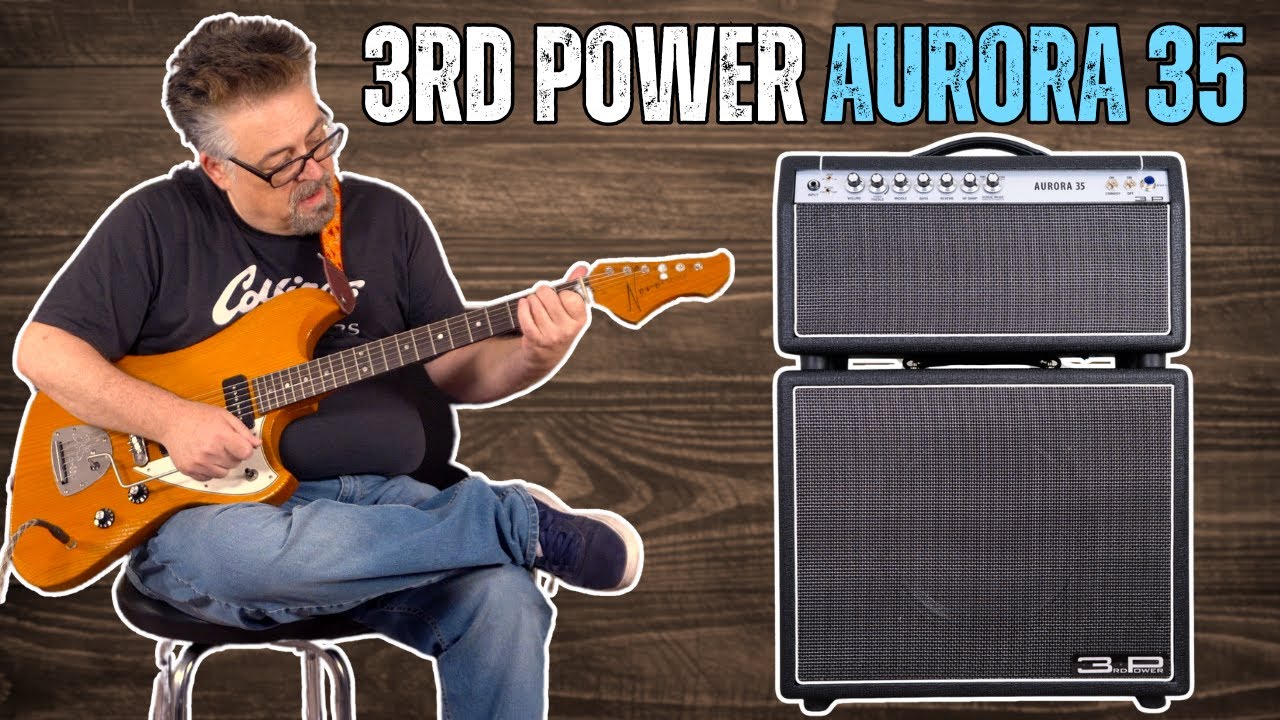
The Lyra has two classic Fender circuits from the ’60s, alongside tube-driven spring reverb and attenuation. It’s a beautifully authentic amp that sounds great. The Aurora 35 starts out in the hi-fi Fender spectrum, like a Dumble, and then opens up.
The signal path is complicated because of the stacking and gain staging, but you don’t need a Ph.D. to get it right; it’s super-simple. But you still get the mid-switch, just in case you need to voice it differently.
Your amps also have modern functions like the HF Damp and HybridMaster.
The High Frequency Damp is geared toward working professionals. Imagine being a hired gun and the singer says you’re too bright. If you walk back to your amp and turn the treble down, you’ve just made sure you have a bad night. Leave it where it is and you might not get that gig again.
Your gain structure hangs on your tone stacking, and with this all of your sonic decisions remain intact. It’s a gig-saver
The HF Damp will keep all of your articulation but shave a little bit of treble from the power amp. Your gain structure hangs on your tone stacking, and with this all of your sonic decisions remain intact. It’s a gig-saver. The HybridMaster is a patented micro volume control that I refined over years. I looked at all the soaks out there.
Some were good for a 15-percent reduction, others maybe 10 percent, and some weren’t good at all. I decided to create a hybrid while only showing the customer one knob. Inside the amp, that knob is controlling a myriad of things.
When you turn amps down, you lose the weight of the moment. Everything gets smaller. I found a way to reduce the volume without sacrificing tone. When you attenuate the signal, I increase the volume strategically in different circuits so what remains feels more alive.

You don’t just design amps. You also have your own MagFRAG pickup line.
It’s my spin on what a pickup could be in this day and age. I jumped on forums and read the arguments, but I didn’t think like a regular winder, obsessing over wires, magnets, insulators and turns.
Instead, I learned about the variables and tried to imagine the sound of Alnico II on the treble strings, the sound of Alnico IV on the middle strings, which is where chords and chimes open up, and then Alnico V for the bass strings.
I wanted one magnet to address each pair of strings. Tracii Guns is a big fan; they’re now on his main guitars. The pickups sound beautiful, making your instrument come to life. It’s like throwing glitter on what you hear.