
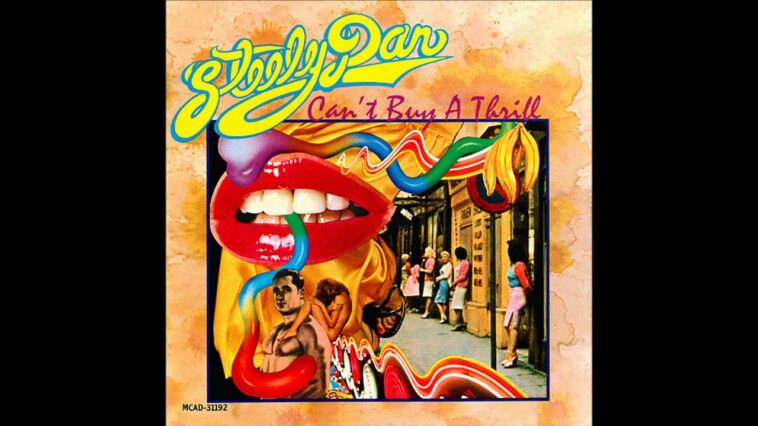
“I’d never say they were difficult to work with, because we had a really good understanding of each other,” Elliott Randall told me during a recently rediscovered – and previously unpublished – 2003 interview. He was talking about working with Steely Dan’s co-founders, Walter Becker and Donald Fagen.
“Everybody’s got their own brand of craziness,” Randall said. “With Donald, Walter and me, we just realized we were a bunch of nutty guys, and – as long as we could get together on a level that we felt happy when creating music – what more could you ask for? Nobody could be more meticulous than those two. They were absolutely the top of the bill.”
Prior to working with Becker and Fagen on their Steely Dan outings, Randall first met the pair when they were doing time on the road as part of Jay and the Americans’ backing band and later while working on early pre-Steely Dan demos.
Latest Videos FromGuitar World
“We’d been friendly acquaintances for quite a while, and I was asked to do a bunch of their demos when they were trying to get themselves a deal in New York,” Randall said. “This was way before they got signed to ABC. Then in 1972, they moved to California. I moved there too [from New York], sort of part time to test the waters and see if I liked it.
“At that point they asked me to join the group, but I had a funny feeling that I’d be better off just being friendly with the guys. I said, ‘I don’t want to join the group, but I’d be happy to make records with you. If you want me to come and do personal appearances, that’d be fine, but I don’t want to be a full-time member of a group at this point in my life.’ That was met with a little bit of eyebrow raising.”
When Becker and Fagen finally began working on Steely Dan’s debut album, 1972’s Can’t Buy a Thrill, they asked Randall to contribute guitar to two tracks, Kings and Reelin’ In the Years, the latter of which would secure Randall’s reputation as one of the group’s go-to guitarists. His blistering solo is nothing short of iconic.
“That solo actually was the first thing that happened when they hit the red button,” Randall said. “I listened to it a couple of times and said, ‘Let’s roll the tape – let’s record.’ I just wacked it off from the very beginning to the very end, but it turned out that the tape operator hadn’t pressed the ‘record’ button. So we wound up doing another one, which is the one you hear on the record.
“[Because of] that incident, producer Gary Katz introduced a policy of where the minute somebody starts doing anything, he made sure you hit the red button so everything was recorded. You never know when you’ll get an accidental piece of music.”
Randall used his usual workhorse, a ’60s Fender Strat, on the track. “I bought it in 1965, though it was two years old at the time,” he says. “It cost me a whopping $175. While the body is ’63, the neck is ’65 [because] I had put it in the trunk of a friend’s sports car on the way to a gig. When we got there, the case had wiggled around so much that the neck got broken.
“But I was able to get a new neck right away. The guitar has been basically that ever since. It’s souped up in terms of the pickups and electronics. The front pickup is a Gibson PAF humbucker I [installed] in 1969.
“There’s a wonderful guitarist from Toronto, Dominic Troyano. He had a Telecaster with two humbucking pickups, and I loved the sound of it. He said, ‘If you love it, let me take you to my friends, Barney Kessel’s Music World in L.A., and they’ll put one in for you.’ They totally warmed up the instrument. It’s really big and fat and very un-Strat-like.”
And then there’s that fiery, unrestrained solo on Kings.
“It’s a really out-to-lunch solo that goes from being very sort of within the changes to being dissonant and wacky,” Randall said. “It actually kind of spoke from my head state at the time. I was going through some serious life changes. I had a failed marriage – we just didn’t understand each other – and I was in the process of getting a divorce. I just played out my nuttiness in that song.”
The obscure lyrical content to Steely Dan’s music has confounded many fans, yet Becker and Fagen have consistently refrained from revealing much behind the songs’ meaning, preferring the subject matter to remain enigmatic.
“They were into combining elements of good literature along with their sophisticated musical knowledge,” Randall said. “They’d write a song like Rikki Don’t Lose That Number, and there’d be a story behind it, but you play it for 10 different people and 10 different people will find 10 different stories.
“That’s the beauty of it. It’s almost like looking at certain kinds of paintings and how they will evoke different thoughts from different people. You can span the entire spectrum, and nobody’s wrong. And the painter’s having a good time because everybody’s enjoying the work in their own way.”