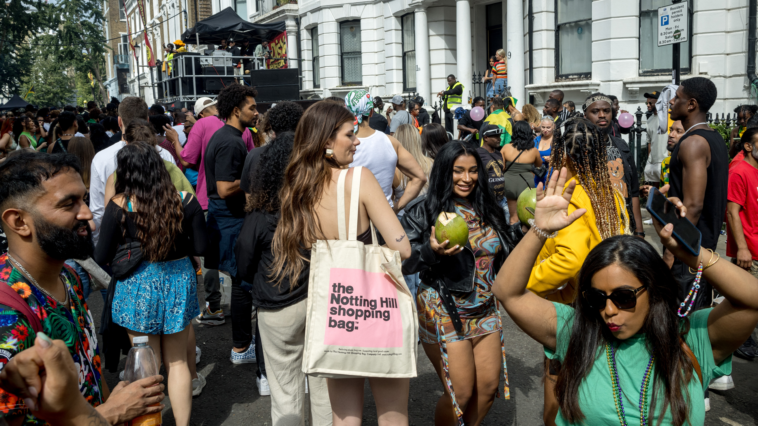
The UK’s August Bank Holiday might signpost summer’s demise but the sun is not setting until Notting Hill Carnival, one of the world’s biggest street parties, takes over London.
Full of people, energy, steel bands, a parade and music, at its heart is the bass and huge speakers of more than 30 static sound systems powering the two-day party. Linett Kamala, an original founder, Notting Hill Carnival Board Director and one of the first women to DJ at the event during the mid-eighties, remembers many raucous years…
“I once had members of the crowd signal that there was smoke coming from one of the drivers of my speakers during someone’s DJ set,” she says. “I was prepared and had a fire extinguisher at the ready but sadly it was an expensive fix. I have kept the now defunct driver as a memory of the day.”
Some two million party goers are expected to attend, following the parade as it snakes its way around West London for this 60th birthday celebration. The afternoons on the Sunday and Bank Holiday are unmatched as a spectacle for the many attendees, with music coming from all angles. Daina Davidson-Shaw is daughter of George Watt, Killerwatt Sound founder, and works as a coordinator. She describes how it can be “a matter of survival” for sound systems on the day.
“The whole team has to be very switched on as it’s a free-flowing crowd and the energy can be unmatched,” she states. “From mosh pits to members of the public climbing on the speakers, the sound itself is usually well-looked after but there are external factors to consider. But this year will be extra special. It’s a jubilee and here in the UK, we do these kinds of celebrations in a very special way.”
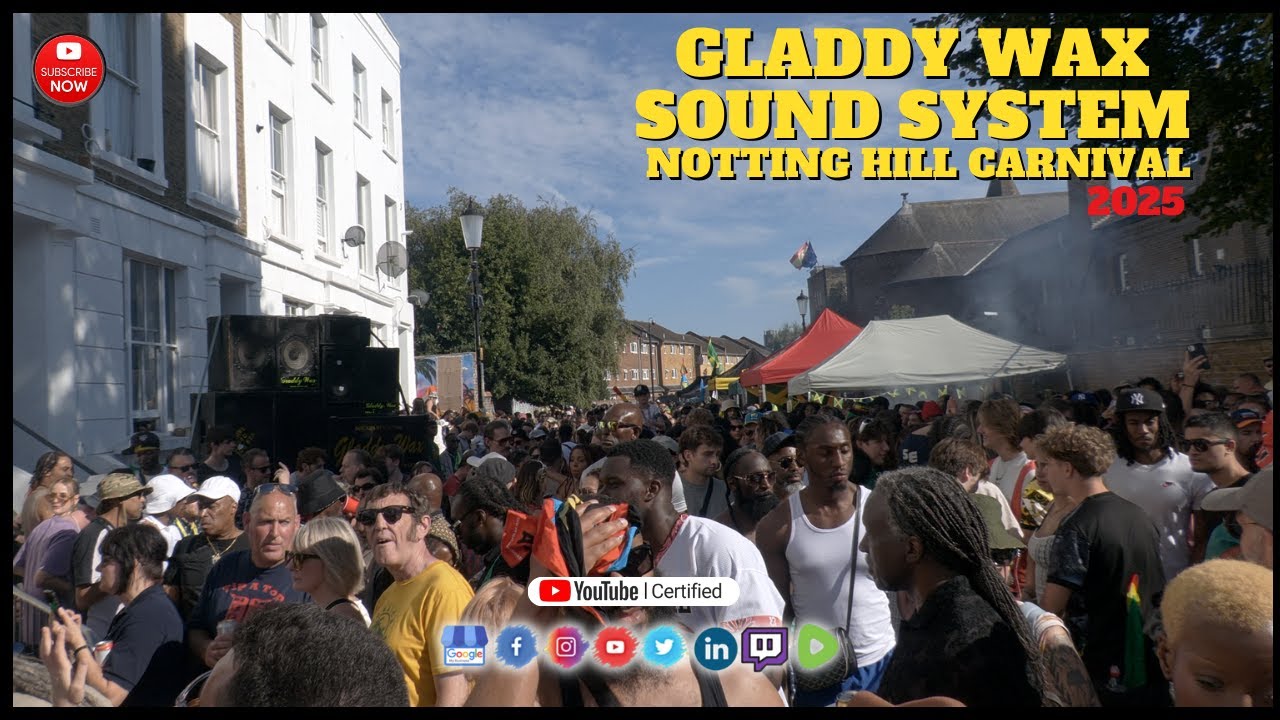
2026 is certainly anticipated to be extra special, the 60th edition of an event that has had to change with the times as it has grown in size. But many of the systems involved are long-standing from Channel One and King Tubby’s to Gaz’s Rocking Blues and the eclectic energy of Rampage Sound. Veteran DJ and sound system operator Gladdy Wax is a regular at the event and has a long-standing connection to the Jamaican music he plays that stems from his family.
“My brother was an electrician and before we knew it, he had made a small amp at home,” he recalls. “We bought some speakers to play music on, then we’d be getting music from Jamaica to play. Many of the UK shops didn’t stock these records so we had to get them sent over.”
Originally based in Birmingham, Gladdy first played on the Leisure Sound System, then became part of Quaker City Sound collective when he moved to London. He opened his own Gladdy Wax shop before putting together his own system. When he first visited Notting Hill Carnival, he felt like his love of music and sensibilities around how music should be shared could find a home.
“Crucially, many of the sound system operators weren’t musicians and I was, I come from a musical family,” says Gladdy. “I listen to music to hear what all the musicians are doing as individual players. That wasn’t clear when I first went to Notting Hill – many just wanted more overpowering bass whereas I wanted to do something that people who appreciated music could listen to.”
Daina of Killerwatt describes how her father George, who first took his system to carnival in 1982, has a similar deep passion in music and interest in how speakers work. His interest in the mechanics of music led him to take his family’s gramophone apart when he was a kid.
“My dad ended up being the one at the family party who would DJ and that’s where his journey began,” says Daina. “He even took apart his mother’s own gramophone and he made his own speaker box out of it when he was younger.
“In a West Indian household, the gramophone is a sacred treasure and ripping this apart didn’t go down well but this is where he started, then going out to different commons and playing music to family and friends.”
Sound systems were born in Jamaica and landed in the UK via the Windrush generation of the post-war era. Due to the racial prejudice of the time many of those arriving from the Caribbean were not allowed into British bars, pubs and dancehalls. So instead they forged their own entertainment. These ‘blues dances’ would take place in homes and halls and feature Jamaican music to establish a new sense of community, despite many of the participants being so far away from home.

Sound systems had become a centrepiece of the Notting Hill Carnival by the 1970s, serving as tools for cultural empowerment.
Rooted in community, united by music, the ethos and values of coming together still stand for the participants. Linett Kamala, one of the original pioneers behind the event, has now diversified to establish her own LIN KAM ART creative hub and family-friendly chill out space at the event. While technology has changed down the decades, there are still essential elements that need to go into a system’s technical infrastructure.
“There is the common centre, the preamp which includes the frequency crossover, EQs and your FX input, such as where the mic is plugged into, then your high-powered amplifiers manage the amount of electricity that is going through the system and the turntables,” she says.
“The more visual aspect which people associate are the drivers or cabinets, these big boxes which contain the speakers. Typically made from birch plywood, you usually have your sub bass or scoops, mid-range kick bins, then your mids or tops. This is known as either four-way or five-way set-up. Rather than one speaker trying to do everything, each speaker is designed for a specific frequency.”
In the early years of sound systems, many operators would adapt whatever speakers they could find to play music to the masses. Fast forward to today, and many have embraced the latest technology to ensure their audio is of the best quality possible. Daina at Killerwatt describes how their four-way system is designed for an outdoor residential environment and provides the specific “weight, clarity, and presence” necessary to maintain the system’s historical sonic identity.

“A common misconception in heritage management is that using modern technology ‘betrays’ the original tradition,” she says. “But Killerwatt’s philosophy argues the opposite: innovation is a continuation of tradition.”
Killerwatt’s rig features ten stacks and a four-way configuration to split the sound across the different frequency ranges. Powered and managed by Full Fat Audio hardware for maximum control and stability, four stacks will be on each side of the stage with two stage-left. The system features Noise Control Audio (NCA) IFLY Series units with the NCA 10TMT units for the high and mid, RGWs for the bass and kick with the VSB 218 systems utilised for the sub-bass.
“The idea is to ensure strong, consistent coverage for an audience that is constantly moving through the space and avoiding the need for extreme, concentrated volume levels that would be lost or distorted in a residential street setting,” Daina explains. “While the acoustic configuration ensures the sound reaches the crowd, the massive physical scale of the rig necessitates a critical logistical focus on power and reliability.
“Historically, sound system operators were always experimenting, modifying, and hacking gear to get extraordinary performance. Using modern digital processing and professional amplification is simply the 21st-century way to achieve those same original goals.”
If you’re on the corner of Golborne and Portobello Road at Notting Hill, then you will likely hear Gladdy Wax’s selections. He’s a stalwart of the event, having been located in the same spot for 37 years. Gladdy’s commitment has seen him receive a Lifetime Achievement Award from the London Notting Hill Carnival Enterprises Trust in recognition of his decades of service.
“I’ve always been well received at Notting Hill, the only thing that’s tough is when it’s time to dismantle the equipment and you have to take the system home despite being totally exhausted,” he explains. “But apart from that, I love everything about it.”

There have been many favourite moments over the years for Gladdy including the year he played a Michael Jackson tribute. The star passed away in June 2009 and Gladdy responded by playing a mix of soul music instead of his usual classic reggae or ska.
“I’d never seen so much excitement”, he says. “But he was too important not to pay tribute too and it was so exciting. I was a little scared at how crazy it was but we rocked the place and it was hard to stop the music.”
Gladdy has also represented the sound system community at an event with King Charles and Camilla at the Tabernacle in Notting Hill. The meeting took place in 2022 to welcome carnival back after a forced hiatus due to the pandemic.
“I usually wear white gloves to play my records so I took them off to shake Charles’ hand,” says Gladdy. “I thought it would be a matter of just saying hello but he wanted to know more about the music. I was playing The Skatalites’ reggae cover of The Beatles‘ song This Boy [aka ‘Ringo’s Theme‘] and King Charles was really interested in finding out more about it, I had to relax and answer his questions.”

As the carnival has expanded, there have been different challenges to navigate. For Gladdy, it is adhering to the rigorous health and safety rules that have come into place alongside lugging his speakers to the event itself. Linett cites both physical and environmental challenges too including crowd management and the vibrations that can cause stacks to become unstable.
“You always need to ensure a consistent and reliable power supply source to drive the sound system, particularly if you are outdoors,” she says. “There’s also the ongoing concern of avoiding blowing your drivers during the event, not only does this compromise the sound quality but they can potentially damage the entire system too.
Still, no matter what the obstacles might be in making the event happen, the love for music is what keeps it moving forward. Much like Notting Hill Carnival’s parade, people and dancing, nothing stays still – there’s a process of constant ongoing evolution around it. At Killerwatt, the team are interested in exploring how they can retain the original spirit and energy but with the more modern equipment.
“We believe that authentic heritage lives in the knowledge, intention, and identity of the operators and the physical equipment is merely the medium for that knowledge,” she states. “By codifying these principles, we ensure the sound’s survival and its authentic core persists – but now it has a rigorous professional approach so it can navigate the modern regulatory environment.”
This focus on the new generation is also a preoccupation for Linett who worked closely with young people on the LIN KAM ART Sound System Futures programmes back in 2024.
“It was one of my favourite years when I first brought out my beautiful custom hand built LIN KAM ART Sound System to the street in Notting Hill Carnival and we invited Deep Medi Musik to do a five hour takeover,” she says.
“We had Mala, Von D, Silkie, Commado, Shafique Rider and Sciara – the energy was incredible, and it was magic watching the reactions to those who couldn’t believe their eyes that that DJs who created some of their favourite dubstep tunes were there in person on the decks.”
London’s Notting Hill Carnival runs this weekend on the 30th and 31st August.