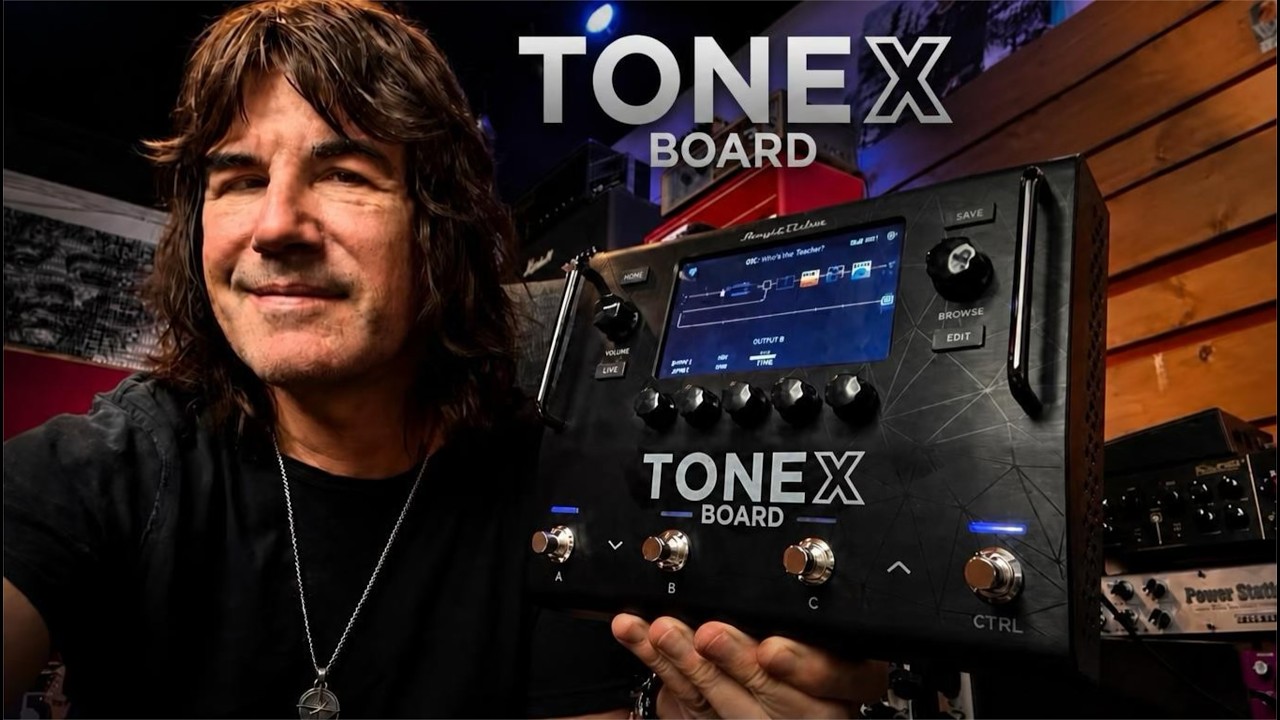
You can trust Guitar World
Our expert reviewers spend hours testing and comparing guitar products so you can choose the best for you. Find out more about how we test.
What is it?
There is no denying the success of IK Multimedia’s Tonex platform. The affordable Tonex Pedal and even more affordable Tonex One brought professional-grade guitar tone to pedalboards at an accessible price point. Although both can run limited effects, the focus of these units is clearly on IK Multimedia’s stellar capture tech – the Tonex Tone Models. This left us wondering: will there ever be a fully featured Tonex floorboard? The answer is yes, and it’s here in the form of the IK Multimedia Tonex Board.
And it is not like this is coming out of nowhere either. IK has long been doing guitar effects via its AmpliTube plugins as well as the limited versions we see in the Tonex Pedal and Tonex One hardware. So a full suite of multi-effects built around its Tonex platform feels like a natural step for the company.
But the Tonex Board also comes with a rather big change in direction when it comes to price – $999. This puts it beyond the affordable credentials of the company’s previous Tonex hardware and into the realm of much stiffer competition.
Latest Videos FromGuitar World
Meaning, there is not a lot of wiggle room for the Tonex Board if it’s going to live up to the bar set by the likes of Neural DSP and Kemper.
Before we get started, it is worth clarifying the difference between capturing an amplifier and modeling one.
When creating a capture, the guitar amp is set to the desired tone and then mic’d via the capture device/interface. The device plays a bunch of otherworldly sounds through the amp, and then processes the results to create a snapshot of the amp at its current settings.
A model, on the other hand digitally recreates each component of the amplifier, mapping the entire amp’s behavior in digital form, controls and all. In other words, the former commits the user to one sound, whereas the latter allows the tone to be tweaked as would be the case on the real thing.
The benefits of capturing are that almost anyone can do it with a few simple tools, meaning you can take the sound of a specific amp that you love on the road, without the backache of lugging a tube amp around. And you can gain access to hundreds of coveted amps that you would never otherwise get the chance to play via libraries like the aforementioned Tone.net.
It’s also worth mentioning that although you are committed to the captured amp sound, captures can be tweaked after the fact, via some generic EQ and gain applied to the model. Also, IK Multimedia calls its Tonex captures ‘Tone Models’ (confusing, I know).
And lastly, drive pedals can be captured too. Okay, with that out of the way, let’s see if the Tonex Board can live up to the rest of the Tonex line.
Specs
- Launch price: $999 | £949 | €999
- Type: Amp/stomp capture and multi-effects
- Controls: 4 footswitches, Volume, Home, Live, Edit, Save, Browse, 6 mini encoders
- Features: Tonex Tone Models, AmpliTube and Tonex effects, dual signal path
- Connectivity: 2 ¼” inputs, 2 balanced ¼” outputs, 2 XLR outputs, 2 mono/1 stereo effects loop, ⅛” headphone output, 2 ¼” external control jacks, MIDI in and out, USB-C connectivity
- Power: 9v, 1.5A, center negative, DC adpater provided
- Dimensions: 235x184x72 mm/9.25″x7.24″x 2.83″
- Weight: 1.6kg/3.52 lbs
- Contact: IK Multimedia
Build quality
Build quality rating: ★★★★½
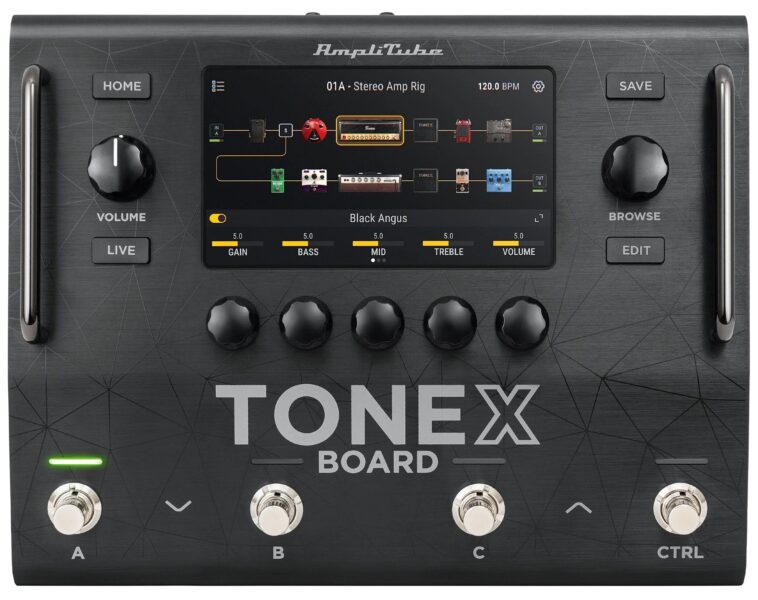
Styled like the other offerings in the Tonex line, the Tonex Board features a robust metal chassis with a matte black finish, tube-like side lighting, metal protective rails (which double nicely as handles too) and aesthetically pleasing geometric lines.
I say gig-worthy, but it isn’t perfect. For example, on a board that could potentially run standalone, I would rather see an IEC cable than the external DC adapter. IEC cables are sturdier and more widely available should one break, and the supplied adapter sports some thin wiring that I would be wary of being too reckless with.
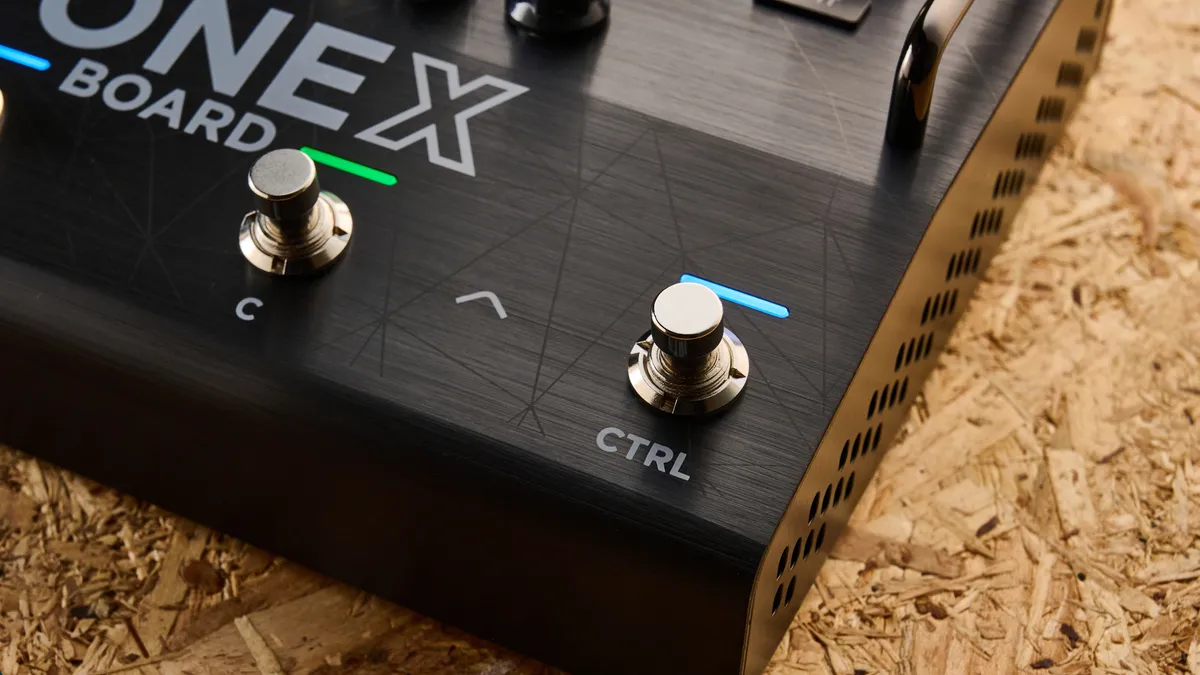
It should be noted that, while slightly bigger than ideal for this, it is small enough to feasibly run on a pedalboard. So, if you own a pedalboard power supply that can handle the Tonex Board’s 1.5A power draw (there aren’t many, but the MXR Iso-Brick Pro is one example), this will be a non-issue.
As you might expect, the front panel contains everything you need to control the unit, featuring four buttons and six rotary controls that are plastic but feel sturdy.
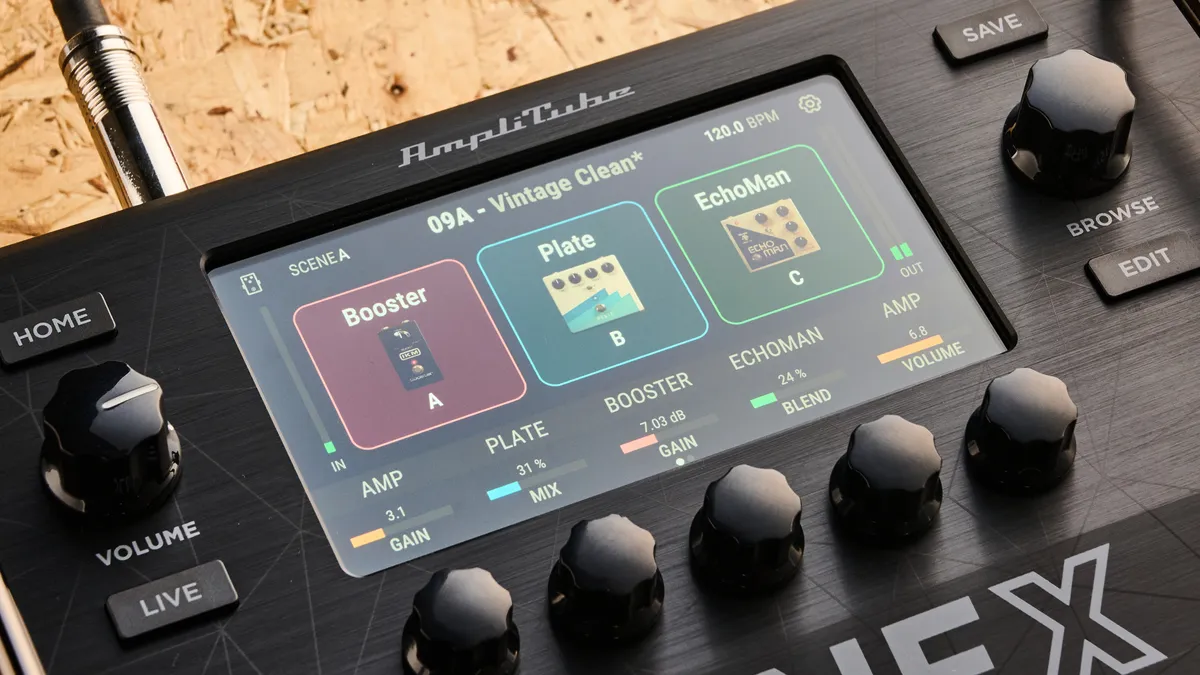
However, the center piece is that five-inch, high-definition touchscreen. It is vibrantly bright, meaning it won’t get drowned out by stage lights, and it is impressively detailed to boot.
Usability and features
Usability and features rating: ★★★☆☆
Having owned and used the Tonex Pedal at a number of gigs, and positively reviewed a few Tonex One iterations, I think highly of the line in general, but have previously criticized the products for being difficult when it comes to tweaking anything past surface-level changes.
Safe to say, things have improved on the Tonex Board, mainly thanks to that high-definition touchscreen.
The interface has three UI modes – Home, Live, and Edit – quickly accessible via three buttons located by the corners of the touchscreen. Home displays the Preset number in large font, Edit takes you into the signal chain to tweak to your heart’s content, and Live will clearly display what each footswitch is assigned to.
Footswitches can be set to the usual three modes we expect from tech of this ilk – Stomp for turning individual effects blocks on and off, Presets for switching through presets, and Scenes for gapless switching between different sound configurations within the same preset.
Safe to say, things have improved on the Tonex Board, mainly thanks to that high-definition touchscreen.
Edit mode is where you’ll be spending the majority of your time tweaking, so I start there and begin setting up my own preset. The good news is that the Tonex Board follows the same conventions that have become the norm when it comes to signal chain and parameter editing – input on the left, output on the right, and a connected chain of up to 12 effects blocks in between.
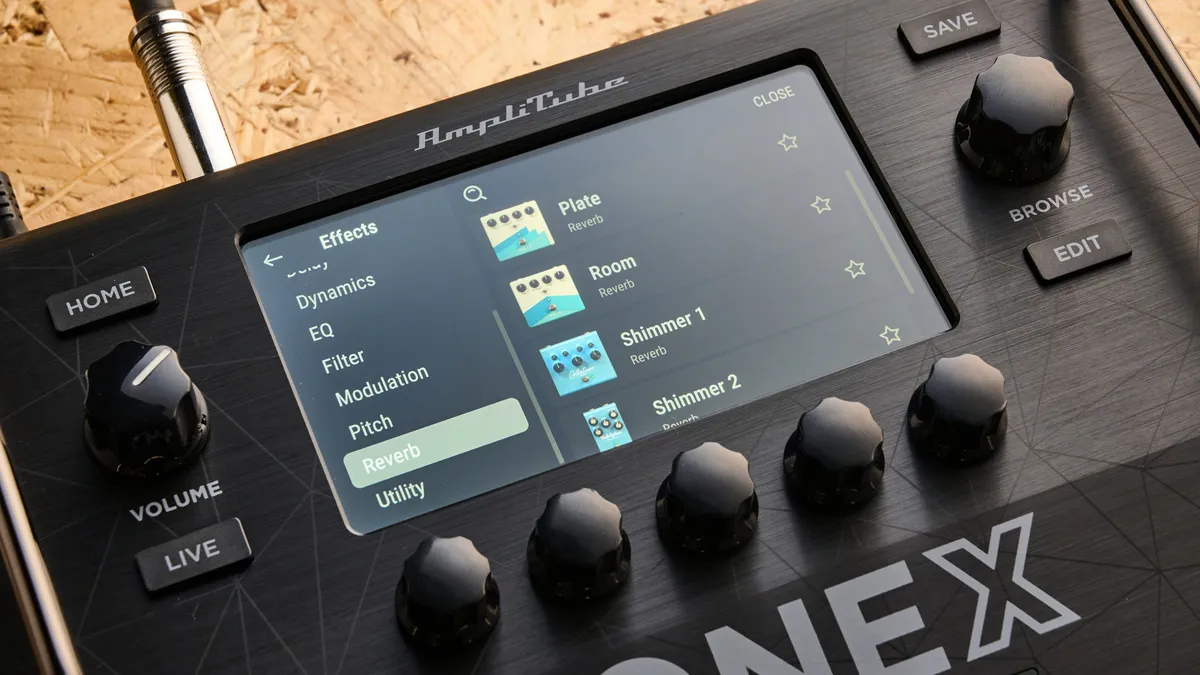
Effects blocks can be dragged around the signal chain, and touching the block will display its parameters in line with the five physical encoders along the bottom, scrolling right to access further parameters if there are more than five.
When a tone model or effect is added to one of the blocks, it is represented by an impressively high-resolution image that makes it easy to keep track of what is going on, even in complicated setups. So far, so intuitive.
With 76 AmpliTube and Tonex effects models to scroll through, capacity for 1,440 presets, and a huge list of preloaded Tone Models, there is a pretty extensive selection of things to browse. Thankfully, this is all split up into categories (Drive, Delay, Modulation, Amps, and so on) and is searchable via a time-saving search bar.
In doing this, I can’t help but notice a bit of lag on the touchscreen, particularly when scrolling. It’s not slow enough to be problematic, but it is a little annoying.
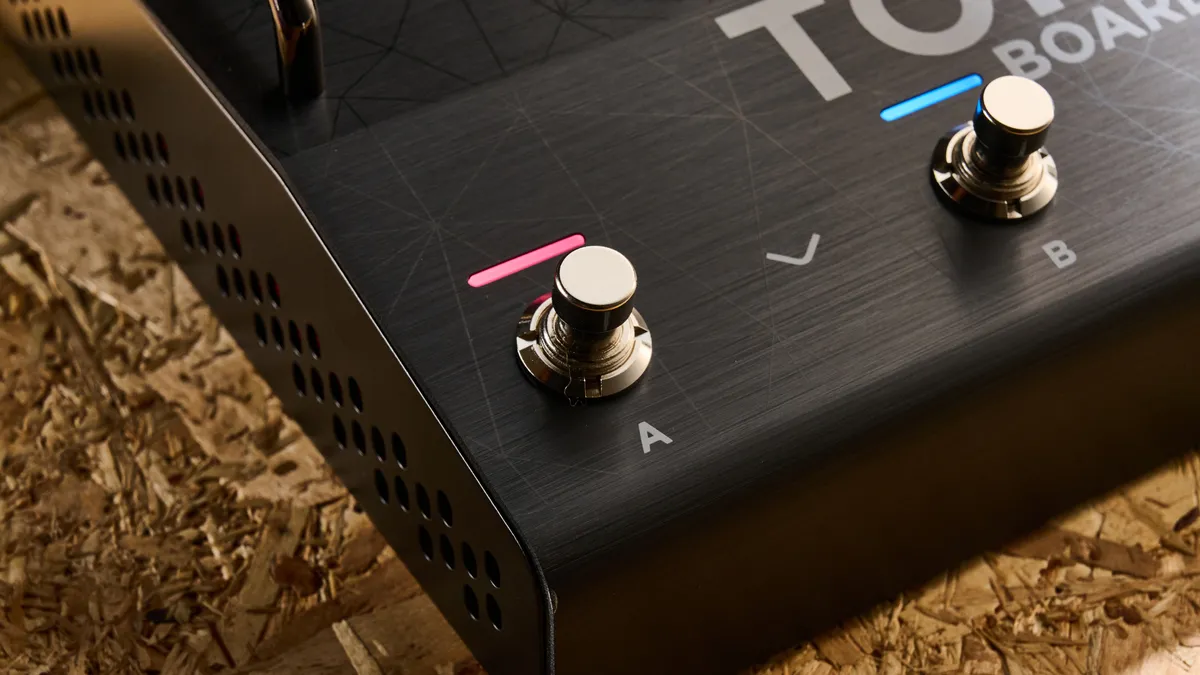
Having set up a preset featuring a Fender Deluxe Reverb Tone Model, and a collection of effects, the next job is to assign Scenes and Stomps to the footswitches. This is a little clunky, as it involves pressing and holding parameters and going through a menu to designate the effects footswitch assignment.
This is not indicated in any way on the screen, so it requires either reading the manual or some experimentation. Other hidden functions include accessing the tuner by holding footswitches B and C, as well as holding the CTRL footswitch to change its function to designated footswitch modes (Scene, Preset, and Stomp).
In the heat of a live gig, you don’t want to have to rely on memory for these things. Better to have it clearly displayed on the unit.
I am also noticing some limitations in processing power. The Tonex Board consists of two paths, each with six blocks that can be linked together for a total of twelve blocks in one chain.
IK Multimedia says the Tonex Board can run up to four Tone Models per chain, but this includes the cab. Furthermore, you cannot run two cabs or two amp models on a single path. In other words, it is one amp tone model and one cab tone model per path.
It’s worth noting, however, that it can run up to four Tone Model Stomps per path (eight in total).
I notice more limitations when it comes to the effects too. For example, on the second path in my preset, I have the Chorus-1, TX Noise Gate, Analog Delay, and TX Room active. When I go to fill the last two slots, a large number of the other effects are greyed out.
So, signal paths on the Tonex Board take a little bit of thought to get the most out of. However, once you have done this, there are a few handy features that go a long way towards redemption.
Firstly, the ability to designate individual parameters as ‘Quick Parameters’. This assigns said parameter to one of the rotary encoders for quick access in Live and Home mode. A godsend for things like Delay Mix and Drive when playing live.
Another handy live tool is the mode configurator that allows the user to choose which Footswitch modes the pedal browses through on the CTRL switch, and in which order.
This sounds like a small thing, but in practice, it is surprisingly useful. For example, I am unlikely to be changing presets during a song, so I find it more useful to remove Presets from the cycle and have the CTRL switch quickly change between Stomp and Scene mode. This helps add flexibility to scenes in a live context by allowing me to more quickly switch stompboxes on and off within each scene.
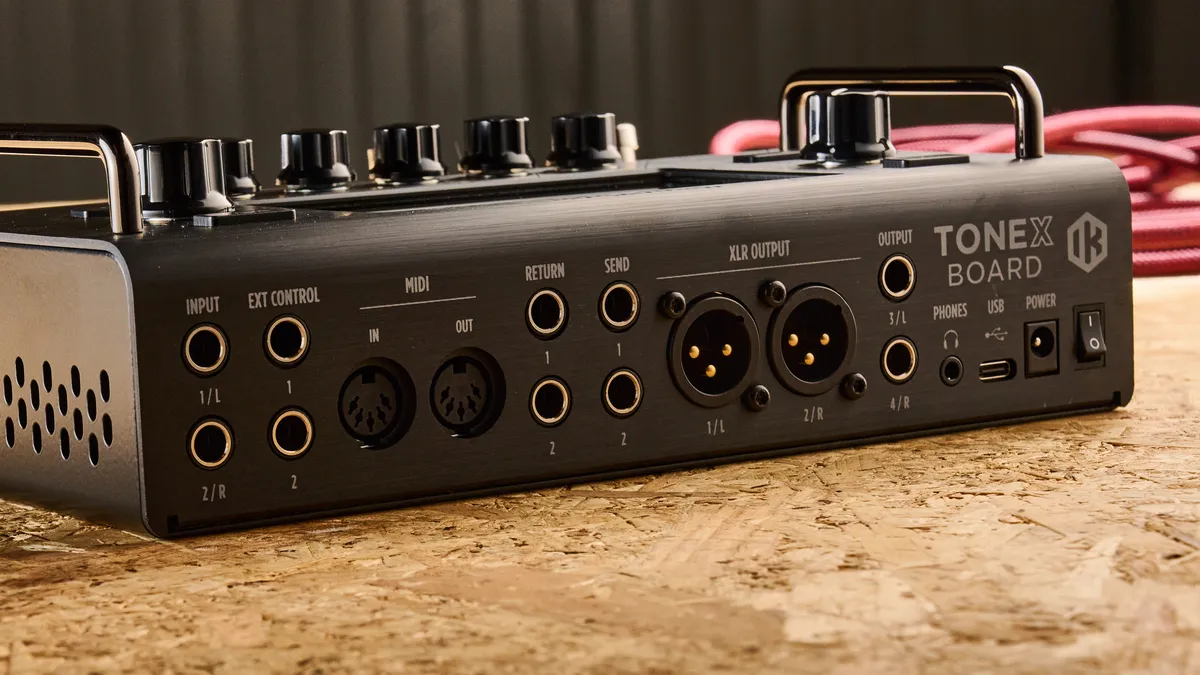
The I/O is fairly extensive too, featuring two ¼” inputs, two balanced ¼” outputs, two XLR outputs, two mono/one stereo effects loop, a ⅛” headphone output, two ¼” external control jacks, MIDI and USB-C connectivity. Bluetooth would have been a nice addition, however.
This allows some pretty flexible routing, even with just the two output blocks (one pre path), thanks to the options available here. For example, the outputs can be set to stereo, dual mono, all, just left, just right, and so on. Also, the effects loops can be utilized as extra ins and outs.
Outside of what is on the board, we have the Tonex software to contend with. I say contend, because it can be a frustrating experience.
For example, to update the Tonex Board firmware, I first need to make an IK user account on the website. Then I need to download the IK Product Manager and register the Tonex Board. From the IK Product Manager. From here I can download what IK Multimedia sometimes refers to as the Tonex Suite in the manual, but is actually called Tonex Max in the Product Manager.
Tonex Max is a suite of apps, one of which is the Tonex Board Editor. Once that is installed, I can then use the Tonex Board Editor to update the firmware.
Contrast this with updating the Line 6 Helix. Make a Line 6 account and download the Line 6 Updater. Done.
Despite the name, the Tonex Board Editor is not yet capable of editing presets. While this is slightly odd, it is not that big a deal given the touchscreen on the hardware. What it does do, however, is allow the user to easily manage their presets and browse Tone.Net in one app.
Tone.Net is where IK Multimedia hosts over 60,000 user-generated Tone Models. The Tonex Board Editor seamlessly accesses these in the centre of the screen, and adding them to your Tonex Board is as simple as dragging them into the hardware’s preset/Tone Model list on the right-hand side of the app.
The drag-and-drop interface also makes managing your own impulse responses, presets, and already downloaded Tone Models a breeze – a huge improvement upon previous iterations of the Tonex ecosystem.
The only little bug is that the sorting drop-down does not seem to work properly when browsing presets on Tone.Net, but it does work perfectly everywhere else.
In terms of adding your own Tone Models to the library, it is still the case that you will need to purchase a separate re-amp box to do this on the Tonex Board. This is a bit of a miss, considering gear like the Neural DSP Nano Cortex and the Mooer GS1000 can do it on the hardware alone, and are both around half the price of the Tonex Board.
Sounds

Sounds rating: ★★★★½
The drives are among the best I’ve played on digital floorboards
As I’ve already alluded to, the quality of a Tone Model depends entirely on how well it was made, with variables like mic placement, mic quality, and the room the amp is in all having an effect.
For example, a lot of the Dual Rectifier Tone Models are too muddy to be useful, but these variables are the same for any capture tech.
In tweaking these models, the generic three-band EQ is useful in that it is fairly powerful, but just be careful not to ruin the character of the Tone model. I am cutting a bit of mids and boosting a little treble on the aforementioned Deluxe Reverb, which adds a little sparkle and helpfully brings out some high-end definition when using my Les Paul.
Testing out the drive Tone Models, the included Ibnz TS9 Hot and JHx MD OD Neutral Tone Models both do a brilliant job of mimicking the mid-forward compressed drive of a pushed Tube Screamer and the transparent offerings of the JHS Morning Glory.
Leaving the land of captures and onto the included digitally modeled effects, IK Multimedia is making use of the effects from its AmpliTube plugins here, and the results are stellar.
The drives are among the best I’ve played on digital floorboards, with a particular favorite being the Ambass’dor – a recreation of the Marshall Guv’nor. It feels accurate with plenty of gain and definition, plus it cleans up nicely on the volume control, whilst reacting well to my picking dynamics. What more can you ask for?
Another highlight is the Fuzz Age, covering Fuzz Face duties. A big, fat fuzz that feels pretty accurate to the original, with the only flaw being that it does not quite open up the high end with the volume dialed in as the real thing does.
Equally as impressive are the reverbs. All the basic food groups are covered, with effects like the TX Room reverb adding some subtle space, right through to the Shimmer for the more ethereal moments. Both feel as if they are part of your sound rather than on top of it, resulting in a natural feeling expansion of the core tone.
And of course, we cannot talk about space without covering delay. I’m enjoying the Analog Delay to widen those lead lines up. It’s gradually darkening repeats stay out of the way of the mix, as does the Echoman Delay in its mimicking of an EHX Memory Man. Perfect for the dotted eighth thing.
One quick note here, though: that Analog Delay seems to clip when placed after the cab in the chain. A little odd, but easily solvable by placing it between the amp and cab, and it’s an issue that seems specific to just that effect.
For a bit of movement, there are plenty of modulations to choose from, all of the same high quality. My favorite is the Uni-V doing a convincing Uni-Vibe effect, something which I have found is rare on multi-effects units.
The only effect I feel deserves some criticism is the Pitch Shifter. Put plainly, it quickly darkens the tone to a point where it is not particularly useful.

As is always the case with this tech, Tone Models vary in quality depending on how they were captured, but as we already know from the Tonex Pedal and Tonex One, the Tonex Tone Models can absolutely stand toe to toe with offerings from the likes of Neural DSP and Kemper.
Browsing through the pre-loaded Tone Models, I am immediately drawn to the Luxury Clean Amp Model, which is captured from a Fender Deluxe Reverb. The tone is as you would expect from this type of amp – a full bass end and sparkly highs, great for strumming through some chords, showing off your funk chops, and adding a bunch of pedals in front of it.
A big upgrade above the Tonex Pedal is the ability for the Board to run dual paths – meaning we can have two amps on the go at once. Take the UK Crunch factory preset, for example. A combination of a Marshall 1959 Super Lead MKII and an Orange Rockerverb MKI, both driven to a tight, bright, mid-forward classic rock gain.
I spend a ton of time here playing through a few Led Zeppelin riffs and classic rock chords. What becomes apparent is how well the Tone Models react to my picking dynamic. Things get gainier as I dig in, and cleaner as I hold back and roll the guitar’s (in my case, a Les Paul Classic) volume down.
The amps feel dynamic and lively under the fingers. In other words, real.
Verdict
I find myself a little conflicted about the Tonex Board
I find myself a little conflicted about the Tonex Board. On one hand, it’s rather underwhelming. The Tonex line of products has always offered professional-grade tones at great value for money, with a few compromises on the usability side of things.
So, for $999, I was expecting a little more processing power than the Tonex Board provides, and perhaps a couple more footswitches considering the ‘Board’ moniker.
Also, the usability is still a little awkward in some aspects, and, at this price, it really should be able to create Tone Models without requiring an extra purchase (as its competition can).
With this in mind, the Tonex Board feels more like an upgrade to the Tonex Pedal than a brand new product. However, viewed this way, it is a significant upgrade.
Depending on when and where you buy it, the Tonex Board is roughly two/three times the price of the Tonex Pedal. But with a vastly increased I/O, a five-inch touchscreen, a fully editable signal chain, and a collection of high-quality multi-effects, it is more than reasonable to say that it easily does more than twice as much.

And the tones are undeniably brilliant. The array of effects is almost universally stellar, and the Tone Models are right up there with the competition in terms of both sound and feel.
Speaking of which, the likes of Neural DSP, Kemper, and Line 6 don’t yet offer something quite like the Tonex Board.
The Neural DSP Quad Cortex Mini, for example, is significantly more expensive than the Tonex Board (but also does modeling); the Nano lacks a touchscreen, as does the Kemper Profile Player, and the Line 6 Stadium lineup with the new Proxy capture tech has yet to launch something as compact and affordable as the Tonex Board.
An outlier, of course, is NAM. We are seeing this free capture tech becoming more mainstream with its inclusion in products like the Darkglass Anagram Guitar Essentials, and while there is still nothing exactly like the Tonex Board (the Anagram lacks the vast number of effects), this is certainly something to keep an eye on.
Guitar World verdict: The Tonex Board cannot create Tone Models on its own, and is not quite as powerful as some may have been expecting, so it is far from perfect. But those imperfections are redeemed by the sheer quality of the effects and Tone Models, meaning that when it comes to guitar tone, the Tonex Board easily holds its own.
|
Test |
Results |
Score |
|---|---|---|
|
Build quality |
A chassis capable of withstanding the general abuse of a gig, and a vibrant touch screen |
★★★★½ |
|
Usability and features |
Editing signal chains is fairly intuitive, but some hidden functions, a lack of DSP and awkward apps let it down. |
★★★☆☆ |
|
Sounds |
The capture tech is convincing, and the effects are high quality. |
★★★★½ |
|
Overall |
It’s the Tonex sounds wrapped in a worthwhile, but imperfect floorboard. |
★★★★☆ |
Also try
Hands-on videos
The Studio Rats
John Nathan Cordy
Pete Thorn