
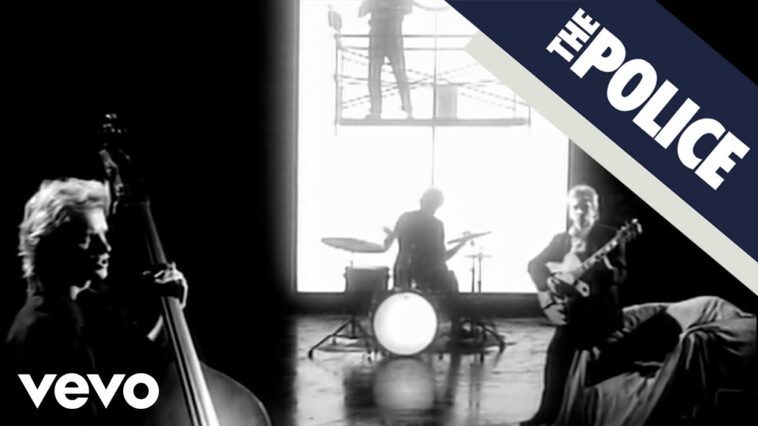
If, for some strange reason, you’d never ever heard the Police’s Every Breath You Take before, and one day, you received a letter that contained the song’s lyric starkly printed in all caps, you’d almost certainly take it for a threat…
Sting’s 1983 stalky-classic was the lead single of Synchronicity, the group’s final record. The song became the only US Billboard number #1 hit for the Police and their fifth UK chart-topper, fast becoming the group’s best-loved song. It scooped Grammys, Ivor Novellos and various other industry awards for its obvious brilliance. A big part of which being Andy Summers’ Béla Bartók-inspired arpeggiated chords, which cemented its emotive effectiveness.
When affixed to this gorgeous arrangement, Sting’s lyric appeared at first glance to be an inoffensive pledge of unyielding devotion to a partner:
Every breath you take
And every move you make
Every bond you break
Every step you take
I’ll be watching you
But, as the song opens out into its chorus, it’s clear that Sting’s lyric actually comes from quite a different perspective.
Our read on the scenario shifts, as we realise it’s someone looking in on someone else’s relationship. Yikes. With our understanding clarified, the intense infatuation of the preceding lyric takes on a more menacing tone…
Oh, can’t you see
You belong to me?
How my poor heart aches
With every step you take?
Easily missed by some, the song’s ominous undercurrent was something that Sting fell into naturally, triggered by the wider feeling of paranoia of the early 1980s
“It sounds like a comforting love song. I didn’t realise at the time how sinister it is. I think I was thinking of Big Brother, surveillance and control,” he told the Independent in 1993.
Back in 2019, we spoke to the Police’s extraordinary drummer Stewart Copeland at his home in Brentwood, California ahead of the release of the group’s vinyl boxset, Every Move You Make: The Studio Recordings. In that interview, Copeland shared his inside take on The Police’s most beloved – but most misunderstood – song.
“Sting wouldn’t explain his lyrics, he would just sing them,” Copeland recalled, when remembering the recording of Synchronicity. “Sitting next to him doing interviews, they’d ask him: ‘What’s that song about?’ We’d hear him and say, ‘Really?’

“A classic example is Every Breath You Take,” Copeland continued. “It’s a sick, twisted song. I thought it was a love song. Just like all those people that get married to it not realising it’s a dark, demented track.”
Stuart also remembered the recording process for the song, beginning with Summers’ expressive palm-muted arpeggios; “That guitar riff was Andy’s. That track was our biggest hit. That started out as a Hammond organ piece but Andy went off and figured out those chords, fingering and that harmony. That’s all Andy. The drum part was composed rather than played. That was done with a click and we had a big battle about it. By that time, Sting had bonded with the Oberheim hi-hat sound, which did have a hypnotic quality. I insisted on playing the hi-hat myself.”
Apparently, that particular hi-hat caused a bit of studio tension: “We went back and forth finishing that song and we fought like cat and dog over the f**king hi-hat. I doubt if anyone can tell from listening to the record. But the drum part was composed. It was all overdubs. The snare was a snare and a gong drum. The hi-hat was eighth notes. The kick was separate. All separate takes. It was an outlier. Certain tracks are outliers in that is not how we normally did things. The drums, I’m proud of how simple they are. They’re very Zen.”