
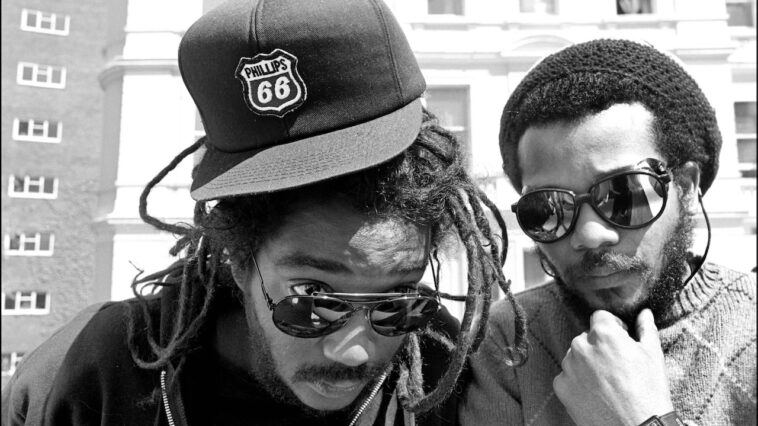
Known for his seismic basslines with punk rock outfit Bad Brains, Darryl Jenifer has spent the last few years exploring a very different musical landscape. His latest project, The Weather Channel, swaps hardcore intensity for psychedelic grooves – but the philosophy underpinning it all remains exactly the same.
“People ask me to describe the new record, but to me it’s just another part of what I’ve always done,” says Jenifer. “I’ve been making riffs and chasing ideas since I was a teenager. I’m just trying to keep that dream alive.”
As a kid growing up in Washington D.C., Jenifer’s career direction was decided by one of the early pioneers of the bass guitar.
Latest Videos FromGuitar World
“When I was young, Stanley Clarke was my hero. I went to see him at the Capital Center in D.C in 1978, and after the show, I got his autograph on a dollar bill.
“I loved his speed and technique, but eventually I became more interested in vibration instead of notes. The pulse became more important than showing people what I could play.”
In the years since, Jenifer has remained remarkably unfussy about his bass setup, relying on the same instrument for decades.
“Too many musicians get trapped chasing equipment, but my advice is always to forget gear. Forget pedals, and forget trying to sound like somebody else.
“I’ve been playing the same Modulus since the ’80s. I bought it because it had a graphite neck. It’s the only one that could survive a Bad Brains show! Give me that bass, a cable, and an Ampeg SVT and I’m ready for anything.”
What’s the concept behind The Weather Channel?
The title came from the feeling of the music. Whenever I’d hear music playing behind weather forecasts, it always had this smooth, calming groove. One day somebody asked what I’d been working on and I said, “I’ve been writing some smoothed-out shit.”
My stuff with Bad Brains is hard music. This is just smooth music. So I thought, The Weather Channel. That’s exactly what it is.
Was it a conscious decision to move in that direction?
I’ve never believed you’re supposed to play a certain style because of where you’re from. If you’re Jamaican, people expect reggae. If you’re from Washington, D.C., you’re supposed to play go-go. But that never made sense to me.
If I’m into punk, I’ll make punk. If I’m listening to Roy Ayers or Lonnie Liston Smith, I’ll make something inspired by that. I just play what I love.
A jazz musician might hear it and say, ‘That’s some punk Weather Channel music,’ but I don’t consider myself a musician, so I’ve never thought that way.
Musicians study theory. They learn the language of music. I never had the patience for that. I think of myself as a riff maker – a guy who loves instruments and has a knack for creating music.
You’ve said you think differently about writing music these days.
When I was younger I used to force it. I’d sit down and tell myself, “I’m going to write a riff that feels like this.” Sometimes I’d even imagine pictures. I’d think, ‘This riff should sound like a brick wall falling over.’ That was how I translated ideas because I couldn’t talk in musical language.
Now it’s different. I believe in true inspiration. I’ll come into my studio, meditate, smoke a little, play for 20 minutes without trying to write anything – and suddenly something appears. That’s when I quietly hit record.
So I don’t go looking for riffs anymore. I create the conditions where they can find me. The music starts telling me what it wants to be. That’s the difference.
Do you analyse those moments afterwards?
Only enough to shape them. I’ve realized over the years that music almost has a life of its own. Sometimes an idea keeps coming back, even if it annoys me. The same thing happens with my artwork. I’ll make something and think, “I don’t even like this,” but other people connect with it. That’s when I think maybe it wanted to exist more than I wanted to make it.
Music is a spiritual force. Sometimes it just wants to happen.
There’s something hypnotic about The Weather Channel. It works as background music, but there’s always enough happening to pull you back in.
That’s exactly how I wanted it. Growing up in D.C. there was a radio show called The Quiet Storm. That music was everywhere. Roy Ayers. Lonnie Liston Smith. Smokey Robinson. Kool & The Gang when they got smooth.
My friends used to laugh because that’s what I listened to. I’ve always had that side in me. So this album is really my Quiet Storm record.
You assembled a fantastic band, too.
The beautiful thing is none of it was planned. Everybody lives around here. One person would say, “Call John Medeski.” Someone else would say, “You’ve got to get Ben Perowsky.” It all happened naturally.
That’s another reason this record feels honest. Nobody was chosen because of their résumé. It was just people making music together.
How much direction do you give players of that calibre?
I’ll show them the basic idea. Maybe there’s a verse and a B section. That’s it. Then they bring themselves into it. It’s like cooking. Everybody throws a little something into the pot and suddenly you’ve got something nobody expected.
Afterwards I go through everything and shape it. I call it combing the music. Like getting a haircut before you leave the barber shop. The music is already there. I’m just cleaning it up.
You’ve always seemed creatively fearless.
When Bad Brains suddenly switched from hardcore into reggae, we weren’t trying to surprise anybody. It just felt right
That’s probably the biggest gift I’ve been given. When Bad Brains suddenly switched from hardcore into reggae, we weren’t trying to surprise anybody. It just felt right. When Sailin’ On suddenly turns into something that sounds like Stevie Wonder, that wasn’t calculated. That’s just where the music wanted to go.
I’ve always trusted that instinct. Sometimes musicians tell me something I’ve written is harmonically wrong. Maybe it is. If it feels good, I’m keeping it.
What advice would you give young bass players?
Learn to love a simple four-string bass, and pay attention to your touch. People won’t remember how many notes you played, but they remember how you made them feel.