
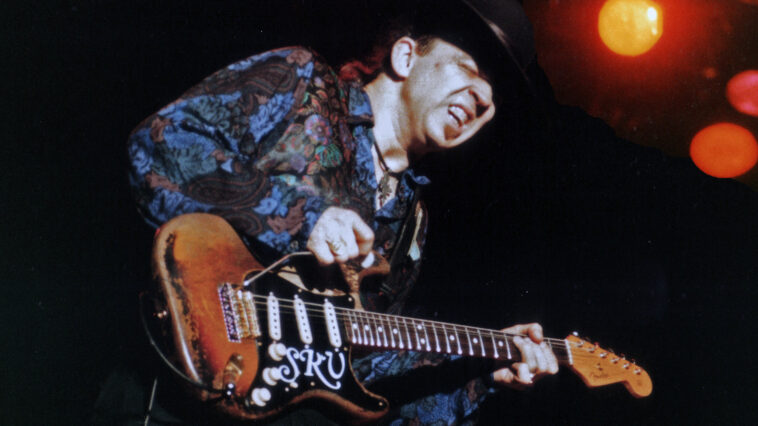
When a guitarist as revered as Mark Knopfler tells you another guitarist is “one of the best I’ve ever heard,” you pay attention. The Dire Straits mastermind has spent decades being hailed as one of the greats himself, but when it came to Stevie Ray Vaughan, Knopfler heard something that went beyond the guitarist’s obvious Hendrix and blues influences.
In a 1991 TV documentary, A Tribute to Stevie Ray Vaughan — An Up Close Extra, Knopfler praised Vaughan’s ability to absorb his influences and turn them into something distinctly his own.
“He was one of the best,” Knopfler said. “He was really, really tremendous.”
Vaughan’s debut album with Double Trouble, Texas Flood, had already established him as a formidable electric-guitar hero. Released in 1983, it peaked at number 38 on the Billboard 200 and eventually went double Platinum in the U.S.
But Knopfler believed Vaughan’s greatest work was still to come.
“Later on, I thought that something was happening where the Hendrix and Buddy Guy influences were giving way to some really powerful stuff,” he said. “He’s one of the best I’ve ever heard. No question.”
That evolution was one of the things that made Vaughan so remarkable. He was deeply rooted in the blues, but he never sounded like a museum piece. His playing carried the influence of Jimi Hendrix, Buddy Guy and other blues and R&B giants, yet Vaughan had an unmistakable voice of his own.
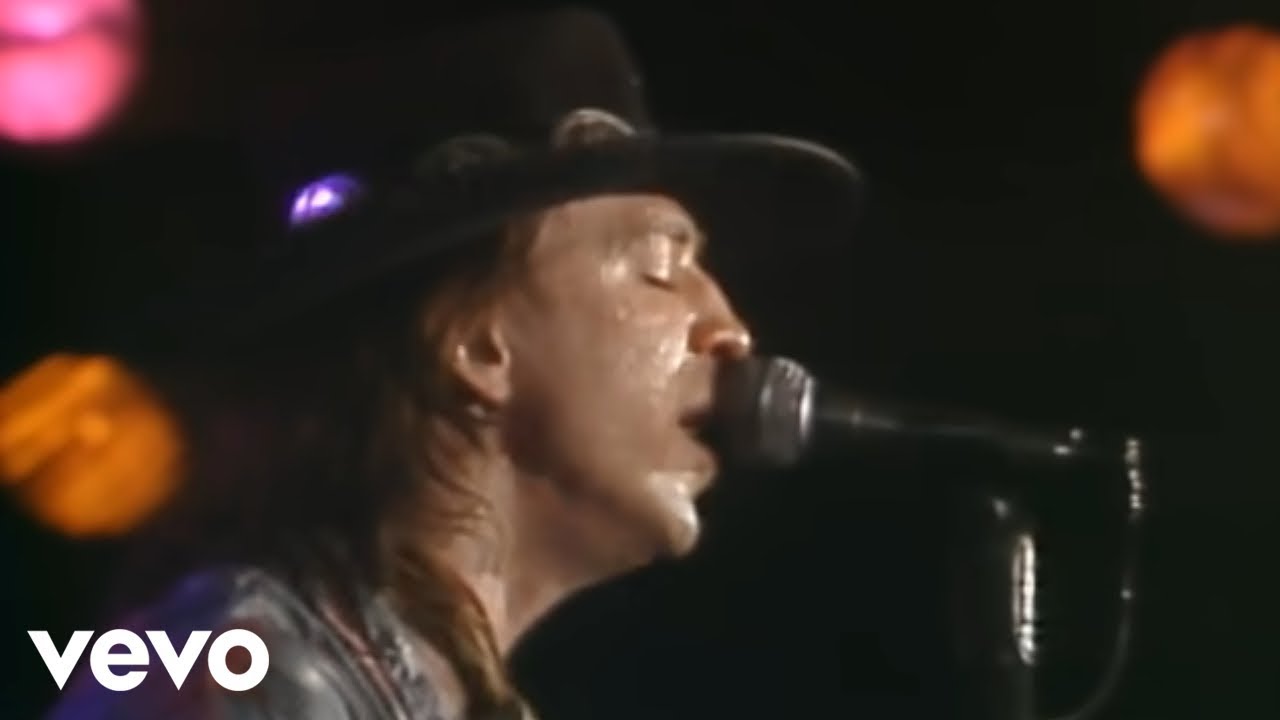
David Bowie was among the first major stars to recognize that quality. After seeing Vaughan perform in Europe, Bowie described him as “just about the greatest new blues guitarist around” and recruited him to play on Let’s Dance. Vaughan’s searing guitar work on the 1983 album helped introduce him to a vastly larger audience.
Other guitar heroes would make similar observations. Eric Johnson called Vaughan a complete musician, while Steve Stevens praised his ability to retain the soul of the blues even when playing in settings far removed from traditional blues.
Vaughan’s rise was particularly striking because it came at a time when the blues was hardly the dominant force in guitar music. The decade belonged increasingly to hard rock and shred, but Vaughan emerged with a stripped-down, intensely expressive style that sounded almost defiantly old-school.
It wasn’t an immediate success everywhere. Huey Lewis recalled that Vaughan struggled initially when Double Trouble opened for Huey Lewis and the News, but by the end of the tour he had won over the audience.
Vaughan’s career was tragically brief, but his influence has only grown since his death in 1990. And among the many great guitarists who have praised him, Knopfler’s assessment carries particular weight: he wasn’t simply impressed by Vaughan’s technique. He heard a guitarist whose influences were evolving into something even more powerful — and who, in his estimation, became one of the best he had ever heard.