
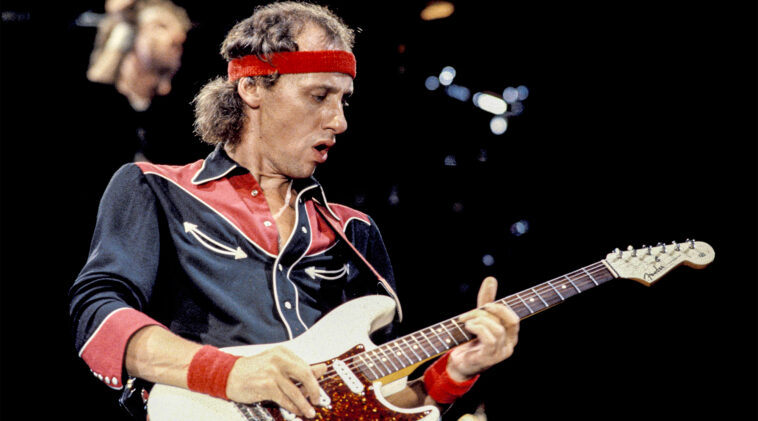
The Hardest Working Man in Show Business? In the ’60s, that nickname was given to Soul Brother Number One, James Brown.
In the ’70s, the Boss, Bruce Springsteen, gave the Godfather of Soul a run for his title. In the ’80s, the unlikely heir to the throne may well turn out to be Mark Knopfler of the group Dire Straits.
The singer/songwriter/guitarist/band leader may not do the splits or leap from the drum riser to the PA stacks, but he definitely has a full workload. The soft-spoken Scotsman is certainly one of the busiest men in show biz. Example: At the time of the following interview, Knopfler was in the studio producing Aztec Camera’s sophomore LP; had just finished some sessions with Roxy Music’s Bryan Ferry; was about to remix his original soundtrack for the film Cal; and was working on another film score for Comfort and Joy — having composed the critically acclaimed score for Local Hero.
Then it was back to Dire Straits for rehearsals in preparation for their next studio album and American tour. In 1983, the band toured extensively, yielding this year’s live double-album, Alchemy, along with a concert video by the same name, and Mark co-produced and appeared on Bob Dylan’s rock and roll comeback, Infidels. When Knopfler says, “I’d love to have 60-hour days,” he’s not kidding.
Knopfler was last featured in Guitar Player in July 1979, just after the release of Dire Straits’ second album, Communiqué. The band’s self-titled debut LP, which included the hit “Sultans of Swing,” was voted Best Guitar Album in GP’s Readers Poll that year, and Knopfler won top honors in the New Talent category for his sinuous, melodic Stratocaster style. That year, he and Pick Withers (then drummer with Dire Straits) also appeared on Dylan’s gospel milestone, Slow Train Coming, revealing a strong blues base reminiscent of Albert King.
Although Dire Straits has since achieved Gold or Platinum status in virtually every country in which it was released, it was anything but an immediate success. In fact, the group was already recording its follow-up before the debut LP began climbing the American charts.
While Communiqué didn’t fare as well in the States, it helped establish Dire Straits’ reputation as a top international draw, becoming the first album ever to enter the charts at number one in Germany in its first week of release (the previous LP was still at number three at the time). The band has gone on to break attendance records at concerts all over the world, including the largest public gathering in the history of New Zealand: 62,000.

Like Ian Anderson of Jethro Tull or John Fogerty of Creedence Clearwater, Mark Knopfler is more than just a frontman or a figurehead; in a very real sense, he is Dire Straits — virtually every song, melodic motif, bass line, and drum beat are a product of Knopfler’s creative genius. (In conversation, he often lapses into first person when talking about the group, saying, “I hired so-and-so,” or, “I decided this or that.”)
It would indeed be hard to imagine a Mark Knopfler solo project sounding much different than a Dire Straits album. Mark and bassist John Illsley are the only original members on board today; brother David Knopfler (rhythm guitar) left the group just before Making Movies, their third LP, was recorded, and Pick Withers departed after recording the group’s fourth album, Love Over Gold. (As of this writing, Dire Straits’ personnel consists of Knopfler, Illsley, drummer Terry Williams, rhythm guitarist Hal Lindes, and pianist Alan Clarke, although the guitarist indicated that more changes were in the works.)
Though Knopfler does not view Dire Straits as a sound, per se, his distinctive guitar style has had a substantial impact on the guitar community, affecting otherwise identifiable stylists such as Eric Clapton and Carlos Santana, and the influence of his linear, Dylanesque songwriting has shown up in such unlikely places as Rod Stewart’s “Young Turks.” The 34-year-old’s style relies on finesse and economy, rather than brute force. His out-of-phase tone, eccentric melodicism, and extensive use of hammer-ons and pull-offs bear an uncanny resemblance to the earlier work of ex-Fairport Convention founder Richard Thompson.
Yet Knopfler claims only a passing familiarity with the fellow ex-folkie’s work. And while he readily acknowledges the enormous influence that Bob Dylan has exerted on his singing and songwriting, he shrugs at the suggestion that the guitar playing of Dylan’s longtime sideman Robbie Robertson was a byproduct of that tutelage.
But Knopfler’s plectrumless guitar style is as varied as it is distinctive — from the National steel-body sounds of “Romeo and Juliet,” from Making Movies, to the acoustic work on “Private Investigations,” from Love Over Gold, to the Celtic melodies of Local Hero.
Following Dire Straits’ fourth album, the somewhat overblown Love Over Gold, Knopfler returned to the basics and produced a four-song EP, with the old-fashioned rock and roll of “Twisting by the Pool” (which received substantial airplay on oldies stations) sitting alongside the beatnik jazz of “Badges, Posters, Stickers, T-Shirts.” The totally live Alchemy double-set is a Knopfler showcase in every respect, featuring extended versions of 10 of his compositions with an extra helping of guitar solos. Not disproportionately, the album cover photos of the guitarist are several times the size of those of his bandmates.
Though breaks in his touring and composing schedules are few and far between, Mark has managed to fit in an occasional sideman session, including dates with Steely Dan, Van Morrison, Thin Lizzy’s Phil Lynott, and Phil Everly, as well as with Bob Dylan. He also helped out on one cut of brother David’s new Release LP and appears on bassist Illsley’s Never Told a Soul. He recently had the pleasure of performing onstage with a group of his early idols, the Shadows, who recorded a cover version of Mark’s theme from Local Hero.
In the following interview, Knopfler details his roots, his association with Dylan, his equipment, and the creative process.

Do you think there’s an identifiable British sound to Dire Straits?
I don’t really think of Dire Straits as a sound, you know. It just depends on the song, and the stuff we’re doing is so varied. I don’t think of sounds as being American or English or Japanese or German. That doesn’t mean anything; it’s all just music. It’s either good music or bad music, and good music, to me, is the stuff that’s got a bit of soul. The other stuff I’m not really interested in.
For Local Hero, did you reach back for some Celtic influences you heard when you were growing up?
Well, I was born in Scotland and spent the first six years of my life there. Then I went to Newcastle-upon-Tyne in northeast England, close to Scotland. So I heard a lot of that music, and of course it’s still very strong.
In fact, what are the Everly Brothers but that Celtic thing? You can hear the Celtic influence in a lot of country music as well as in people like Gerry Rafferty [of “Baker Street” fame] — that Celtic drone. I had to get even closer still with Cal, which is set in Ireland. For that, I used a fair amount of uilleann pipes played by Sean O’Flynn, who’s maybe the best exponent of that. Lately, I’ve become friendly with an Irish singer called Paul Brady, who plays whistle on Cal.
I had to wait until I was 15 before I got a guitar, because my old man wanted me to appreciate it when I got it.”
— Mark Knopfler
Was rock and roll the first music you ever played?
Yes. I heard my uncle Kingsley playing boogie-woogie on the piano when I was about eight or nine, and I thought that those three chords were the most magnificent things in the world — still do. The first records I made my mom buy were Lonnie Donegan skiffle records. That was before I was 10 years old. I had to wait until I was 15 before I got a guitar, because my old man wanted me to appreciate it when I got it. It was a red Hofner V-2, I think they called it. Cost 50 quid. It was Strat-shaped, and it had to be red.
American-made guitars were pretty scarce in England in the early ’60s.
Yeah. A Strat was a thing of wonder. When I was 14 or 15, the Shadows were a big influence, and they had the first Strats that came to England. Cliff Richard brought them back for them. Hank Marvin played lead on a Strat, and Bruce Welch played Tele rhythm.
Were you also influenced by American instrumental bands from the late ’50s and early ’60s?
Oh, yes. I went up the street to a little pal of mine and made him play me “Because They’re Young” [by Duane Eddy] 49 times. I could spend the whole day listening to that: the twang.
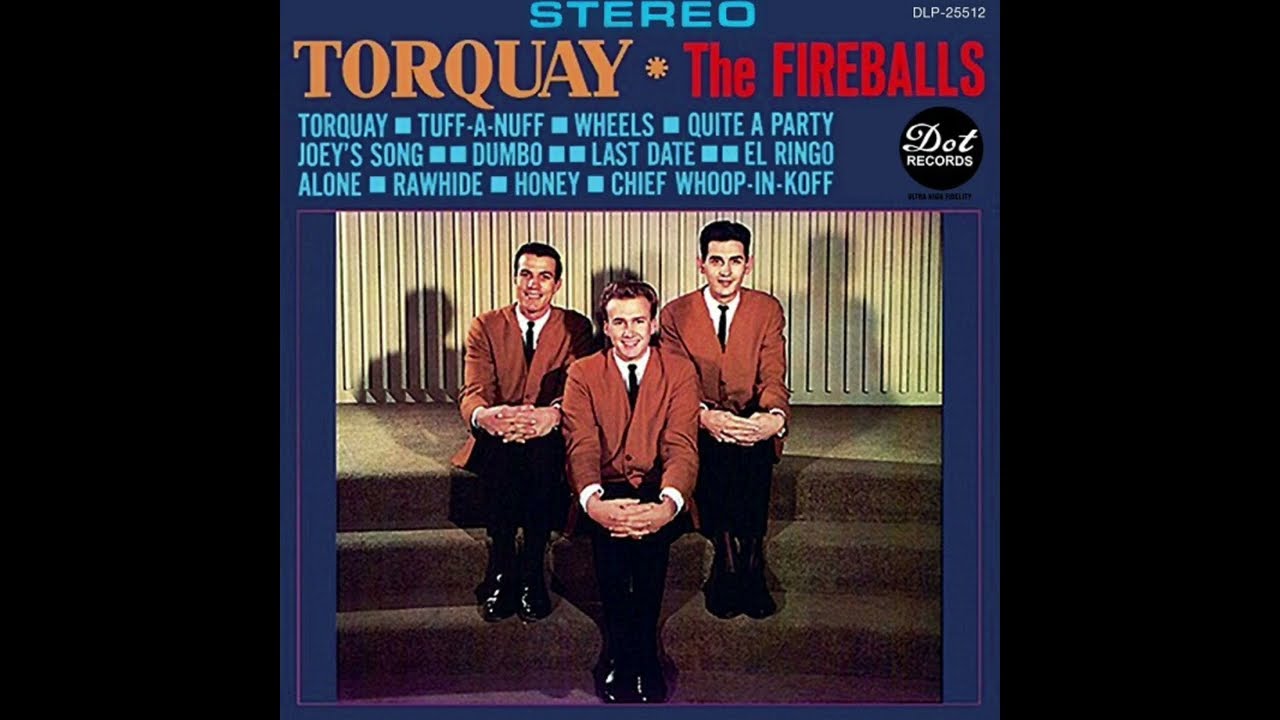
Do you remember the Fireballs? I have one Fireballs single with “Quite a Party” on one side and “Gunshot” on the other. I played that 4,900 times. Completely and utterly in love with it. Then you’d grow up into Radio Luxembourg, and you’d sit up talking to your older sister. She talks about her boyfriends, and you listen to Ben E. King’s “Spanish Harlem” or “Hey, Baby” by Bruce Channel — stuff like that.
Were you also into rockabilly?
Early Elvis, of course, and one of the biggest of all was the Everly Brothers — with Chet Atkins on guitar; but of course, I didn’t know that, and they didn’t put their names on records then. But he’s probably the greatest of all.
Then there was Ricky Nelson — a record called “Just a Little Too Much,” which doesn’t get a lot of exposure — and I didn’t know then that that was James Burton on guitar. The sound on those records — just listen to the backing on “Hello, Mary Lou” — is astonishingly great. Jerry Lee Lewis was another complete genius.
A lot of English rock guitarists got their start playing “trad” jazz, Dixieland. Were you involved in that at all?
No, the only thing young kids were really exposed to were the occasional novelty pop singles like “Midnight in Moscow” by [trumpeter] Kenny Ball or “Stranger on the Shore” by [clarinetist] Acker Bilk. Later on, I got into it some. Everything went in stages. After I’d gotten the solid-body Hofner, I didn’t have the nerve to ask my dad for an amplifier — it cost so much — so I had to borrow a friend’s acoustic guitar.
All the time I wanted to play rock and roll, I got forced into playing sort of folk joints. Of course, that was very good, because I learned how to fingerpick. The first time I heard a 4/4 clawhammer picking pattern, I fell totally in love with that.
So things were progressing on a number of fronts. Later, I got into National steel-body guitars from a guy in Leeds called Steve Phillips, who also builds beautiful guitars. I got involved in all kinds of slide playing and ragtime, country blues, jug band, and even western swing.
All the time I wanted to play rock and roll, I got forced into playing sort of folk joints. Of course, that was very good, because I learned how to fingerpick.”
— Mark Knopfler
When you got into different styles, how studied was your approach?
Not studied at all. I was just trying to absorb the spirit of the thing, rather than take an academic approach. I’ve never had a guitar lesson. I’m not proud of it particularly, but it’s just the way I seem to do it. It’s not the best way. I don’t recommend it to all your readers.
Considering the enormous impact the Beatles had on American groups, they must have been an even bigger influence on a young musician like yourself growing up in England.
Oh, huge! “Please, Please Me” was one of the first records that I bought. It’s funny now, because while I’ve been working with Aztec Camera at AIR Studios [the studio of former Beatles producer George Martin], I’ve been playing Asteroids about every other day with Paul McCartney. It’s slightly strange to think, “Oh, that’s him.” [laughs]
But I also liked the Rolling Stones, and I absolutely loved the Kinks. I got into trouble for writing “Le Kinks” on notebooks and desks in school. I loved songs like “Where Have All the Good Times Gone,” “Waterloo Sunset,” and “You Really Got Me.”
I enjoyed that period, and then a few years later, when I was 18 or 19, I got into a lot of the American bands, like the Doors, and some of the English bands that didn’t necessarily make it as big, such as Head, Hands & Feet [with Albert Lee]. I never really got into deep record collecting, because I was always moving around and was too impoverished.
When did you get into R&B guitar players?
When I was listening to Elvis and the Everlys, I suppose. Then shortly before Dire Straits, I was playing a Gibson Les Paul Special in a rockabilly/R&B band in London.
When I heard B.B. King, at age 16, that was another big turning point, because I was really struck with the relationship between the guitar and the voice and the whole bending thing, the way it sounded. Later, when I was 20 or 21, I remember hearing Lonnie Johnson with Eddie Lang — the Blue Guitars album. Then I realized that there was a connection, and I read an interview with B.B. King saying that Lonnie Johnson had been a big influence on him. It’s great to make these little connections and see how they do line up.

Bob Dylan is probably the most obvious influence on your singing and writing.
I was hugely influenced by him about the age of 14 or 15, going ’round to girls’ houses, drinking 75 cups of coffee, smoking 90 cigarettes, and listening to Blonde on Blonde 120 times. I heard Bob Dylan from the very beginning, the “Hard Rain” days, and went with him all the way up, and I’m still with him. I still think he’s great. Blood on the Tracks is one of my favorite records, with “Tangled Up in Blue.” On the last record [Dylan’s Infidels], to hear the first lines of “I and I,” that’s enough to make anybody who writes songs want to retire. It’s stunning.
Bob’s musical ability is limited, in terms of being able to play a guitar or a piano. It’s rudimentary, but it doesn’t affect his variety, his sense of melody, his singing. It’s all there. In fact, some of the things he plays on piano while he’s singing are lovely, even though they’re rudimentary. That all demonstrates the fact that you don’t have to be a great technician.
It’s the same old story: If something is played with soul, that’s what’s important. My favorite records, by and large, aren’t wonderful technical achievements, with the exception perhaps of people like Chet Atkins. But generally speaking, all you’ve got to do is listen to a Howlin’ Wolf album — that’s just soul.
It’s the same old story: If something is played with soul, that’s what’s important.”
— Mark Knopfler
Along with the impact Dylan had on you, were you also influenced much by the Band, in particular Robbie Robertson’s guitar playing?
No, I don’t think so. Not really.
Were there any specific guitar influences that made your style take the form it did?
I don’t know.
Some of your playing is reminiscent of J.J. Cale’s.
Oh, of course, yeah. I listened to a lot of J.J. Cale around the time my style was developing. He’s great. I’d love to meet him. He’s very, very special to me.
Another guitarist to whom you bear a remarkable similarity is Richard Thompson.
Well, I haven’t really heard much of Richard Thompson’s stuff. I saw him play live years ago with his then-wife [Linda Thompson] and enjoyed it very much. But I’ve only listened to one of his records.
Around the time Dire Straits was starting, we were all in this house, and John [Illsley] had one of his records. I haven’t really kept up with him, but I mean to do something about that. We’ve both done folk music and things, so there’s probably quite a lot of common ground. I think I was probably more into the blues, while he was doing Fairport Convention.
But like Thompson, you don’t at all resemble the stereotypical blues-based lead guitarist rattling off pentatonic licks.
You mean down-da-da-da, down-da-da-da, down-da-da-da? Have you heard that Pretenders single [“Middle of the Road”]? Right, I don’t do that. [laughs]
On Slow Train Coming, on the other hand, you didn’t play the sorts of things you’re known for with Dire Straits. It’s very bluesy, à la Albert King.
I was asked to do that. [Producer] Jerry Wexler said, “Try for a gut-bucket style of thing.” So I borrowed a Gibson ES-335 that somebody down there had, and off we went.
On Infidels, whose idea was it to have Mick Taylor on guitar?
Bob decided on the whole band, although I did suggest that Alan [Clarke] be there, because we’d been in the room doing Local Hero and had sort of a working thing going on there. And I suggested the engineer, Neil Dorfsman, who did Love Over Gold and Local Hero. We were like a three-man team at that point.
Sly Dunbar and Robbie Shakespeare [reggae’s top studio drummer and bassist, respectively] were Bob’s ideas, as well as Mick Taylor. I suggested Billy Gibbons, but I don’t think Bob had heard of ZZ Top. It would have been great to have done that with Billy. My roughs are different from the final record. Bob mixed it, because I had to go on tour in Germany with Dire Straits. I think he changed some things. I’ve only heard the album once.
Was it difficult producing Dylan?
Yeah. You see people working in different ways, and it’s good for you. You have to learn to adapt to the way different people work.
Yes, it was strange at times with Bob. One of the great parts about production is that it demonstrates to you that you have to be flexible. Each song has its own secret that’s different from another song, and each has its own life. Sometimes it has to be teased out, whereas other times it might come fast. There are no laws about songwriting or producing. It depends on what you’re doing, not just who you’re doing. You have to be sensitive and flexible, and it’s fun.
I’d say I was more disciplined. But I think Bob is much more disciplined as a writer of lyrics, as a poet. He’s an absolute genius. As a singer — absolute genius. But musically, I think it’s a lot more basic. The music just tends to be a vehicle for that poetry.
When you’re playing on someone else’s record, what sort of directions do you usually get from the artist or the producer?
In 99 percent of the cases, almost none. It’s always very nice.
Yes, it was strange at times with Bob. One of the great parts about production is that it demonstrates to you that you have to be flexible.”
— Mark Knopfler
What do you want to know about the song you’re playing on?
I want to know what the lyric is, what the song is about. I like to talk to the lyric to a certain extent. That’s important to me. What was funny and kind of nice about doing Bryan Ferry’s stuff is that Bryan works backwards from the way I work. He creates these very nice-sounding, very simple grooves, and they seem to instigate the lyric. The lyrics come last — which is great, just fine.
But, you know, I would say to Bryan, “What do you think this is going to be about? A dragonfly. Oh.” And that can create tension or whatever, too.
Do you usually get called to do a session because someone is after your specific sound?
It varies. It’s usually all-around guitar playing. A lot of the things that I do on session don’t relate to the Dire Straits sound, if there is such a thing. I might be just playing my Gibson Chet Atkins solid-body classical or a National, maybe just doing a part or something.
You don’t feel as though you’ve been stereotyped for your identifiable sound and lead approach?
To me, that’s never seemed to be limiting in terms of sessions. I like to play a lot of different styles of things on sessions. On Tina Turner’s new album, she recorded a song I wrote called “Private Dancer,” and she got the whole Dire Straits band to play on it, but I was busy doing the Bryan Ferry sessions. So she got Jeff Beck to play the second ugliest guitar solo you’ve ever heard on it.
What are the advantages and disadvantages to doing sessions or working on film scores as opposed to playing in a band?
Oh, it’s all just advantages. It all makes you bigger. It’s a challenge. I look at something like Cal, where I did all the music cues, and I didn’t think I could do it at first. But I just started at the beginning and staggered through it from one piece to the next until it was finished.
It’s a finely tuned film, and the slightest thing you add or subtract really affects what’s going on. It’s very exacting. There are a lot of decisions to be made. It’s part of a picture, but at the same time you want the music to stand up on its own. I don’t like soundtrack albums that have one song and the rest is all filler.
On a film score, do you work along with the director?
Yes. For instance, with Cal, I made sure that Pat O’Connor, the director, was in the studio almost every day. I’d just drag him in there. That’s another reason I like film work: You’re trying to do something for somebody else, and you’re cooperating. It’s less selfish in a way than this egomaniac thing of “Singer/Songwriter Does Own Record.” It’s nice to be a part of a bigger thing.
That’s another reason I like film work: You’re trying to do something for somebody else, and you’re cooperating. It’s nice to be a part of a bigger thing.”
— Mark Knopfler
Do you think you’d ever put out a solo album not connected with a film or with Dire Straits?
I feel that with the band there’s enough for all that expression. But I would like to make some little records for different kinds of things — maybe built around the guitar or whatever.
And I love to do sessions. I get enough to do without feeling frustrated about not doing solo records. The film stuff gives me an opportunity to do all that. To have musicians like [saxophonist] Mike Brecker and [vibist] Mike Mainieri or [bassist] Tony Levin play on your music is wonderful. Words can’t express it.
Apart from sessions and Dire Straits, do you get a chance to sit in with other musicians on a regular basis?
A little bit, but not as much as I’d like to. But that’s just because of the demands of the cycle of events of the group, the production stuff, and the films. I love to play with other people. I think musicians should and, generally speaking, do intermingle a lot. I’m totally in favor of that. I’ve got a little project in the back of my mind that Mike Mainieri has been asking me about. We sort of talked about putting some people together and making music. It’s all just a question of time. I’d love to have 60-hour days.
Has your composing for Dire Straits been influenced much by movie soundtracks? A lot of your songs have a feel somewhat like The Good, the Bad, and the Ugly.
Yes, that’s Ennio Morricone. He’s done The Good, the Bad, and the Ugly, A Fistful of Dollars, things like 1900. Yes, he’s a big influence.
Do you have any particularly strong literary influences in your songwriting?
Lots and lots. That was my subject at university, and I taught English for a while. There’s too many to name: Shakespeare, a lot of American writers, such as Raymond Chandler, metaphysical poets.
Do you find that certain keys or chord progressions give pieces a more majestic quality?
Yeah, I like certain keys more and more. I’ve been doing a lot of stuff in F and D minor. “Down to the Waterline” is B minor, which is a nice key as well.
Is that the Ennio Morricone influence coming through?
Probably, yes. That slightly comic, melodramatic thing. I call it “spaghetti music.” Things like “Private Investigations” [from Love Over Gold] are almost tongue-in-cheek — deliberately exaggerated.
Your guitar playing seems fairly delicate, yet there are a lot of dynamics, a lot of driving rhythms in your music.
Thank you. I like arranging other people’s instruments, and working with the way verses go into choruses. I like dynamics and things to be a little bit dramatic. I work with every aspect of the whole thing: the bass, the piano, when a bass drum is hit, every hi-hat beat. Certain pieces just go, but with other pieces I like to get into everything that goes on.

On a studio album, how much overdubbing do you do?
We end up keeping quite a lot of the live takes, actually. Love Over Gold was a heavily worked-on record. Too much attention was paid to that, I think, in a lot of respects. But it was interesting to have done it that way. I don’t think I’d like to do another record that was so heavily produced, though.
Do you ever play rhythm guitar yourself?
Oh, I love to. I like to have two rhythm guitars on most pieces anyway.
Do you also instruct or direct the other rhythm guitarist’s part?
Pretty much, usually. The bass and drums as well.
So you write the arrangement as well as the song itself?
Pretty much, but people always bring their own little bits and pieces to it. Sometimes they bring the entire thing, and that’s even greater. Every musician will come up with things that only he could come up with, and I like to use those things. Hal [Lindes] often comes up with different voicings than I would have had in mind.
Does that change the mood of the song?
It can, yes.
You have a very vocal-like guitar style, but it’s not at all like the B.B. King style you mentioned earlier.
Part of the difference, I suppose, would be chucking away the pick when I was evolving my own style. Style, I find, is always impossible to define, but it’s easy to recognize.
What made you start playing lead with your bare fingers?
It just started to happen. I remember sitting in a house in London — starving to death at the time — playing a cheap Japanese acoustic with really light electric guitar strings on it. I knew then that it was on a turn, it was developing. I was doing things with my fingers that I couldn’t do with a pick — really fast things and what have you. I still love to play with a pick, and sometimes you have to record certain parts or songs with a pick — for instance, “Expresso Love” [from Making Movies]. But it’s interesting that now I’m not nearly as comfortable with a pick as I am with my fingers.
Did you go through different stages of developing techniques and experimenting with fingerpicks?
Yes. I went through thumbpicks and even steel fingerpicks with the Nationals, and I dispensed with them. It’s a bit of a disadvantage without them sometimes, because a thumbpick is just great for that chunk thing that Chet Atkins can do so brilliantly.
What does your picking technique consist of now?
It’s the thumb and first two fingers, and I tend to anchor with the back of my hand and my other two fingers, so it’s a solid base.
Do you pick with your fingernails or with the meat of your fingertips?
It’s really from skin, but sometimes the nail will catch. You can use the nail to snap it. A lot of times, I’ll hit a note with the thumb and second finger together, so it might seem as though I’m pinching the string, squeezing it. The second finger hits it first, I think, behind the thumb, so you can get a real physicality with a note.
Is your tone a product of the type of guitar you play, or is it a result of your picking technique?
I think it’s a combination. I like to play all kinds of guitars, not just Strats, but I wasn’t getting the sound I really wanted until I got a Stratocaster. It was about a ’61 with a rosewood neck. I like rosewood necks a lot, even though I end up playing a lot of maple necks. I very rarely use a Fender Strat these days; it’s usually a Schecter instead, which is a more powerful guitar.

Your old Fender Strat used to have the three-way toggle switch taped so that it would stop in the position between the middle and rear pickups. Why didn’t you just get a five-position switch to achieve the same pickup combination?
I liked the three-way switch better than the five-position; it had a better sound. But I kept knocking it out. I have a five-position switch on the Strat now. The roadies are always pulling bits out and sticking things in.
Why did you switch from your Fender to a Strat-style Schecter?
I didn’t want to keep flogging a Strat around the world, getting it smashed to pieces. Same thing with my beautiful Telecaster that David [Knopfler] used to play rhythm on in the band. It’s a double-bound sunburst Custom Tele, about a ’67 or ’68, and I’m not inclined to have it smashed to bits. The Schecter is beautifully made and very strong.
Does it weigh a lot more than the Fender?
Yeah, the Schecters do tend to weigh a lot more. Probably the best electric I ever had was a Schecter that I used on Making Movies, but it was stolen. John Suhr, at Rudy’s Music Stop in New York City, has worked on all my guitars, and so does Jack Sonni from the same shop. I got John to come to the studio all the way through the Dylan sessions [for Infidels], just to work on all the guitars. He screens different pickups and installs them. John does the best work I’ve ever seen — brilliant fret jobs and what have you.
Are your guitars heavily modified?
Not really. One Schecter has Seymour Duncan Vintage pickups, and another red one has heavier Seymour Strat pickups in it.
Have you amassed a very sizable instrument collection?
No, I haven’t. For instance, I still haven’t got a flat-top wooden acoustic, because I’ve never found one that was as good as the two best flat-tops I ever played. One was a David Russell Young guitar that Steve Khan lent me, which was absolutely stunning. The other was a hand-built Greco that Rudy [Pensa, of Rudy’s Music] lent me.
I used the David Russell Young on Love Over Gold, and the Greco on Infidels. When I got my Ovation Adamases, I started using them straight away on Slow Train Coming and Local Hero. For the Aztec Camera thing, I borrowed a couple of old Martins from Eric Clapton, because they’d been using Ovations, and you just can’t get the personality out of them. They’ve also been using my new red Schecter Tele, which is one of the best-sounding electric guitars I’ve ever had.
So on Dire Straits albums you play borrowed acoustics?
I have some Ovations, but no wooden flat-tops. Hal has a Martin, and my Adamas guitars — a six- and a 12-string — have seen quite a bit of recording. One of my favorite guitars is the Gibson Chet Atkins solidbody classical, which has been on a lot of sessions since I got it. It’s a beautifully made thing. I use it onstage, too, because you can get really loud with the thing. The action is low, so it tries to get the best of both worlds. By and large, I think it succeeds. It’s a lot of fun to play. I used it on the Bryan Ferry sessions, some sessions with Phil Everly, and on the film scores I just did.
When you record with an Ovation, do you play it through an amp?
It sounds great direct. I might have an amp out in the studio with a microphone on it, too. On Local Hero, we sent the Adamas direct quite a lot.

Do you ever work out solos ahead of time on a session?
No, not really. Sometimes it might break down in the middle, and then you figure out which way it should go, and punch it in. But generally speaking, it’s pretty rough-and-ready. I’ll often play three passes, record them all, and then make something by stitching them together.
You usually stay pretty close to the song’s melody or play a countermelody, instead of working off licks and patterns.
Well, it doesn’t go down-da-da-da, down-da-da-da. [laughs]
Judging by the live album, you’ve recently begun taking more extended solos.
I started writing other sections for songs like “In the West,” instead of that sort of skeletal Communiqué approach. With the keyboards coming into the band, I started writing new sections and was inspired to build things up a bit, trying to get the full possibilities of the song out, instead of the more linear approach that marked the earlier sound of Dire Straits.
Why did you decide to come out with a live LP at this point?
Several reasons. I wanted to have a record of the band at that certain stage. Second, we played to about three-quarters of a million people on the last tour, and a lot of them found their way into our dressing room. One of the major things the fans would ask for was a live record. Also, I wanted to see if we could do a genuine live album without tampering with the multitrack in any way — which we managed to do.
On most supposedly live albums, they’ve overdubbed…
Everything. I got to play an awful lot of pool during that record, because the engineer was doing a lot of the mixing, so I was just upstairs playing pool. It wasn’t very taxing.
Why did Dire Straits put out a four-song EP after Love Over Gold, rather than a complete album?
Well, the EP was actually a reaction against the album. After doing something where you spend a lot of care — and doing “Private Investigations” about 20,000 times — then all you want to do, basically, is play “Bebop-A-Lula.”
Do you vary your amps and settings much in the studio?
We just take potluck and go. For stage, I have two amps set up for different things. They’re Boogies with Marshall cabinets. One’s set lower, and I put the National through that, and you have to graphic [EQ] pretty heavily for that onstage. It’s a metal-body with palm trees and canoes on it [a 14-fret Style O from the 1930s].
What about effects? There’s an interesting fast echo on “Waterline” [from Dire Straits].
I have no idea what that was. Rhett Davies was the engineer on that record, and he’s in love with Roland Chorus Ensembles, so it might well have been that. I actually use a Roland onstage. Most of my effects are echoes. I have a DeltaLab that I like very much, too.
Do you prefer a certain brand and gauge of strings?
They’re called Dean Markley Custom Lights. I’d have to check the gauges [high to low, .009, .011, .015, .026, .036, .046].
Is there a pattern to your creative process when you write a song?
No, there’s no formula, no law. I’m lazy. [laughs] One song might come quickly, and another might take hundreds of hours over a long period of time with varying amounts of inebriation.
What’s the most inebriated song you ever wrote?
“Once Upon a Time in the West” [from Communiqué] was one of them. I was watching the film on TV in a slightly altered state.
Do you use a multitrack cassette recorder to keep track of ideas and come up with arrangements?
No, I should. I don’t even use a tape recorder. I just write things down in a book. A lot of ideas come around, and I’ve forgotten them in the morning. Sometimes I figure, “Well, if I wake up and can still remember it, then it’s worth remembering.”
Do you just jam on guitar to come up with melodies and changes?
Yes, for hours and hours. And then for more hours. I can play by myself quite happily for days. Sometimes I sit down at the piano and hit the keys, make shapes, but I’m not what you’d call a player. I’m not even what I’d call a proper musician on the guitar. I feel as though I’m a student who’s not going to school. I’ve been working from the Mickey Baker book [Jazz and Hot Guitar, Book I] to get some extra chords. I love to learn a new chord and find out what it means, and use it in what I write. I’m developing slowly that way.
Have the outside projects made it difficult to keep to a schedule with Dire Straits?
Dire Straits’ schedule is dictated partly by whether or not I’ve written any songs, and also by how many other things I want to do. If I did all the things I get asked to do, then there would be no time for Dire Straits at all. So to a certain extent, it does affect the band. The band would probably be working much more if I weren’t doing anything else. But then life would be extremely dull and tedious, wouldn’t it?
Is there anything else you’d like to add?
Just this [picking up his red Schecter]: down-da-da-da, down-da-da-da, down-da-da-da….