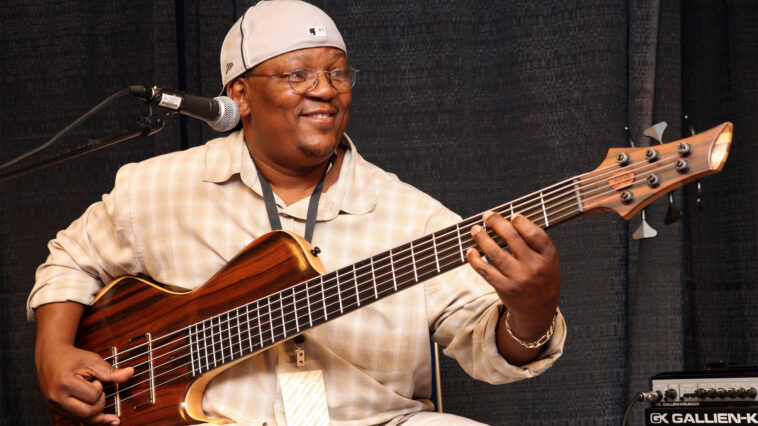
Roy Halee helped turn a one-measure bass line by Bakithi Kumalo into one of the most recognizable hooks on Paul Simon’s “You Can Call Me Al” by playing the recording in reverse and placing it immediately after the original performance.
The idea began with Kumalo, whose fretless bass playing became a defining feature of Simon’s 1986 album Graceland. While recording “You Can Call Me Al,” the bassist was given the freedom to contribute his own musical ideas. What he came up with was a short, fluid passage that Halee, the album’s engineer, recognized as an opportunity to create something more unusual.
The result was a two-measure break that seems to fold back on itself, with Kumalo’s original line followed by its reversed counterpart. The effect became one of the song’s signature moments — and an example of how Halee’s studio ingenuity helped shape Graceland’s sound.
Author Kalvin Schmidt-Rimpler Dinh recounted the story during an appearance on Booked on Rock with Eric Senich. Dinh wrote Paul Simon’s Graceland, published by Bloomsbury as part of its 33⅓ Africa series.
“This particular session actually fell on Bakithi Kumalo’s birthday,” Dinh explained. “And Kumalo asked if he could basically contribute an idea to the song. And he came up with an idea that then Roy Halee had sort of in response to that, decided to play and then reverse. And that’s the iconic sort of break in the middle where it plays one line and then plays it backwards.”

Kumalo had no way of knowing that his improvised contribution would become such a memorable part of the recording. In a 2023 interview with Guitar World, he recalled the spontaneity of the session.
“That was my idea,” he said. “We were recording that song on my birthday, and there was space to fill, so Paul said, ‘Go ahead, Bakithi, do what you like.’ I just played — and they loved it. It was one take. Listening back, I didn’t know what happened; I thought it was from God, you know? I never planned it.”
Halee’s decision to reverse the line, however, created a problem when Kumalo had to reproduce the passage in concert. Playing the original line was one thing; matching its reversed version on a bass guitar was another. Dinh said Kumalo searched for a pedal that could recreate the effect, but found no suitable solution. He ultimately had to work out how to approximate it with his hands, playing the phrase in one direction and then reversing the movement himself.
“I think it’s important to acknowledge Roy Halee’s contribution there as well,” Dinh said. “Or that’s an instance where we can remember that the engineer is also doing a lot of work here.”

Halee’s role went beyond reversing the notes. Dinh noted that the engineer also made creative decisions about the bass guitar’s tone, volume and placement in the mix, helping determine how it drove the music. Simon and Kumalo have both acknowledged the importance of those studio choices to the bassist’s recorded sound.
Kumalo’s playing became central to Graceland, an album that brought Simon’s songwriting together with South African musicians and musical traditions following his 1985 trip to Johannesburg. Simon had contacted producer Hendrick Lebone, who had previously worked with Kumalo on traditional South African music. Lebone recommended the bassist, whose playing impressed Simon enough that he brought him to New York to complete the album.
The fretless bass lines Kumalo contributed gave Graceland much of its distinctive fluidity and rhythmic character. On “You Can Call Me Al,” one spontaneous idea, captured on Kumalo’s birthday and transformed by Halee in the studio, became a particularly enduring example of that contribution.