Pete Townshend wasn’t always comfortable performing onstage. But he quickly found his footing, developing a repertoire of moves that would make him one of the most dynamic guitarists to grace a stage in the 1960s and ’70s.
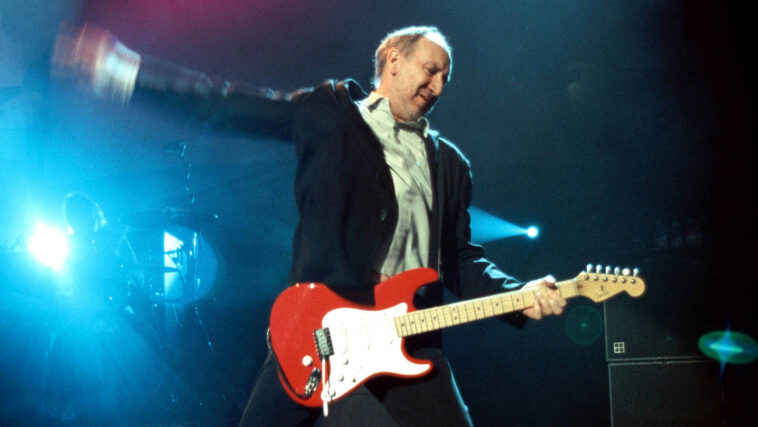
Equipment trashing was generally reserved for the end of the Who’s shows. But long before then, fans would have seen Townshend unleash his signature moves: the flying leap, the feedback pose and — perhaps most famous of all — the windmill, an arm-swinging acrobatic display in which he strikes the strings of his electric guitar with a sweeping motion from above or below.
Townshend uses the move like physical punctuation, emphasizing a downbeat or adding drama to a sustained chord. And while it’s now inseparable from his stage persona, he’s never claimed to have invented it. In fact, he says Keith Richards did it first, around 1964, during one of the Rolling Stones’ early performances.
“[The Who] supported the Stones for two shows,” Townshend explained in a 2012 interview with David Letterman. “They were young, they were brand new and they had one hit, with a Chuck Berry song called ‘Come On.’ I met them backstage and they were all very charming.
“As the curtain opened, Keith Richards is doing this,” Townshend said, standing up to demonstrate the windmilling motion. “I was thinking, Wow, that’s so cool! I thought it was part of his thing.
“A couple of weeks later, we supported them again in a club in south London. I’m watching carefully, waiting, and he didn’t do it.”
At the first opportunity, Townshend asked Richards why he hadn’t performed the windmill.
“He went, ‘What?’” Townshend recalled. “I can’t tell you exactly what he said, but the inference was, ‘I’m Keith Richards. Do you really think I’m gonna do ballet?’ That was the inference.”

Richards had addressed the matter some 30 years earlier, in our April 1983 issue.
“I never took credit for this, but apparently he said that he lifted that arm swing he does from seeing me,” Richards said. “I don’t recall doing it, but I guess if he says so, he did. It’s something I’ve never been aware of.”
With Richards seemingly disavowing the move, Townshend was free to make it his own. After years of practice, he had the windmill perfected by the time the Who became a global touring act in the 1970s. By then, he was saving it for the big downbeat at the top of “Baba O’Riley,” sending audiences to their feet. He made it look powerful and athletic — and, somehow, easy.
But the move came at a cost. As Townshend told Guitar Player in our October 1989 issue, the windmill could be brutal on his hands.
“As soon as we’d hit ‘Baba O’Riley,’ I’d go djaaang, swing, swing, all my fingernails would just get broken off across,” he said. “And from then on I would be in absolute agony for the rest of the tour. I wouldn’t be able to sleep. You know, at night my hand would be throbbing.
“And the other thing is, when you swing your arm and you’ve got a cut finger, blood pours out of it at a great rate, and it goes all over your strings.
“I’ve seen a lot of people do arm swings,” he added, “and I’ve never seen anybody do it right.”

Townshend explained that most guitarists who imitate the move splay their fingers and use them to strum the guitar at the critical point of contact. That’s doing it wrong.
“The right method is to bleed, you know?” he said. “Your hand and the pick have to connect with the fucking strings.
“You don’t open your fingers up and just sort of slap.
“And you have to be able to do it in a downward direction as well as an upward direction. Doing it from the top is right easy, but coming up from below… you know, you’re going around, the string catches under your fingernail, carves it back, pulls it out and then goes poing, backwards. If you get it wrong.”
By the time of that 1989 interview, Townshend had decided he was finished with the windmill. Like his habit of playing loudly — which had left him with deafening tinnitus — the move seemed destined to become a relic of his past.
“I just don’t want to do that anymore. It’s another example of the way that I developed a way of working which is disabling.”
But old habits die hard. Townshend continues to perform the windmill in concert to this day — just a little more carefully.