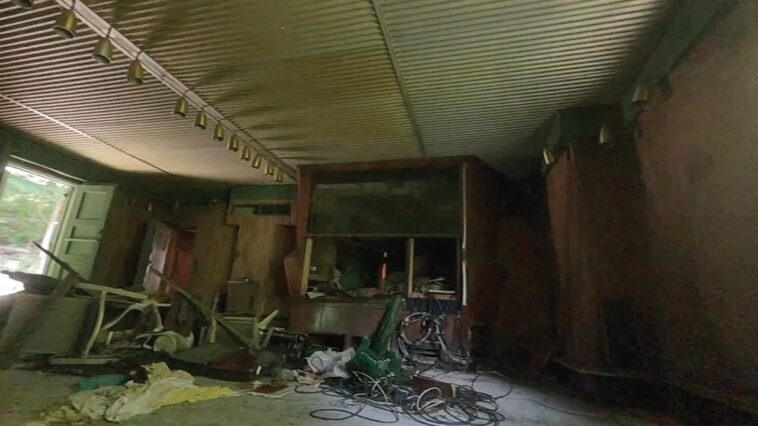
A video showing Les Paul’s longtime home, workshop and recording laboratory in Mahwah, New Jersey, in its final days before demolition has surfaced, offering a look inside the property before it was razed earlier this month.
The video was shot by guitarist, collector and recording-studio owner Perry Margouleff, who narrates the footage as he walks through the deteriorating property. It shows the rooms and workspaces where Paul developed his ideas for the solidbody electric guitar, recording techniques and other musical innovations over several decades.
Paul’s Mahwah home was demolished this month after the property was sold for a reported $990,000. The property had remained largely intact after Paul’s death in 2009, although much of the equipment associated with his work was eventually moved elsewhere.
Margouleff says in the video that he learned that the property was scheduled to be demolished and went there with a friend to document it.
“It made me sick,” Margouleff says in the video. “That house was not just where Les Paul lived. It was his workshop; his journey of dreams.”
Margouleff is a longtime collector of American guitars and vintage recording equipment. He also founded Pie Studios on Long Island’s North Shore, where artists including the Rolling Stones and Bad Brains have recorded.
His video focuses on the condition of the Mahwah property and the significance of its rooms to Paul’s work. He also raises questions about the decision to demolish the house and directs criticism toward Michael Braunstein, executive director of the Les Paul Foundation.
“A name kept coming up when trying to get to the bottom of who did this,” Margouleff says. “Michael Braunstein moved all the gear to Los Angeles and apparently sold the property to be razed.”
Braunstein previously described the Mahwah property as essentially “four walls” in discussing the decision to move Paul’s equipment. Much of the equipment associated with Paul’s recording work is now housed at the Les Paul Recording Studio in Hollywood, which opened in March 2025.
The Mahwah property had a long history of visitors from the music world. Jimmy Page and Eddie Van Halen were among the guitarists known to have visited Paul there.
Paul’s son Gene has also criticized the handling of his father’s legacy. In an August 25 Facebook post, he said Braunstein “took control of everything” following Paul’s death.
“The entire family found ourselves on the outside looking in,” Gene wrote. “We are seldom consulted about anything regarding my father’s estate, his money, or his legacy. Suffice it to say, we have never been happy about this arrangement.”

In a subsequent statement, Gene expanded on his concerns about the Mahwah property, saying Braunstein had told him after Paul’s death that having the home designated as a historic landmark, or otherwise preserving it, was impossible. Gene says he accepted that explanation for years, along with the idea that the only practical alternative to demolition would have been turning the property into a museum.
He now questions both assumptions, arguing that preservation did not necessarily require the home to operate as a museum. He also says he has begun looking into whether the property could have qualified for historic designation and whether such a nomination was ever pursued.
“My father’s Mahwah home wasn’t simply an old house where a famous man once lived,” Gene said. “It was a place where Les Paul lived, worked, experimented and helped change the way the world makes and records music.”

Gene now describes the years of deterioration before the demolition as “demolition by neglect.”
For now, the video provides a record of what remained of the property shortly before it was demolished, while Gene Paul’s questions leave open a broader issue: whether Les Paul’s Mahwah home could have been preserved, and whether that possibility was ever seriously pursued.