What happens to iconic guitars after a famous (or cult hero) guitarist dies? These days it’s common to see instruments sold at high-profile auctions and vanish into the clutches of anonymous collectors with deep pockets.
However, some guitars live on in museum collections, remain under close guard as family heirlooms, or pass along to famous player friends, where they continue to make history.
We decided to take a closer look at five of the most celebrated Telecasters (actually, one is an Esquire) played by guitarists we’ve loved and lost, and figure out where those instruments are now. Today, we look at Roy Buchanan’s 1953 Fender Telecaster, nicknamed “Nancy”.
Latest Videos FromGuitar World
The enigmatic and highly influential blues-rock guitarist Roy Buchanan inspired hundreds of players to pick up Telecasters during the ’70s, including Danny Gatton and even Jeff Beck, who returned to the Tele in 1974, after favoring Les Pauls and Strats for nearly eight years, to record his tribute to Buchanan, Cause We’ve Ended As Lovers.
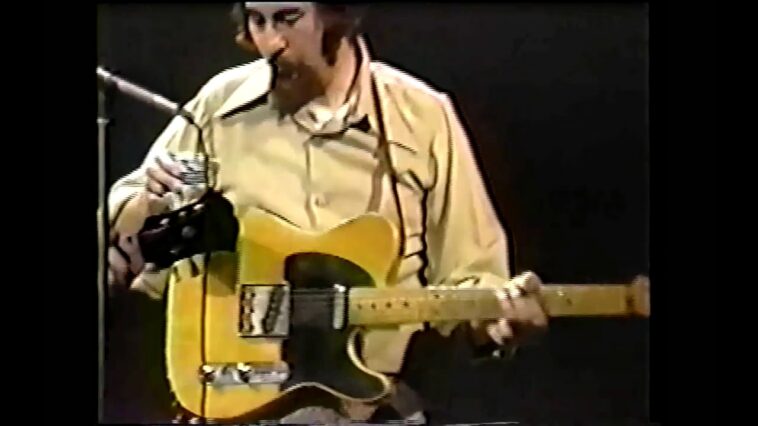
Buchanan owned a variety of early ’50s black-guard Telecasters during this period, but he was best known for a 1953 model nicknamed “Nancy” (serial number 2324) that appeared on most of his Polydor and Atlantic album covers.
Guitarists who managed to track down an early ’50s Tele often wondered why their instruments never matched the sharp, biting treble, voice-like, crying midrange, and subdued bass, of Buchanan’s signature tone.
The secret wasn’t any special effects, a particular amp, or studio trickery, but rather a very simple quirk or flaw. At some point, perhaps even before Buchanan acquired the Tele in the late ’60s while attending barber school, a winding in the bridge pickup became broken.
Although the pickup’s resistance didn’t register on an ohm meter, it still operated normally, albeit with a distinctive tonal character that mystified pickup designers for years (not unlike the humbuckers in Eddie Van Halen’s Frankenstein and 5150 guitars).
Buchanan had a few other tricks up his sleeve that guitarists quickly caught on to. The guitarist often placed a penny underneath the center saddle of the Tele’s three-saddle bridge, which raised its height without extending the screws excessively.
Many players feel that extending the saddle screws too far can make the tone thinner and affect sustain, as the string vibrations don’t transfer as well when the screws aren’t embedded fully in the saddle.
At some point, Buchanan drilled a hole through the headstock, but this was done only so he could hang it from a protruding nail on the wall (similar to the practice of many Spanish flamenco guitar luthiers) and not for any tone or performance reasons.
According to Seymour Duncan, the wiring in the “Nancy” Tele was 100 percent stock, providing the era-correct bridge, neck, and neck dark/bass settings. A .1µF capacitor in series with the output performs like a high-pass filter to roll off some of the bass frequencies.
Although the volume and tone pots were allegedly stock, they had the short on/off throw of linear taper pots, which made it easier for Buchanan to perform his signature volume and tone control swells.
Buchanan toured and gigged with “Nancy” up until the early Eighties, when the value of vintage Teles soared. Worried that someone would steal his increasingly valuable ax and needing a sizable influx of cash to support himself, Buchanan sold it.
His ’53 Tele circulated among a few vintage-guitar shops and buyers over the years until collector Mac Yasuda purchased it in the ’90s. Since then, Yasuda has loaned it to occasional exhibits at the Fullerton Museum Center’s Leo Fender Gallery in Southern California.