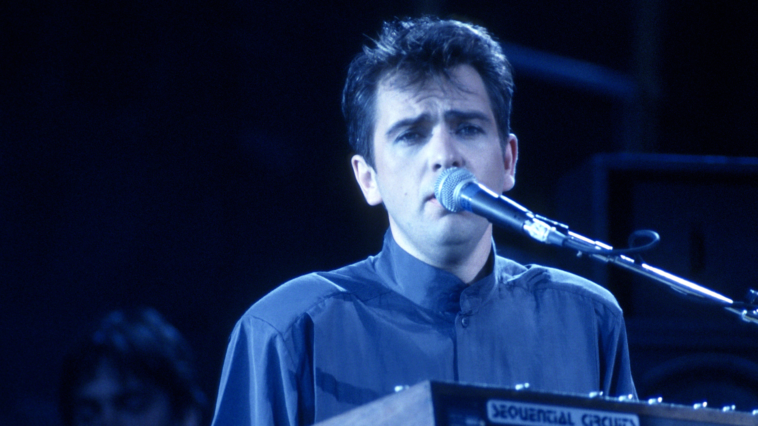
If we cast our minds back, we can actually remember the very first time that we heard Peter Gabriel’s Sledgehammer. And, if we are being completely honest, it didn’t much grab us on the first few listens. However, one fine spring day, we caught its extraordinary music video on MTV, and suddenly it all made sense…
By the time Sledgehammer was released, Peter Gabriel was already a successful artist. Having played a pivotal role in the original lineup of Genesis, he proceeded to embark upon an incredibly creative period, delivering four solo albums, and some very notable singles, such as Solsbury Hill and Games Without Frontiers.
Sledgehammer was released as a single in April 1986, with his fifth solo studio album, So, following one month later. The surprisingly massive success of both of these releases catapulted Gabriel to the top-end of the charts.
A household name with critical acclaim, Gabriel was overawed by this surge in popularity.
“I wanted Sledgehammer out as the first single because it is in fact different to the rest of the So album,” Gabriel told Sound on Sound in 1987. “I think it was a surprise for people who have a fixed image of what I am and what I do.”
In retrospect however, Sledgehammer seems an obvious single choice with its heavy R&B influence supported by the shuffling-lope of the infecteous rhythm section. But Gabriel is right in citing it as an outlier on the album, as Peter’s more creative edge shone through some of the more experimental tracks, alongside collaborations with Kate Bush and Laurie Anderson.
Of course, we have to credit the accompanying animated music video for wowing new audiences (and convincing us that the song was pretty decent, actually).
Working with the founders of Aardman Animation, Peter Lord and David Sproxton, alongside a young animation-employee called Nick Park (now of course better known as the multiple-Oscar-winning Wallace and Gromit creator), stop frame animation techniques were employed to deliver a music video which was not only exceptionally impressive, but perfectly timed for the MTV age.
The video took several weeks to film, with Nick Park having the unenviable task of animating dancing frozen chickens over a series of days. Unsurprisingly, he was quite concerned about salmonella, taking precautions to avoid exposure to the thawing chickens…
“David and Nick told me that they were going to use me as an animated model. So I spent a couple of days, lying under a glass screen, being filmed with bright lights and a rostrum camera, being painted, having my hair played with, everything,” Gabriel told Uncut Magazine.
“The most painful thing was having the sky painted, frame by frame, on my face. The clouds would be moved across, and my skin got very sore after the clouds had hit the halfway point!”

Sledgehammer – and the So album – were produced in Gabriel’s home studio, which was set up in a converted cow shed in the grounds of his Ashcombe House home. The cows themselves still roamed the fields outside.
Sledgehammer was in fact the very first song on the album to be recorded. Starting life in a considerably embryonic form, the initial demo consisted of Gabriel playing his ideas on a keyboard, while accompanied by a drum machine.
Long time collaborator David Rhodes joined him on guitar, along with the album’s producer, Daniel Lanois. Much of the album was assembled in this way, with engineer, Kevin Killen working with the curated material, compiling the best takes and elements into a single cut.
“Peter was working with a beatbox, and he had the basic groove for Sledgehammer for a long time,” Lanois told Uncut. “It was a basic hip-hop shuffle, and Peter would play this syncopated organ stab over the top, while singing the wordless melody. We had these yellow construction hats hanging around the studio, Peter got us to wear them. I was the foreman: ‘OK guys, I’m gonna ding the workbell and you won’t get another ding until lunch break. Now, let’s hit it with a sledgehammer!’”
As Lanois told us in 2023, the song’s improvisational spirit came through in the final mix; “What we’ve had good luck with, is if you’re on a metronomic time journey then make it longer than the song need be; leaving room at the back for improv stuff and jamming. Ok, the song’s finished – let’s have some fun. And Sledgehammer became that.”
From a theoretical standpoint, Sledgehammer is full of surprises. First of all, the song is in the key of Eb. As any guitarist or bass player will attest, this is not the best key for stringed instruments, and was probably informed by the range of Gabriel’s voice.
The song shifts between minor and major elements. In a bizarre twist, the verse structures are in Eb major, with the chorus switching to Eb minor.
This flies against everything you might expect in a conventional song, where the chorus section would normally be brighter and breezier, but in this context, it largely goes over our heads, although there is plenty of harmonic ambiguity elsewhere in the song.

If we consider the album version of the track, it begins with the classic sound of the Shakuhachi flute, in a sampled form, played on Gabriel’s Fairlight CMI.
The Fairlight was a sampling and digital synthesizer workstation, long before DAWs were a thing! and Gabriel was the first UK-based ownner…
“He was like a kid with a new toy,” co-creator Peter Vogel told Electronic Sound of Gabriel’s enthusiasm. “He was very excited and wanted to explore every possibility of the Fairlight. He got the idea immediately. It was like he’d been dreaming of such an instrument forever.”
This Japanese flute sound became very popular in the late 80s and early 90s, and was arguably overused by many artists, but thanks to Gabriel’s melodic formation, it provides an artistic and creative quality which somehow removes it from its original sampled construct.
The introduction section also provides the infamous horn riff, moving down the notes Bb, Ab, Gb and Eb, which places us in the key of Eb minor. What’s interesting here is that the accompanying elements adopt an open chord, based on Eb, so the tonality is left to the horns to cement the minor leanings.
As we move into the verse structure, we switch quickly to Eb major. The chords themselves repeat each bar, but this is where ambiguity begins.
Strictly speaking, each bar can be broken into the chords of Eb for two beats, and Db/Eb for two beats, but this is a fairly broad interpretation. The bass, provided by Tony Levin, was played on a Music Man Stingray fretless bass.
Being in the key of Eb, Levin employed a Boss OC-2 octave pedal to give the illusion of two notes playing in octaves, at a lower pitch. Being a fretless bass, there are a number of beautiful moments of interpretation and improvisation, which extend beyond the pedal note of Eb. Levin tends to play through the notes of the chord of Eb in the style of an arpeggio to form the bass riff.
The first two verses are joined together by a short bridge section, which drops to a chord of C minor for two bars, before rising back up to Eb.

After the second verse, we hit the chorus section, which reverts back to Eb minor. At this point, there is more ambiguity in the harmony, thanks to the improvised nature of the keyboard parts, and we can interpret what we hear in a couple of different ways.
If we were thinking literally, we might analyse the chords as C minor for one beat, followed by Db for three beats, and F minor for the duration of the second bar of the chorus. If only it were that simple!
Another way of interpreting it is by listening to what the horn section does, where it seems to imply a chord of Eb/F in the second bar.
We also have to mention the tonality interplay that we hear at the end of each four bar section, where the organ part plays an interesting role. If we consider that we are using a chord of F minor at this stage, Gabriel then plays around with the 3rd of the chord, by shifting up to the note Bb to create a sus chord, which then resolves and drops to an A natural. This means that the chord of F minor affectionally moves to F sus4 and resolves to F major. That’s some beautiful chordal interplay.
The song form is relatively regular, with a third verse followed by a double chorus, but it’s after this point where we hear the outro section, and a welcome return of the classic Shakuhachi flute sample.
The chordal accompaniment here brings the return of open chords, beginning with Eb5, for two bars, and Cb5 (note description, to keep us enharmonically accurate) for a bar, with a final bar of Ab5 to end the sequence.
Once again, Gabriel plays around with the 3rd of the chord of Ab, to give us Absus4, which resolves to Ab major. It’s this bittersweet twist that brings so much to the outro.
Of the ‘Kick the habit’ vocal section, Lanois remembered when chatting to us that, “Peter just went off and went into an improv lyrically. Then we were able to take those improvs and bring them to earlier parts of the song to help build the arrangement and the journey.
“If we hadn’t had that looseness and that fun patch to work with, we wouldn’t have quite had the same song.”
According to Daniel Lanois, it was Peter Gabriel’s dream to get the legendary Memphis Horns section to play on Sledgehammer, although he only ended up with the original trumpet player, Wayne Jackson, as his usual sax section member was busy on another session.
Before the horn section was booked, it was decided that the production team should work on the song, to get it sounding as good as possible. This included finding a drummer who could play the perfect shuffle groove.

“My worry was that it didn’t groove enough,” Lanois remembered in Uncut. “It was quite slow and so it needed quite a lot of syncopation to work. Peter tended to work with rock drummers – we recorded lots of them on that song, but none of them really worked. I started going a little crazy. “Can’t anyone play a f**kin’ shuffle? You Brits, this ain’t f**kin’ skiffle!” Then there was this Senegalese guy, George Acogny, who was working with Peter, and he suggested his friend Manu Katché
Senegalese drummer, Manu Katché nailed the song in one take, but it didn’t stop Gabriel from asking for a second take. Upon hearing this request, Manu Katche asked “Why?” He told Gabriel that he had played it to the absolute best of his ability, so what was he hoping to improve? The initial drum take remained, and that’s what we hear on the record.
“I think there’s still something magical that happens when you get the interaction between live players. No amount of good programming can replace that,” Gabriel told Sound on Sound. “As I hear more and more bands based completely around drum machines and sequencers, I pine to hear more musicians playing with each other. Now, at the same time, those tools are incredible. They’ve revolutionised what I do. My music today is far better because of drum machines and synthesizers. That isn’t because of what they can do in terms of sound and rhythm, but in terms of what I’ve learned as a musician from having had access to them.”