
You can trust Guitar Player.
Our expert reviewers spend hours testing and comparing guitar products so you can choose the best for you. Find out more about how we test.
Do-it-all digital rigs have been migrating to smaller packages in recent years. Positive Grid has taken that route with products like its Spark Pedal, which we recently reviewed, as well as with its amps, including the Spark Live four-channel smart amp and PA system.
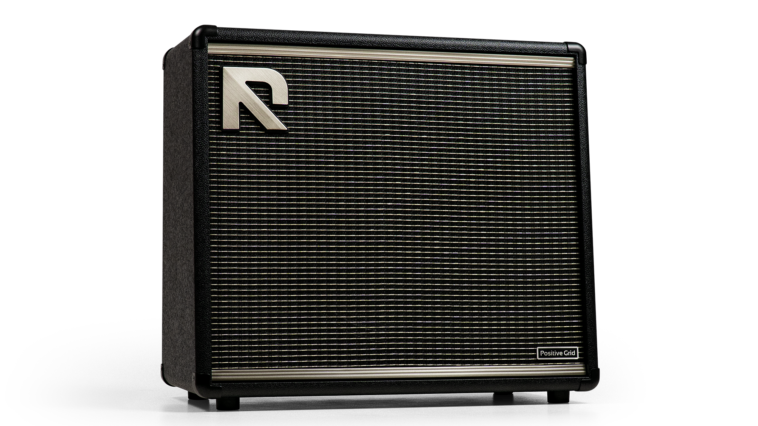
The new Reactor 50 is the latest addition to the company’s amp line, a 50-watt, 1×12 combo with comprehensive features and a stunningly low price. Add in the optional six-button, multi-function Reactor Control ($149) and its versatility increases considerably.
While the bundled effects-amp-cab-emulation package is a pretty familiar format by now, Reactor 50 also takes the tone-chasing challenge right into the AI race with the accompanying phone app. It allows rig tweaking and preset juggling within its proprietary Amp Intelligence modeling engine, as well as ground-up creation of prompt-driven amp design and even the ability to generate entire rigs.
But we’re getting ahead of ourselves, so let’s dig into the basic features and functions before going virtual.
Following the single input at the left of the front panel, Reactor 50’s controls include a six-position amp category selector, two mode switches for Push and Heat, traditional controls for gain, bass, middle, treble, master, and an overall volume control. Between the latter two sits a level control and six pushbuttons for dialing in the built-in effects — gate, comp, drive, modulation, delay and reverb — plus a seventh for setting tap tempo.
Swinging back to the left end again, those six basic amp styles include Clean, Warm, Grit, Crunch, Hi-Gain, and Extreme, although several flavors of each are available via the app’s AI functions, and all are further adjustable for gain, saturation and overall dynamic character via the controls and two toggle switches. Above all this sit the pushbuttons for bank switch and select, where you call up one of the eight presets that can be loaded into the amp at any time. A long-press on the former calls up the tuner, and saves parameter adjustments on the latter.

The rear panel includes a USB-C connection for data and audio out, an effects loop send and return, ¼-inch line and 1/8-inch headphone outputs, power amp input, and both five-pin MIDI and ¼-inch Reactor Control inputs. Adding the latter to the package provides foot-ready selection of all six onboard effects, banks, presets, tuner and more, depending on the unit’s mode. The pedal is rechargeable via USB-C and has its own ¼-inch input for an added expression pedal.
With 50 watts of maximum power, the combo is switchable down to 25 watts and 1 watt for more restricted playing situations. The internal Positive Grid-branded 12-inch speaker within the entirely open-backed MDF cab has a relatively small ferrite magnet and is only rated for 50 watts itself, so the company might not be expecting you to push it too hard. Weighing in at 24 pounds, the amp is an easy carry.

Moving beyond all the hardware to the Reactor app is where we find things getting particularly clever. It has sections for Tone, Creator Hub, Tone Cloud and Settings. Tone is where you’ll likely spend most of your time, as it carries the virtual access to control settings for all parts of your signal chain and facilities for saving and arranging presets. Creator Hub is home base to the AI-fueled tone-creation engine, and it provides four ways to get there: by describing your desired tone in words, uploading a photo that represents it, uploading or recording a song, or adjusting current presets with the Fix My Tone option, which allows you to describe what’s not working and have the app suggest and apply adjustments.
In addition, Reactor app 1.2.0 introduces a Tone View feature that lets users select how amps and presets are presented visually. The new Classic View presents gear with a familiar, true-to-life look, while Expressive View offers an artistic, mood-driven take on your gear.

The photo upload option can generate a rig not only from gear-related images but from any photo you load into it — from a pastoral scene to one that’s aggressive or foreboding. While the app can cobble together rigs from traditional amp and effects elements, it can also create a custom amp out of the ether by following your prompts, so there’s no real limit on the variety of sounds that can be dialed up here. And of course, new amps generated in this fashion can be adjusted with further prompts, or by dialing in on the Tone page or the amp itself once it’s loaded in.
Tested with a Fender Telecaster and a Gibson ES-335, the entire Reactor system unveiled a mind-boggling variety of sounds. Suffice it to say, you can generate Reactor’s own representation of traditional guitar tones — from clean to extreme — with relative ease, or shred the blueprints and generate new originals of your own, all with a bevy of effects slathered on top if you desire. And while the results won’t rival boutique tube amps or pricier market leaders in the modeling sector, the quality is very good.
On the whole, I found it easier to dial in convincing and enjoyable tones from crunch to high gain than I did from clean to edge-of-breakup tones. That’s not to say those weren’t available — and pretty decent when adjusted to taste — but for my own playing style and likely uses they just delivered a little less veracity. That said, for an amp clearly aimed at the home player, casual DIY recordist and occasional small-gig guitarist, the Reactor 50 offers a bundle of usable amp and effects sounds, with a dizzying number of options waiting to be tweaked to taste or created from scratch once you start applying the AI functions.
Speaking of which, the app does handle that extremely well, and relatively easily. Any results that weren’t quite there on the first attempt were easily tweaked on the second. As for functionality, hardware and app alike are simple and intuitive to use with a heavy emphasis on WYSIWYG control interfaces, virtual or actual.

The added Reactor Control helps immensely in live use, though it may be a big extra bite for beginners just entering the market. I’d like to have seen at least some basic, passive two-button footswitch for Rhythm/Lead selection and maybe FX on/off included, but Reactor Control is there if and when you can throw some extra cash at the package.
Taken as it is, then, and considering its target audience, the Reactor 50 is an extremely impressive bundle of tone creation and generation for the money.
SPECIFICATIONS
CONTACT positivegrid.com
PRICE Reactor 50, $349 street. Reactor Control, $149 street
CONTROLS Amp selector, Push and Heat switches, gain, bass, middle, treble, master, volume, FX level, pushbuttons for FX selectors, tap button, preset and bank/tuner
CONNECTIVITY USB-C, FX loop send and return, ¼-inch line and 1/8-inch headphone outs, power amp in, five-pin MIDI, ¼-inch Reactor Control input
WEIGHT 24 lbs
BUILT Vietnam
PRO An impressive and even mind-boggling array of tone creation available from an extremely affordable modeling combo and clever accompanying app.
CON Sonic veracity is inevitably limited by the quality of the hardware, but is good for the price.