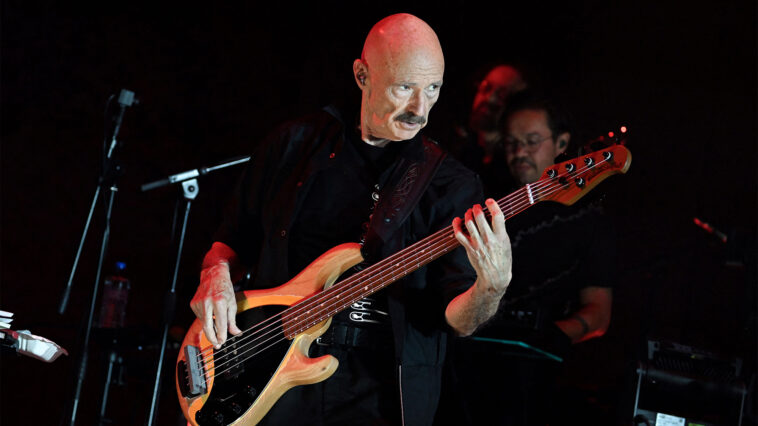
When he considers the musicians he’s worked with — and the guitar players in particular — Tony Levin’s outlook is simple.
“It’s a lot of, ‘How lucky am I?’” the bassist and Chapman Stick specialist tells us via Zoom.
Skill has more to do with it, of course. The Boston-born Levin started studying bass at 10, later learning tuba and even starting a barbershop quartet. He was classically educated at the Eastman School of Music in Rochester, New York, and played in the Rochester Philharmonic Orchestra. In 1968, he joined drummer and classmate Steve Gadd as the rhythm section for jazz pianist Gap Mangione’s first solo album, Diana in the Autumn Wind.
Fast forward, not too far, and you have Levin playing in bands and becoming a session player for Buddy Rich and Paul Simon, among others. John McLaughlin said Levin was his first choice for Mahavishnu Orchestra, but the bassist was already with Gary Burton, and would then move on to Herbie Mann and, in 1977, began a continuing association with Peter Gabriel.
Levin joined King Crimson in 1980, the same year he played on John Lennon and Yoko Ono’s Double Fantasy album, and he’s amassed a wealth of credits that includes 1987’s A Momentary Lapse of Reason — Pink Floyd’s first album without Roger Waters — and his own Stick Men trio with Crimson bandmate Pat Mastelotto and Markus Reuter.
“I’m always learning from the different players I play with,” says Levin, who released a new Stick Men album, the Crimson homage Let’s THRAK Again, during September and is currently preparing for another North American tour with the Crimson spin-off Beat, with Adrian Belew and Steve Vai and new drummer Terry Bozzio.
With that in mind, we asked Levin to comment on some of his most significant collaborations with those on the guitar side of the stage.
Robert Fripp
“I met him in July of 1976, doing an album with this young guy, Peter Gabriel, who had left the band Genesis. Robert was one of two guitars playing on the session. There was also Steve Hunter. I found [Fripp] to be a unique player, very much in his own style with his own sound. I don’t know how he got that sound, but it was not something I had heard before.
“Then [Fripp] came out on tour with us. Interestingly, he insisted on being in the wings. He didn’t want to be onstage; we heard him, but the audience didn’t see him. He was sitting on a stool offstage — so quirky and distinctive and unusual in his ideas about how to perform live, also.

“Then, soon after, he asked me to record with him on the [1979] album Exposure. I didn’t think, Hey, this is like King Crimson, but it was. The tracks were very much in the Crimson vein, so when he called me in ’80 to get together with Bill Bruford and Adrian Belew, I was musically a little bit ready for it, ’cause I’d been exposed to Robert’s music, his composition style and sense of how to play.
“We have a great relationship in respecting each other musically, and consequently he hasn’t really said to me a whole lot about how to play the bass parts of King Crimson. He’ll give hints and he’ll give suggestions of a general idea, but it’s not usually, ‘Hey, I wish you would play this here.’ That’s a nice way to be in a band, where you feel like you’re free to do your own part but you get some direction from the person whose vision the band is.”
Adrian Belew
“I met Adrian back in 1980 when I was called by Robert Fripp to get together with a few guys. It turned out it was an audition, but I didn’t know that. And I heard this extraordinary player who was doing things that nobody else does, period, and making sounds that nobody else makes. That’s extraordinary on the guitar.
“Adrian does a number of things super-well — writes songs, sings, performs. He’s an artist, too, a graphic artist. But his guitar playing is extraordinary.

“He’s just different from anybody else. I think he surprises himself a little bit with the sounds he comes up with and turns and looks at his amps. It’s also changed through the years, his grasp of the pedals and the effects in order to use them for the reasons he wants and to get the sounds he wants — to get an elephant screeching and animal sounds. To get that he really has to have command of the pedals and the effects, and he’s great at that.
“As a performer he evinces his joy in doing that, in playing his guitar, a little bit like a kid in the sandbox but with the technique of an adult who has worked on it a lot. So he’s unique and wonderful to play with, wonderful to be onstage with — and I oughta know, because it’s been decades now we’ve been playing together.”
Steve Vai
“I had heard him but I hadn’t played with him until 2024, when we rehearsed for Beat. He had the unique challenge of not only covering Robert Fripp’s parts for the music of Beat but also still being Steve Vai, and not just being a cover band of Robert. That’s a lot to take on, and he did it extremely well — and still does. He gives it his own flavor; he varies it some and goes away from the basic parts a little bit. But he still gives us the feeling of those basic parts.

“That’s not really easy, and I ought to know as a guy who, in King Crimson, has played the iconic bass parts of some players in King Crimson from before my time in the band. It’s not easy. It’s a challenge, in addition to the challenge of trying to come up with your own parts on the instrument.
“I was aware Steve had talked to Robert before. I guess he had a good relationship with [Fripp] before we started touring in Beat. I know Robert is very pleased with Beat. He comes and hears us once in a while, and consequently he must be pleased with what Steve’s doing.”
David Gilmour
“I found him to be a great guy. I hadn’t been able to do the A Momentary Lapse of Reason tour, but there was a time later in the same year [1988] when I was in New York doing a Les Paul tribute show; I was kind of the house bass player, playing with all these guitar players coming in and playing their Les Paul guitars, which was wonderful.

“The producers of this show came to me and said, ‘We’re short an artist or two. Would you mind asking David Gilmour if he would come in and play this show that’s two days from now?’ And they gave me the Pink Floyd management phone number and I said, ‘Okay, I’ll try.’
“I called management and five minutes later David Gilmour called me; I explained the situation and said, ‘I’ll put you in touch with the management of this show.’ And he said, ‘Oh, no, I’ll be there,’ and he was. He left the Pink Floyd tour ’cause this guy, Tony Levin, said there’s this Les Paul tribute show, and he came to Brooklyn on his own and joined us backstage and played a song or two, which is the kind of guy he is.”
Paul Simon

“I can’t remember ever, on the road or in the studio, hearing him make a mistake on the guitar. I noticed in my time with him that he was studying, that he was learning different chords and different ways to write his songs. That’s pretty impressive when you consider he was already very successful and well-known for writing the style of chords he did. He came out of folk, and he went into kind of learning… what seemed to me jazz chords, and not playing in a jazz way but expanding his harmonic background of the pieces.
“He was really fun to play with. You can only imagine being in the studio with him when he brings in a new song and you’re hearing lyrics that could become part of the idiom of our language. How special is that?”
John Lennon
“I can’t find the word to describe it, but we all know the way he plays. We all have a big history of hearing that style of guitar playing — and yes, he was doing it [during the Double Fantasy sessions]. He brought in these songs that he had worked out, so he had his parts and was very active producing the parts the others of us played.

“He was playing without thinking about his part because he was listening to the others and making suggestions about those. It’s a terrific technique to be able to do that and not even think about his own guitar parts. They’re distinctive. They’re really special, and they are the songs.
“But I wasn’t thinking, ‘Oh, that’s John doing John, and doing that.’ I was just reacting musically to it. I was just very happy to be the guy who was there. I was aware there were many, many bass players who could have done a great job on that album, on those songs.”