When Yes first exploded into the public consciousness back in the early 1970s, the monicker of ‘prog rock’ seemed to spawn almost entirely around their conceptually dense, instrumental-heavy arrangements.
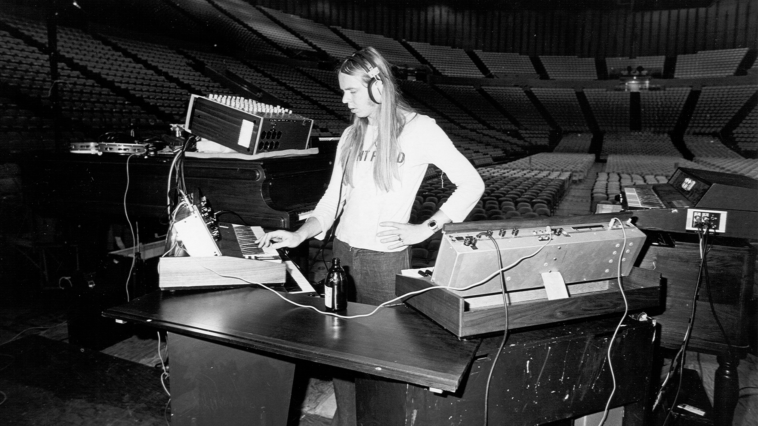
The band’s keyboard wizard, Rick Wakeman became one of the most well-known demonstrators of the abilities of the synthesizer – proving its worth as a viable rock instrument, years before Kraftwerk and their ilk reframed electronic music as the icy harbinger of a mechanised future.
For Wakeman, the synth was tantamount to a portal to myriad other dimensions, a multihued expressive tool that could bring even the group’s most eccentric ideas to life.
“When you’re making music, you are automatically limited by what you’re able to create,” Rick told us in an interview we conducted with the great prog overlord in 2020, “But [you’re] also limited by what your imagination can conjure up. Does that make sense? It’s a bit like an artist saying, ‘I’m going to paint a picture with a colour blue that hasn’t been invented yet’. If you don’t know what that blue is and there’s no way of getting hold of it, you can’t really paint with it. Getting hold of the Minimoog in 1971 was like finding that colour blue. As well as reds, purples and millions of other colours you’d never thought possible.”
After years as a seasoned session keys-man, Wakeman reflected back on when he finally got his hands on that first synth, and shared how it unlocked new avenues of sonic exploration.
But using – and even getting hold of – a Moog synth was in no way a straightforward affair…
“Up until the late-’60s, I’d been making music on a piano, a Hammond and a couple of electric pianos,” explained Wakeman. “If I needed a weird noise, I’d stick the Hammond through a guitar pedal. Bob Moog had already started making synths, but the first time I really took notice was when Wendy Carlos released the Switched-On Bach album in 1968. Classical music played on a Moog Modular. Mind-blowing!
“But the Moog wasn’t cheap, with systems costing anything up to 4,000 quid,” remembered Rick. “Even when Moog released the Minimoog in 1970 – generally recognised as the first ‘affordable’ musician’s synth – it was way beyond the reach of ordinary folk. At £1,000, it would set you back more than a brand-new Ford Cortina.
“I eventually managed to get my hands on a Minimoog, and it was a complete game-changer,” said Wakeman. “As musicians, we were desperate for new sounds… new ways to experiment. This was our time!”
The Minimoog was a solid starting point and Wakeman’s further synth-buying exploits lead to him procuring an incalculable number of additional machines…
“God knows how many I’ve owned over the years. I don’t think I could even hazard a guess. It’d be well into the hundreds. The current collection has been trimmed down a bit. Including all the ones in storage, I reckon it’s about 50 or 60. Maybe more. But who’s counting? They’ve all put a smile on my face.”

As well as sharing his top five synths of all time in our interview, Rick also pondered whether the genre of prog itself would even have evolved if the synth hadn’t been on-hand to suggest new possibilities…
“Would prog music have happened without the synth? I’m not sure it would. But it wasn’t just prog that was affected. Pop, jazz, punk and new romantic. Electronic music, of course. Even classical… eventually. The effects were felt everywhere.”