You can trust Guitar World
Our expert reviewers spend hours testing and comparing guitar products so you can choose the best for you. Find out more about how we test.
What is it?
The Boss RC-600 Loop Station is the company’s most advanced floor-based looper pedal. It’s a product I have plenty of experience with, as well as its predecessor, the RC-300. Working in a guitar store, the RC-300 was probably the most requested demo product, as artists like Ed Sheeran and KT Tunstall dominated the airwaves with catchy loop-based tracks that made the technique look easy.
Looping has had a long journey from the avant-garde experimentation of Brian Eno and Robert Fripp’s analog tape reels, otherwise known as “Frippertronics”. DigiTech brought looping to the floor in the 1980s with its PDS series, while brands like Line 6 incorporated looping functionality into products like the DL4 in 2000. A year later, Boss released a product that would launch a range that eventually became the gold (or red) standard of looping pedals: the Boss Loop Station RC-20.
The RC-20 helped establish Boss as a dominant force in looping, and there have been many iterations since. Today, the Loop Station series offers everything from simple loop sketch pads like the RC-1 to the beatboxing-friendly RC-505MKII, right up to the flagship model that is the subject of my review today: the RC-600.
Latest Videos FromGuitar World
Launched in 2021, the RC-600 built on over two decades of looping innovation since the RC-20, becoming a go-to choice for guitarists seeking the most feature-packed floor unit available. There have been a few changes since the RC-600’s predecessor, including the removal of the built-in expression pedal, an increase from three tracks to six, and a jump to around 13 hours of total recording time across all memories, to name but a few.
The flagship Loop Station now faces competition from an increasing number of pedal brands, including Sheeran’s Looper X, the Singular Sound Aeros Loop Studio and Headrush’s Flex Prime. Does the RC-600 remain the cream of the crop? That’s what we’re going to find out.
Specs
- Price: $659 | £499 | €496
- Made: Malaysia
- Type: Floor-Based Looping Station
- Controls: 3x Record/Pay footswitch, 3x Stop footswitch, Track Select footswitch, Undo/Redo footswitch, All Start/Stop footswitch, Output Level knob, 4 LCD screen control knobs, 7x buttons (Menu, Loop, Rhythm, Tap Tempo, Enter, Exit, Page)
- Features: 6 stereo tracks, 200 rhythm types, 16 rhythm kits, 49 input effects, 53 track effects, 2 master effects, 99 memory channels, Graphic LCD display, 32-bit AD/DA conversion, 44.1 kHz sampling frequency
- Connectivity: 2x XLR inputs w/ DC 48V phantom power (10 mA max), 4x ¼” TS instrument inputs (2x stereo pairs), 2x ¼” TS main outputs (1x stereo pair), 4x ¼” TS sub outputs (2x stereo pairs), 1x ¼” TRS headphones output, 2x ¼” TRS expression/control inputs, MIDI in + out, DC power jack in, USB-B port
- Power: 9V DC center-negative, 1.2 A (with phantom power), 1.1 A (without phantom power), AC adapter included
- Dimensions: 435 mm x 163 mm x 66 mm
- Weight: 2.5kg/5lbs 8oz
- Contact: Boss
Build quality
Build quality rating: ★★★★½
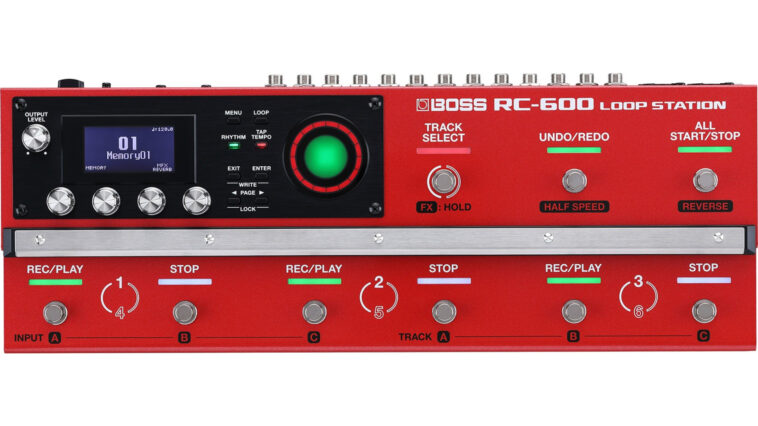
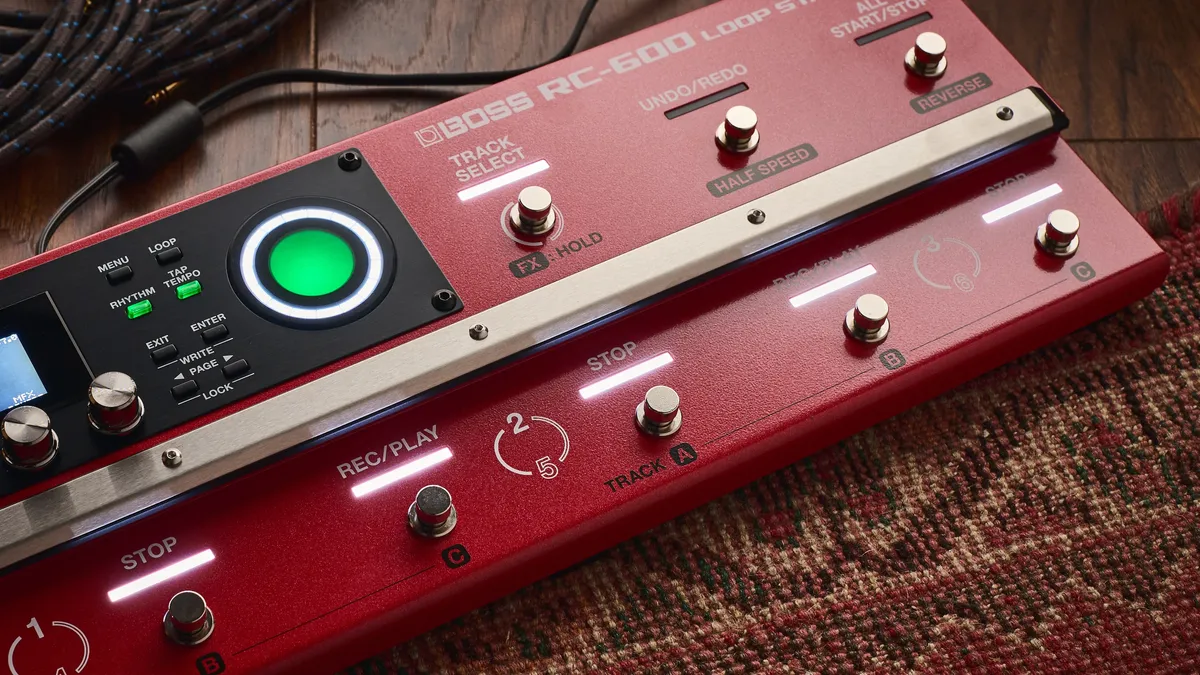
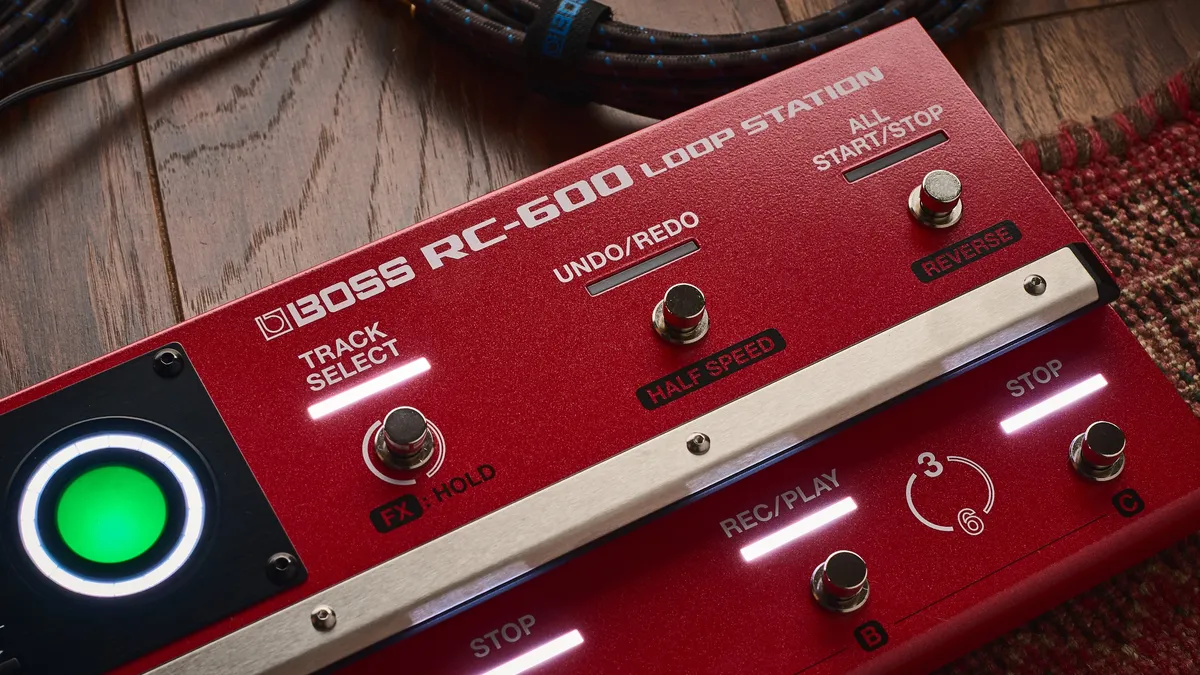
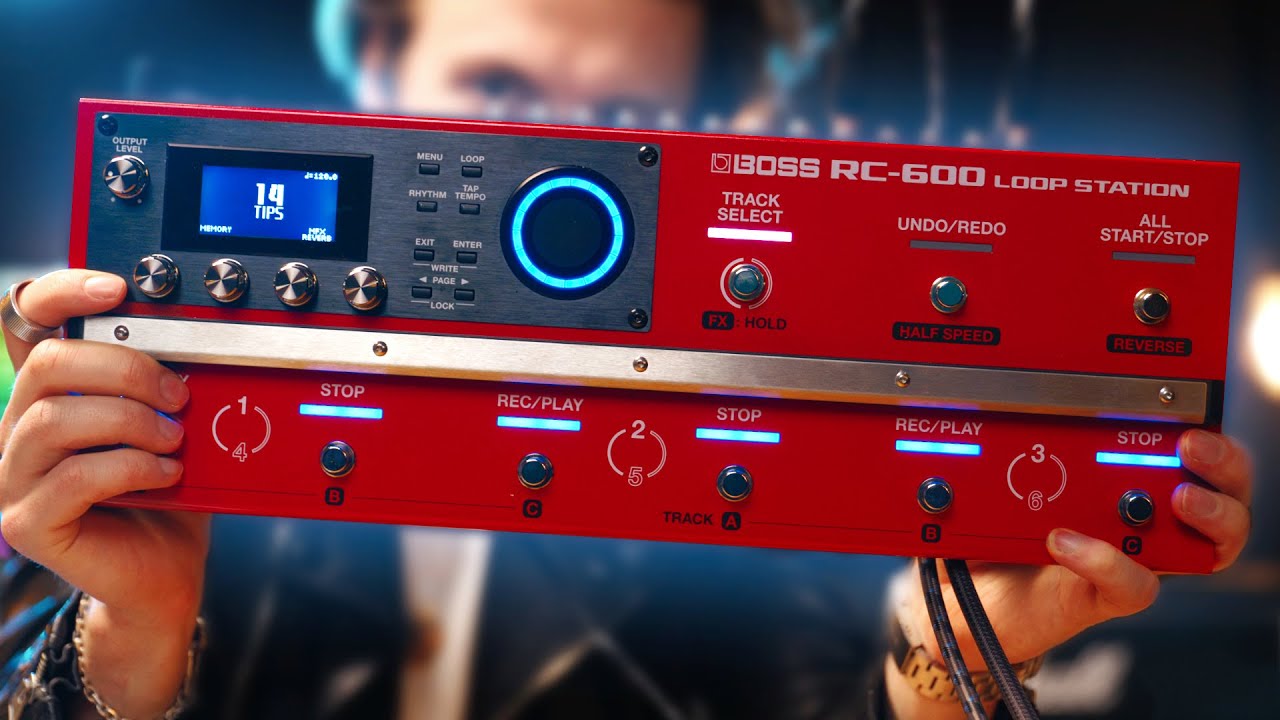
The change in size from the RC-300 to the RC-600 is quite astonishing; it’s around 4 inches narrower and 3 lbs lighter. The RC-600 has three rec/play switches and three stop switches, with a track select switch allowing you to switch between tracks 1 to 3 and 4 to 6. Gone are the trigger latches, replaced by smaller metallic footswitches. The switches, whether rec/play, stop, or track select, all press reassuringly on my demo model and have a soft click.
However, in an attempt to save space, the switch surfaces are small, and I find them a little fiddly to hit accurately. On a looper where timing is imperative, this could prove frustrating during a live performance. If I were to keep this in the long run, I’d invest in some footswitch toppers to expand the surface area and make accurate tapping easier.
The metal chassis of the RC-600 feels incredibly durable. It feels premium straight out of the box, and if you’re planning on using this for gigging, I wouldn’t worry about its ability to survive the rigors of the road. Gone, too, is the expression pedal of its predecessor. Now, if you want to use an expression or control pedal, you’ll need to connect an external one to the appropriate input.
It’s easy to read on a dark stage, straightforward to use, and isn’t cluttered
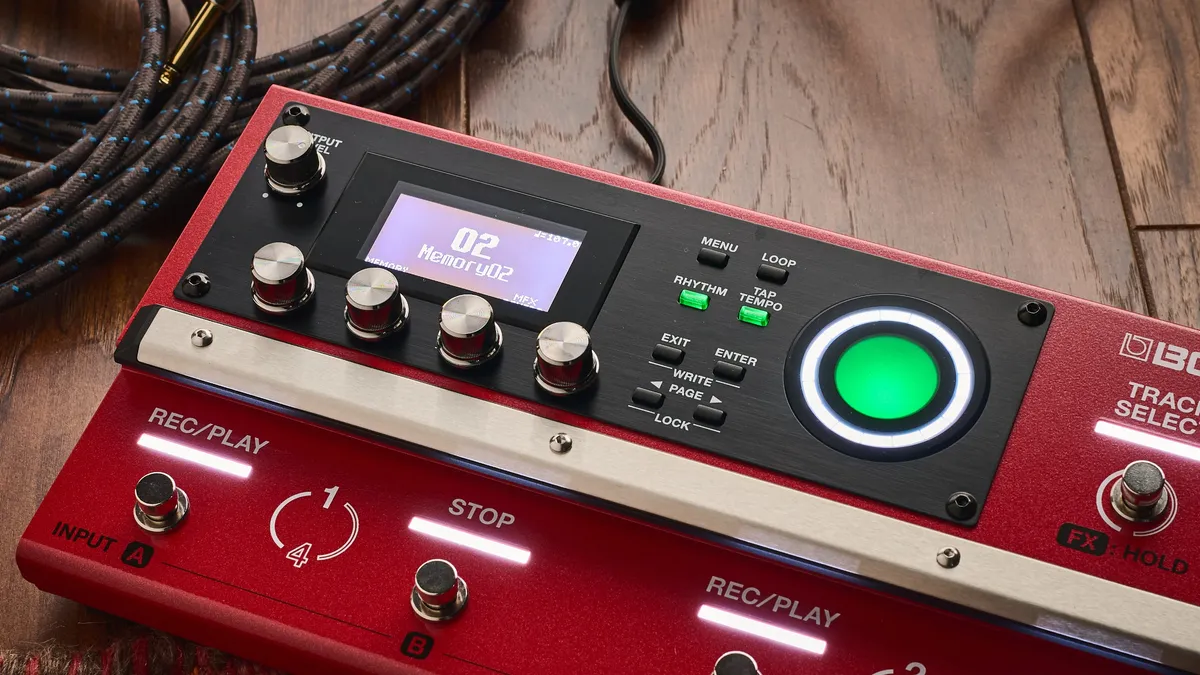
On the left side of the RC-600, you’ll find a backlit graphic LCD screen. It’s easy to read on a dark stage, straightforward to use, and isn’t cluttered with unnecessary options. Underneath, there are four continuous rotary knobs that let you select different settings when pressed, change effect parameters, and toggle between options.
Each knob is pleasingly weighted and allows for controlled menu diving without getting frustrated. The device itself is naturally angled, with a raised section for the top controls.
Around the back, you’ll find the impressive connectivity options. The chassis-mounted 1/4-inch jacks are all incredibly sturdy. This feels like a small feature, but when you’re running multiple cables between expression pedals, instruments, and other devices, a secure connection is paramount.
The only downside to the connection options, for me, is the power. In terms of build, the RC-600 is certainly gig-worthy, but the AC adapter cable lets it down. I’d prefer a more robust IEC connection, which is much more widely available at venues.
Usability and features
Usability and features rating: ★★★★½
I’m greeted by dazzling lights of many different colors
Switching the RC-600 on for the first time, I’m greeted by dazzling lights of many different colors. Didn’t Dolly Parton sing about that? Anyway, you’ll quickly realise that the light show is more than a pretty feature. In fact, as the user, you depend heavily on the colors, which indicate many different things.
For example, the track select button starts with a solid white light, indicating that tracks 1, 2 and 3 are selected. When track select is red, you’ve got access to tracks 4, 5 and 6. Holding the track select button switches the controls over to the effects, turning the indicator blue.
The effects are split between input effects, where you get 49 different types, from flangers and phasers to pitch bends and robot voices. Input FX affects your incoming signal, and when you record with an effect applied, that effect becomes part of the audio playback.
This is a minor gripe of mine, as I can’t simply remove the effect from the audio once it’s been recorded. Although the input effects are split into A, B and C for footswitch control, I can actually have four different effects available at once, with effect D requiring access through the screen or an external footswitch.
On the right-hand side are the track effect controls, also split into A, B and C, with option D selectable through the menu. These effects color the playback of your recorded tracks and include things like slicers, beat scatter, and vinyl flicks. If I’m honest, I don’t really get much use out of these. I struggle to find much use for them as a guitarist or singer-songwriter, but they’re there to experiment with if you’re feeling funky.
Although you’d imagine the LCD screen being the main visual cue, it’s actually the cycloptic, circular indicator to the right of it that I find most helpful. This can be found, albeit in a simpler form, on more affordable models like the RC-1. The circle moves to show the loop’s position, helping you keep track of where you are without constantly looking at the screen. When recording, a rotating red border makes it clear what’s happening. When the track is playing, this border turns green and moves around until the loop reaches its end.

There’s no denying that Boss has created a device that could easily be complicated, but it’s laid out intuitively with clever color coding. However, nailing the timing when stopping a loop so it flows perfectly can be tricky. Diving into the menu and activating quantization is a real eureka moment. This is a fantastic feature that helps snap your loop to the correct measure, and it’s something I recommend using.
Every time I use a Loop Station, I keep things fairly simple. After getting to grips with everything, I start layering a track with A, B, and C sections in the style of Prince’s “When You Were Mine.” I use the octave effect on the Boss RC-600 to create a bass part with my Gibson SG Standard, monitoring through Logic Pro with a Neural DSP plugin. On top of that, I play the song’s chord progression.
On track 2, I record the lead line, bringing it in and taking it out when needed. The B section, which I recorded on track 3, was the chorus, while part C, or the bridge, used tracks 4 and 5, applying similar techniques. Of course, this is just scratching the surface of what the RC-600 can do.
Building the arrangement this way also highlights the benefit of having six tracks available. I can dedicate separate tracks to the bass, lead, and additional parts without having to constantly reuse or overwrite existing loops. For a singer-songwriter building a fuller arrangement from scratch, that extra flexibility is a real advantage over a more basic looper.
While I keep things fairly simple here, you can delve much deeper into its effects and control options to build more elaborate arrangements. This is where the RC-600 can become as complicated as you want it to be, but it also means there’s plenty of room to grow as your looping skills develop.
Spending around an hour layering tracks, getting the timing right and making everything sound great, I got sidetracked peeling the potatoes for tea. I came back to my horror to find the RC-600 had powered down and my work was gone. Nightmare.
I have a look online and find that the RC-600’s auto-off function is designed to shut the unit down after a period of inactivity. However, my review model seems to be powering down much sooner than I expect. I recommend checking the auto-off settings on your own unit and saving your work regularly, so you don’t end up losing an hour’s worth of looping to a potato-related distraction.
Sounds
Sounds rating: ★★★★½
Being the flagship model, I expect top-notch audio quality, and that’s exactly what I get. Boss has upped the AD/DA conversion to 32-bit, alongside 32-bit floating-point processing, and the playback is crystal clear.
I am impressed by how clearly the RC-600 reproduces my layered parts, even as the arrangement becomes busier. I tested playback through my audio interface and Logic Pro, using a Neural DSP plugin, before switching over to my Peavey Classic 30 amplifier. This gave me a chance to hear the loops outside of my computer-monitoring setup and get a better feel for how the layered arrangement translated through a guitar amp.
The octave effect is useful for creating a bass part from my guitar, while the modulation options offer further ways to shape the sound before recording. I’m less drawn to some of the more experimental track effects, which feel better suited to more adventurous loop-based performances than the guitar arrangements I put together.
I would have liked to see more recognizable recreations of Boss’s standalone stompboxes
While these give you plenty to experiment with, I would have liked to see more recognizable recreations of Boss’s standalone stompboxes. Given the brand’s extensive pedal lineup, this feels like an opportunity missed, and something that could have taken the RC-600 to the next level.
I also barely notice any lag. My setup involved monitoring through Logic Pro via an audio interface, and I was skeptical about how well it would function as even the smallest amount of latency can throw things off musically. However, it performed admirably and was pleasingly responsive. I experience the same immediate response when switching over to my Peavey Classic 30, and have no complaints about the playback feel when interacting with the loops.
Verdict

The RC-600 offers a huge amount of creative potential
The Boss RC-600 is a seriously capable piece of kit, and it’s easy to see why it sits at the top of the Loop Station range. The audio quality is excellent, playback remains clear as you layer tracks, and the six-track setup gives you plenty of room to build arrangements. I also found the interface more intuitive than its cockpit-like appearance suggests, with the color-coded controls and visual loop indicators helping you stay on top of what’s happening.
However, it’s not without its frustrations. The footswitches are small and can be fiddly to hit accurately, which isn’t ideal when timing is everything. The onboard effects are useful, but I would have liked to see more recognizable recreations of Boss’s standalone pedals. The Auto Off experience on my review unit was another unwelcome surprise, so I’d recommend checking the settings and saving your work regularly.
For guitarists and singer-songwriters who want to build elaborate live arrangements, the RC-600 offers a huge amount of creative potential. Beginners may find its deeper features take time to master, and those who mainly want to sketch out simple ideas could be better served by a more straightforward looper. But if you’re willing to explore what it can do, there’s a lot to get excited about.
Guitar World verdict: The Boss RC-600 is a powerful looping station for guitarists who want to build elaborate arrangements, with six tracks, extensive connectivity, and a flexible recording workflow. The small footswitches take some getting used to, and not every effect inspired me, but its creative potential makes it a compelling choice for players who have outgrown simpler loopers.
|
Test |
Results |
Score |
|---|---|---|
|
Build quality |
A sturdy metal chassis, solid connections, and a premium feel |
★★★★½ |
|
Usability and features |
Intuitive color coding and helpful loop indicators make the basics approachable |
★★★★½ |
|
Sounds |
Crystal-clear layered playback and pleasingly responsive performance impress |
★★★★½ |
|
Overall |
A powerful, versatile flagship looper with excellent audio quality and plenty of creative depth |
★★★★½ |
Also try
Hands-on videos
Ben Rowlands Music
The Loop Academy
Devan Bishop