

An essential part of my approach to guitar playing is the incorporation of chordal sounds, melody and harmony that I’ve picked up from listening to jazz and classical music, as well as gospel.
Utilizing elements of these rich musical traditions offers one such a wide range of sounds and emotions that you don’t usually find in blues and provides access to some of the most beautiful sounds and harmonies that can be discovered.
I learned a lot about creating new and unique chordal sounds on the guitar from listening to keyboard players. As is always the case, I let the muse guide me and try to maintain an open mind as to what I can discover harmonically while in the midst of improvisation.
Latest Videos FromGuitar World
In Figure 1, I begin by sounding my open A string as a pedal tone and then play sliding 3rd intervals, first on the G and B strings then on the D and G strings. I then shift to the bVI (flat six major) chord, F(6/9), followed by a low C/F, making use of my open D and G strings.
The line in bar 3 is based on the A natural minor scale, also known as the A Aeolian mode (A, B, C, D, E, F, G), followed in bar 4 with a shift to the more classical-sounding A harmonic minor scale (A, B, C, D, E, F, G#). Some of the notes of A harmonic minor can be played as a diminished 7 arpeggio superimposed over E7b9 (E, G#, B, D, F), with the notes G#, B, D and F. The figure ends with the chordal resolution of E7b9 to Am7add4.
I should remind you that I play the guitar “upside down”; in other words, I take a guitar strung for a right-handed player and play it left-handed, so the order of the strings is reversed, with the high E string closest to the ceiling, and the low E string closest to the floor). Additionally, I tune down a half step (low to high: Eb, Ab, Db, Gb, Bb, Eb).
Playing with the strings ‘flipped over” like this allows for some chord voicings that may feel a little awkward and unnatural with the guitar strung and played in a conventional manner. The Am7add4 that ends Figure 1 is a prime example, because, for me, I can fret my high E and B strings with my thumb, as others sometimes do with their low strings.
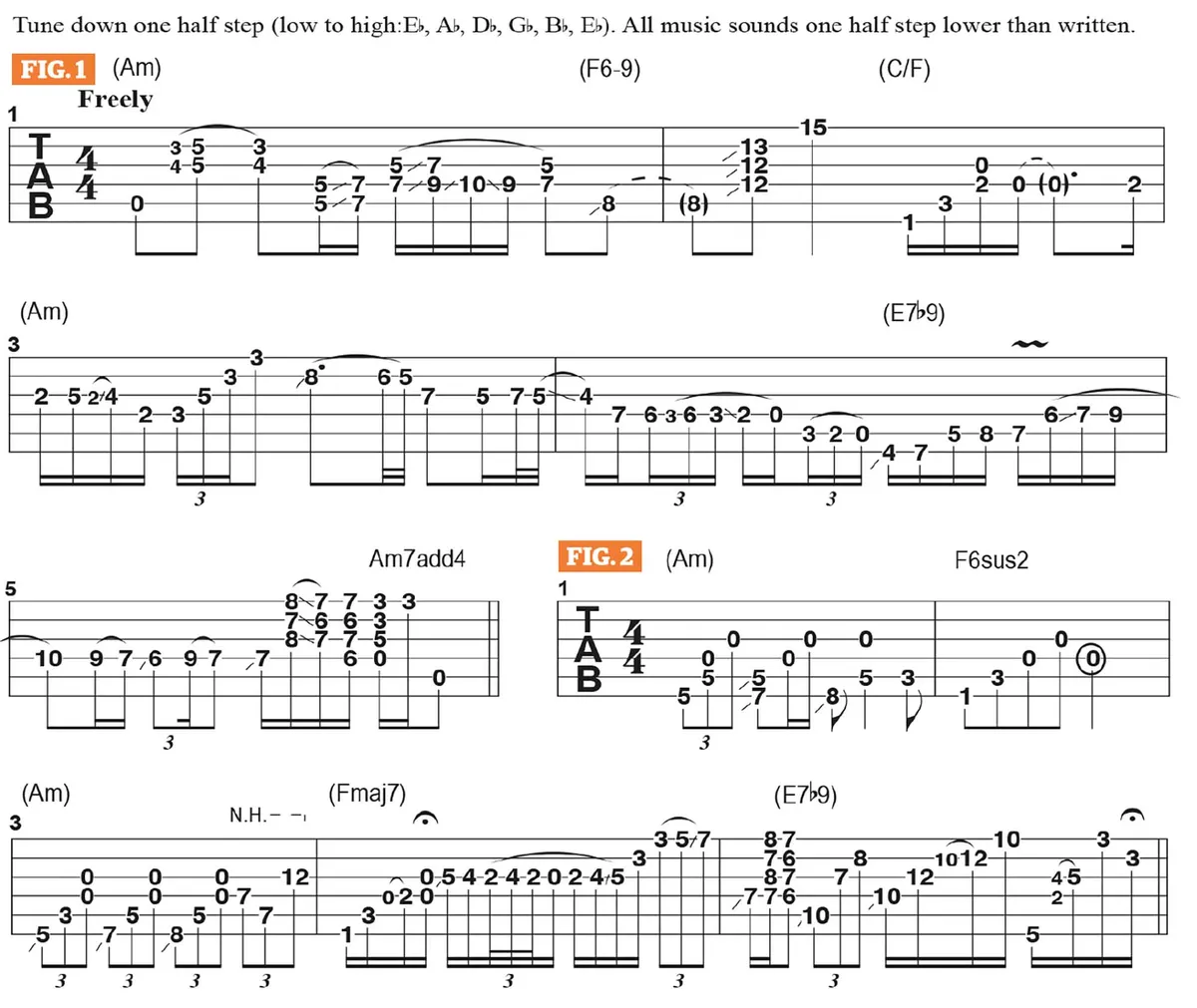
Figure 2 offers another example of different ways to move between the tonalities of Am and F. Notice the use of ringing open strings in bars 1-3.
At the end of bar 3, I use natural harmonics (N.H.) on the A, D and G strings as a transition point between Am and Fmaj7. In bar 5, I bring in E7b9 once again as a transition chord to resolve back to Am7sus4.

You can also melodically describe the wider harmony of these chords using only single notes.
In Figure 3, the lines in bars 1 and 2 are based on A natural minor. In bars 3 and 4, I shift to a bluesier sound with fast descending phrases based on A minor pentatonic (A, C, D, E, G), phrased in groups of five and six, wrapping up with a return to Fmaj7sus2.