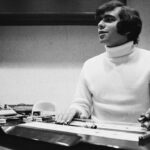

Recently, we were saddened to learn of the loss of a giant figure in guitar electronics, not to mention an unforgettable character who preferred to bill himself as a ‘tone explorer’ or ‘sonic alchemist’, rather than a sober-minded engineer.
“Alan Entwistle – our fearless leader, innovator, guitar and pickup designer, historian, joker, vivid imaginer and very dear friend – has left us,” read the moving Instagram post from James Davies, Entwistle Pickups brand manager and close friend of 35 years. “He really was an amazing person who always lifted any room he entered with his jovial manner and quirky sense of humour.”
Speaking to us last year, Entwistle had sharp memories of the instrument that set him on his path.
Latest Videos FromGuitar World
“The Höfner Galaxie was the first decent guitar I bought. I didn’t have Fender Strat money in my wallet! I went into Reidys in Blackburn – it must have been in 1965 – and they had all sorts of stuff, Voxes, Strats, Shaftesbury… and there was this Galaxie sat there. It was really nice, clean and, of course, it was red!
“It looked the business and it was on sale for 55 guineas, so I took it on a two-year hire purchase agreement. I really got into it; it had lots of sounds, different tones.”
As an art school graduate with a knack for wrangling electric setups, by the late ’60s, Entwistle was much in demand as a repairman to the blues-boom generation.
But he announced his talent for electronics early on – one formative project combined his father’s stereo with a microphone ‘borrowed’ from a public telephone – and rapidly gained a reputation for both his own guitars built from the ground up and the head-turning pickups within them, soon to become highly prized on the aftermarket scene.
Entwistle’s abiding love was for the classic tones of the ’60s (he cited Höfner, Framus, Klira, Vox, Mosrite and Burns). But while his retro-modern pickups caught that same vintage character, he also forged ahead with a series of innovative variable tone devices, most notably the ATN 5 and ATN Tone Shaper.
“Think of the ATN as a ‘global’ control,” suggested Guitarist’s Dave Burrluck of the passive-circuit rotary control that Entwistle developed in the mid-80s as an evolution of the Gibson Varitone, “that filters and thins the sound progressively as you move through the positions.”

Featured on various respected brands – including Vintage, Revelation and Entwistle’s own Rapier line – the ATN gave modern players close control over his own idiosyncratic pickups.
“It’s quite subtle, but it does become more dramatic if you back off your volume control slightly,” he observed. “So if you select bridge and middle, and move the ATN back anti-clockwise one or two positions, it begins to sound like an electro-acoustic and can get very jangly.”
Despite the long hours that went into these technological advances, Entwistle was adamant his products should remain within the budget of everyday players.
“Alan never saw the advantage in making unaffordable guitars only available to the few,” noted the tribute on the Entwistle Pickups website, “as he knew it was possible to produce great products at a much lower cost. This extended to his pickups, where he had no interest in hand-making boutique pickups at astronomical prices, when a well-designed, well-made factory pickup sounded just as good.”
Celebrated as a great British designer, Entwistle nonetheless spent much of his life and career in Eastern Asia and the Southern Hemisphere (where he moved in the late ’70s).
Sadly, in February 2026, a desperate GoFundMe appeal announced that the veteran designer was in intensive care in China, having suffered a recurrence of the brain tumour he had bravely fought a year earlier, and facing crippling medical bills.
The end came on 30 April, yet there is no doubting Entwistle’s legacy as an all-time electronics visionary, who buzzed with ideas until the very end.
“Even at nearly 80, he was still creative and highly motivated, looking forward to what his next range of guitars might be,” concluded Davies’ valedictory post.
“Over the last six years, I got to help him develop certain products and learned a wealth of information from him (although probably only a fraction of what he had in his head). I know I will never meet anyone quite like him and that the world is now a sadder place, but I will treasure those times.”