Since launching 15 years ago, Positive Grid has become one of the biggest success stories in the industry. It all began with software products like the JamUp and BIAS line, designed specifically to make studio-quality tones accessible to players everywhere.
A few years later, the company moved into the hardware market with the BIAS head and rack, bringing that tech into the physical world.
But some might say the biggest game-changer came in late 2019 with the arrival of the Spark amp – a revolutionary 40-watt smart desktop workhorse that outperformed its competitors in terms of features, connectibility and ingenuity.
Latest Videos FromGuitar World
Smart Jam, for example, was created to instantly generate authentic bass and drums to accompany guitarists in real time, essentially serving as a virtual band that never keeps you waiting, while Auto Chords was designed to display shapes in real time, allowing users to slow down or loop difficult sections in order to learn.
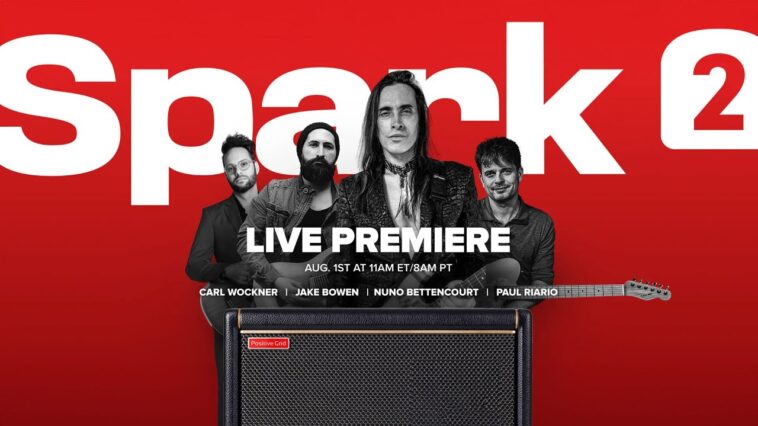
Then came the Spark MINI, the even more downsized Spark GO, the Spark LINK wireless system, plus an array of cabs, footswitches and audio interfaces. For the world premiere of the 50-watt Spark 2 in 2024, hosted by GW’s Paul Riario, Nuno Bettencourt took a central role in sharing his enthusiasm for the new release, describing it as “like taking Madison Square Garden wherever you go.”
Around the same time, Steve Vai, Paul Gilbert and Zakk Wylde were signing up to promote their own signature Sparks, putting stamps of approval on the company’s ingenuity alongside custom presets to nail their iconic tones.
Product Manager Mike Lee and Senior Vice President of Marketing Laura Whitmore tell GW about Positive Grid’s journey so far and what we can expect to see down the road.
What was the mission statement early on?
Laura Whitmore: The idea was to make playing guitar feel effortless. We wanted to remove friction. Traditional gear can be complex and expensive. You usually need a whole rig to get you where you want to go. We saw a chance to change that. It was about packing more features and value into one unit to give players great tone, instant control and tools they’d actually use.
For decades, amps followed a familiar path – better tone, more channels, incremental upgrades. Instead of complicating things, we streamlined the amp concept into something more powerful and immediate – a single product you could fire up for everything from practice to writing sessions. It’s not about adding in features for the sake of it. It’s about those “A-ha!” moments, like when you plug in and instantly find a tone that works.

What was the thinking behind your first products, and what were the challenges in terms of delivery?
Mike Lee: The early products came out of fairly simple observations about what guitar players actually needed. JamUp was a mobile app built around a familiar pedalboard interface.
The goal was to give players something that sounded good, felt natural on a phone or tablet and was approachable enough that you didn’t have to think about it. It worked just as well as a daily practice companion as it did for setting up chains and switching between them on stage.
BIAS built on that by letting players go a step deeper – swap components, adjust the details, design their own amp voicing. For a lot of people, that was the first time amp design felt accessible. You didn’t need a workshop or a collection of vintage heads, just an idea and curiosity.
Who were we making this for? Players like the ones on our team. People who cared about tone but didn’t want the cost, the complexity or the isolation that often came with it. The hardest part was keeping things simple. Real amp modeling, component-level control, a community layer – under the hood, there’s a lot going on. But if it doesn’t feel easy to the player, none of it matters.
Spark took the desktop-amp world by storm. How did you go about creating such a game-changing practice tool?
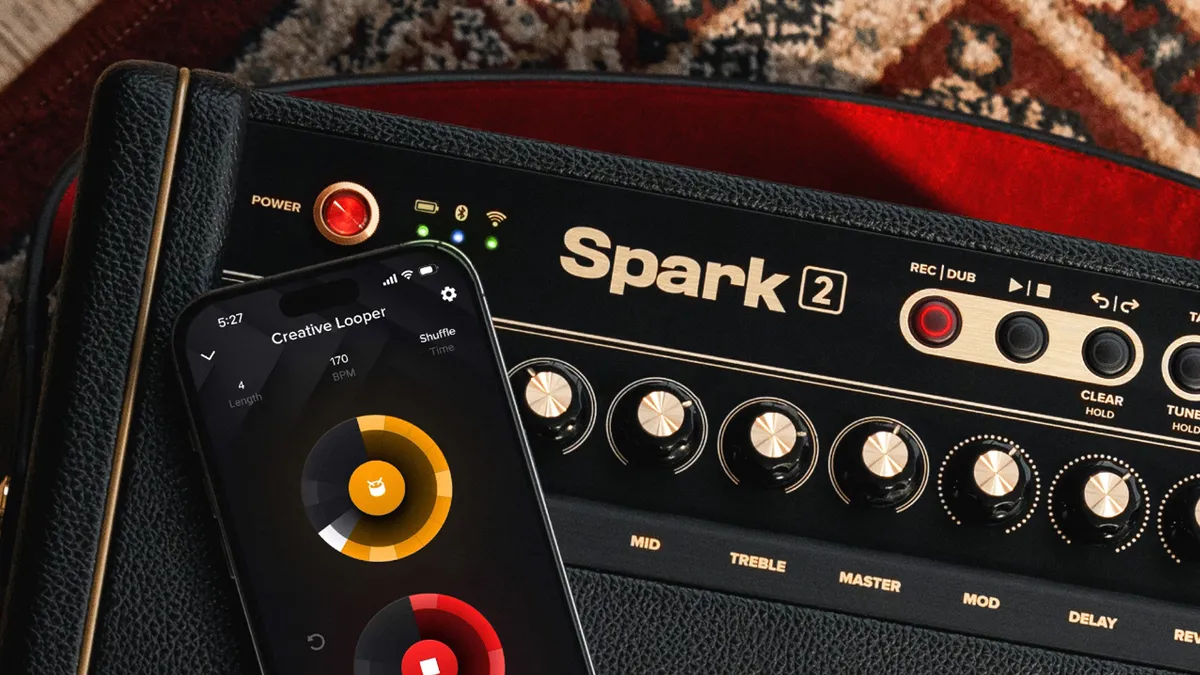
Whitemore: The success of BIAS got us thinking: could we put that software inside a physical product? And that led to Spark. Instead of a traditional practice amp, our team took everything they’d learned about how players work – and the tones they’re after – to build a self-contained product you’d want to plug in and play.
But what really made it fly was the Spark app and its features, like automatic chord recognition, intelligent jamming and seamless tone discovery; players really hadn’t interacted with an amp like that before. It shifted expectations because this was no longer just about sound output. Instead of just dialing in settings, you had a creative tool.
There were moments early on where it wasn’t clear if the idea would fully land, and there were even talks about us going in a different direction. But the positive response from players drove us on. They were using it to get inspired, chase down ideas, freshen up practice sessions and more.

The Spark NEO is the latest addition to the Spark line, including AI features. What did you learn from redeveloping the amps into a headphone format?
We had to rethink driver design and acoustic tuning to recreate that amp-in-the-room feel inside your head, rather than just shrinking a tone into a pair of headphones
Mike Lee
Lee: Spark NEO was one of the more ambitious things we’ve taken on, and it came down to a simple question: could we move the full Spark experience into a pair of headphones? Getting there meant solving three very different kinds of problems at once – the sound, the trust and the feel of wearing them, so that people can put them on and focus on playing.
Our team framed it well early on; the biggest challenge wasn’t the size, it was the physics. An amp moves air in a room. A headphone seals sound against your ear. That difference shaped everything. We had to rethink driver design and acoustic tuning to recreate that amp-in-the-room feel inside your head, rather than just shrinking a tone into a pair of headphones.
NEO was our first product where human ergonomics became a central part of the design. Headphones sit on your head for hours, and we wanted NEO to hold up through real, long practice sessions.

Which of your products has been the bestseller, and why do you think that is?
Whitmore: The original Spark launched during Covid, when people were looking for creative outlets and ways to stay connected. People began to see that amp as a companion, a way to start playing, keep improving and stay active when the rest of the music scene shut down.
Aside from the tone, the built-in smart features and the ToneCloud community made people feel less isolated; they shared videos, traded tones and bounced ideas off each other. Each new Spark product found an audience while staying true to that core idea.
Spark MINI hits a sweet spot. Steve Vai loves it so much he collaborated with us on a signature edition. Spark GO made the whole Spark experience even more portable and accessible.
What names are you most proud to have affiliated with Positive Grid?
Whitmore: The Spark MINI collaborations with Vai, Paul Gilbert and Zakk Wylde were special. When giants like that connect with your work, it shows you’re doing something right.
Beyond formal collaborations, seeing someone like Elliot Easton embrace Spark felt like a huge endorsement. We’ve also worked with Jake Bowen from Periphery, Jeff Loomis and Dustin Davidson from August Burns Red. Nuno Bettencourt played a key role in the launch of Spark 2.

What can we expect from Positive Grid over the next year or so?
Lee: The biggest thing for us right now is Reactor, which we’ve just launched. It’s a combo amp, 50 or 100 watts, and it represents a different way of thinking about tone. What makes it different is the technology inside – we call it Amp Intelligence. It’s a sound engine that doesn’t just model existing amps; it builds tone from scratch based on what the player asks for.
You can describe a sound in your own words, upload a recording or snap a photo of something that inspires you, and the amp builds a complete tone for you in seconds. You also can use it to design amp voices that don’t exist anywhere else and save them as your own.

The question wasn’t “How do we add the latest technology to an amp?” It was “What would an amp look like if it actually understood what a player is trying to create, and how can new technology help them do that?”
That’s the direction we’ve been working toward; Reactor is the first product where it all comes together. What it means for musicians, day to day, is less time fighting with menus or hunting for the right preset, and more time playing. The amp listens to what you want and meets you there.
Would you consider making an all-tube guitar amp, or is that not really an area of concern for PG?
Whitmore: An all-tube amp isn’t in our plans, but, as they say, “never say never!” If we did make an all-tube amp, it’d include a new twist that combines the best of the classic experience with something players haven’t seen. So again, it’s not just about making great gear, but finding new ways to inspire guitarists.