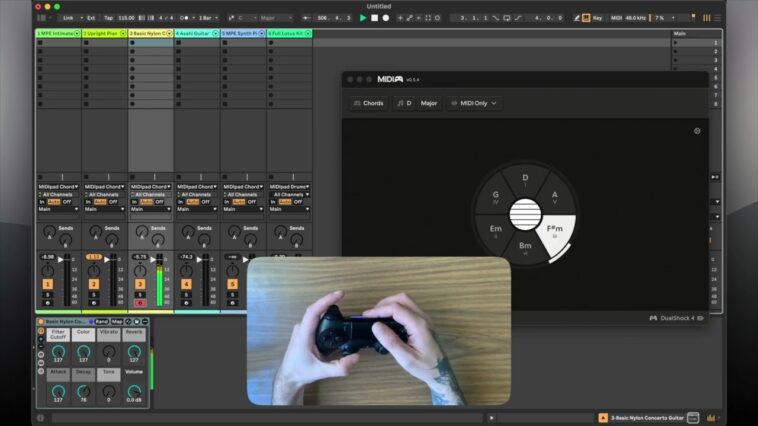
Developer Steve Mitchell has released MIDIpad, a genius app for macOS that turns a PlayStation controller into a musical instrument, working as both an MPE-compatible MIDI controller and a standalone synth and drum machine – and there’s a free version too.
MIDIpad is built around two distinct instruments: Chords is described as a “guitar-like chord machine” and Drums is a “gestural drum machine”. In the Chords mode, the controller’s left stick can be pointed towards one of six chords on a wheel in the centre of its interface, and that chord can be strummed using either the right stick or the touchpad, with the chosen chord laid out vertically across six “strings” in a guitar-style voicing.
The speed of the strum controls the velocity of the notes played, and notes can be sustained by shaking the controller or palm-muted using the left trigger, while dragging horizontally across the touchpad’s X axis shapes the sound’s timbre and dynamics.
Latest Videos FromMusicRadar
By default, the wheel is segmented into six chords – all the diatonic triads from your chosen key except the diminished chord. If you want some harmonic colour, holding the bumper controls opens up a new chord wheel: the right bumper gives you the dominant seventh of each chord from the main wheel, the left bumper flips the quality of the chords from major to minor (or vice versa) and you can access suspensions and extended chords by holding down the left stick.

MIDIpad’s Drums mode turns the controller into a drum machine with a twist. It’s possible to use the right-hand buttons on the face of the controller to trigger four drum hits like a traditional pad controller, but it’s the joysticks that open up a more complex and unusual method of crafting a groove.
Pushing the left stick in any direction triggers a rhythmic sequence, or “stream”, of closed hi-hats, pushing the right stick does the same with a kick drum, and the direction of the push controls the sub-division of your rhythm, from quarter-notes through to thirty-second notes. Push the stick further out to the rim and a snare will sound on the 2 and 4, giving you a backbeat.
There’s a velocity contour applied to each rhythm to stop beats sounding metronomic, and drum patterns can be tweaked even further using the rest of the available controls: you can throw in off-beat hits and snare rolls, drop the whole pattern into half-time, or adjust the velocity shaping.
MIDIpad can be used standalone, and its internal synth engines are based on the open-source code for Mutable Instruments’ Plaits and Braids modules – it’s equipped with twelve preset “voices”, each of which gets three macro controls for timbral shaping, and a selection of drum sounds.
Of course, you can also route MIDIpad out to your DAW to control other instruments via MIDI, and the paid version offers MPE support: each string gets its own MIDI channel, with per-note pressure and timbre, and shaking the controller feeds pressure back into notes that are still ringing to create volume swells. (In the free Demo Mode, Chords is routed over a single MIDI channel.)
Mitchell says he created MIDIpad in response to challenges he faced as a self-taught electronic musician. “I’ve picked up a bunch of music theory concepts over the years via osmosis; I started as a bassist, then picked up guitar, taught myself rudimentary keyboard skills, I can generally noodle around pretty competently but the muscle memory has never quite clicked for me,” reads a post on Mitchell’s blog.
“A lot of the time I’d find myself thinking ‘I want this sound, but I don’t know what it’s called’, so I’d just be blindly putting my fingers on the frets or on the keys until something I liked fell out of the instrument.
What if playing music could work more like playing a video game?
“I wanted to make music without having to lug something bigger than my laptop around with me. MPE also looks super cool! But I can’t afford the very expensive hardware controllers that actually make use of it.”
He continues: “Then one day I found my old PS4 controller collecting dust in a drawer and I had an idea: what if playing music could work more like playing a video game? The word ‘play’ is right there in both of them, after all.”
Turning a gamepad into a MIDI controller isn’t a novel concept, but most previous examples we’ve seen have essentially just mapped a controller’s buttons and joysticks to notes and MIDI CC, which is fun but limited.
MIDIpad is something else, an instrument with its own harmonic and rhythmic logic, and its chord wheel and stick-controlled drum streams are unlike anything we’ve come across before. (Plus, if an MPE controller like the Osmose CE or Push 3 is out of your budget but you have an old PlayStation controller lying around, then it’s a problem solved.)
MIDIpad is a free download and most of its functionality is available in the Demo Mode, but a paid license gives you complete control over routing for audio and MIDI, all twelve voices (the demo has three) and access to more advanced settings. The paid version is currently priced at $19/£16 and also gets you free lifetime updates.
MIDIpad is available now for macOS and is designed to work with Sony DualShock 4 and DualSense PlayStation controllers over USB or Bluetooth. It can be used with controllers for other consoles, but this limits what you can do with it – check out the manual for more details.