Marty Stuart’s enviable collection of historic guitars and country-music memorabilia is rooted in the same deep love for country’s rich legacy that inspires his music. More than a collection of rare instruments, it’s a personal mission to preserve pieces of American musical history before they’re lost forever.
As a boy growing up in Mississippi, Stuart collected autographs, set lists and used guitar picks from country musicians who passed through his hometown. In 1972, at just 14 years old, he joined bluegrass legend Lester Flatt’s band, putting him in an ideal position to acquire memorabilia and forge friendships with many of the artists whose legacies he would later help preserve.
With the rise of the 1980s urban-cowboy phenomenon, Stuart watched traditional country music fall out of fashion. Vintage electric and acoustic instruments and priceless artifacts were disappearing into pawnshops, private collections and overseas buyers, convincing him that someone needed to safeguard the genre’s history.
“The old-timers were kind of disregarded and put out to pasture,” he says. “Their costumes, manuscripts, instruments, and all things pertaining to the old world of country music were being forgotten. The guitars at the time were either going to George Gruhn’s or they’d get traded in pawnshops around town. Japanese collectors would come to Nashville and buy up country culture. It seemed like the family jewels were getting away.”
It seemed like the family jewels were getting away.”
— Marty Stuart
That conviction only deepened after Stuart joined Johnny Cash’s band in 1980. During a U.K. tour with Cash, he visited the London Hard Rock Cafe, which had recently begun displaying celebrity guitars and music memorabilia.
“I really understood and respected what they had going on,” Stuart recalls. “All the way back home to America, I kept going, ‘I know my mission. I’m going to self-appoint myself to save as much country-music old-world culture as I can.’ I see it as American culture and a great part of our story that’s been squandered, pawned and thrown away. So I got serious.”
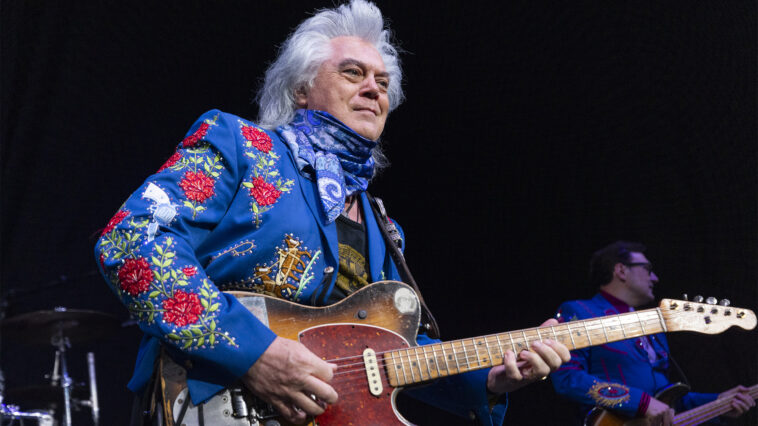
The instrument that perhaps best embodies that mission is the sunburst 1954 Fender Telecaster that belonged to country-rock pioneer Clarence White. More than just White’s stage guitar with the Byrds, it’s one of the most influential Telecasters ever built.
White’s ’54 Telecaster was fitted with one of the earliest Parsons/White B-Benders, a groundbreaking mechanical device developed by White and Byrds drummer Gene Parsons that allowed a guitarist to raise the pitch of the B string by a whole step, recreating the soaring, weeping sound of a pedal steel.

The idea came to Parsons during a 1967 recording session for country duo Vern and Rex Gosdin. White wanted to bend a string behind the nut while simultaneously playing harmonics higher up the neck and joked that he’d need “a third hand” to pull it off. Parsons, a former machinist as well as a drummer and multi-instrumentalist, began wondering if a mechanical third hand could do the job instead.
It is absolutely one of the most magical guitars I ever played.”
— Marty Stuart
His first prototype used a floor pedal, but White wasn’t interested.
“If I wanted to play pedal steel,” he told Parsons, “I’d play pedal steel!”
Working together, the pair devised a system of levers, springs and fulcrums activated by the guitar’s upper-bout strap button. By pushing down on the neck and releasing it, White could smoothly bend the B string while continuing to fret and pick normally. Parsons built the original mechanism from pedal-steel parts mounted to the back of White’s Telecaster beneath a wooden frame and Masonite cover. Later versions would become far more refined, but the original remains unlike any B-Bender that followed.
That’s exactly how Stuart prefers it.
“It’s an indescribable guitar,” he says. “You could put a hundred Telecasters in a row, and when you plug this guitar in it just has a voice all its own. It is absolutely one of the most magical guitars I ever played.”

The guitar’s unique personality isn’t down to the B-Bender alone. A hot-wound Stratocaster neck pickup crafted by pedal-steel legend Red Rhodes contributes to its unmistakable tone, giving the Tele a voice Stuart considers impossible to duplicate.
Stuart’s connection to the instrument stretches back long before he owned it. Clarence’s brother, bluegrass mandolin ace Roland White, was the man who got the teenage Stuart his job with Lester Flatt. Stuart later lived in Roland’s Nashville home and became close with Clarence’s widow, Susie White.
I had basically laid my checkbook on the table and said, ‘Susie, name your price.’ She could have asked for far more and I would gladly have paid.”
— Marty Stuart
In 1980, Stuart traveled to Susie’s home in Elkhorn City, Kentucky, intending to buy a 1954 Stratocaster she had decided to sell. Knowing how deeply Stuart admired her late husband’s playing, she also brought out Clarence’s Telecaster and invited him to spend some time with it.
“She said, ‘That’s what you really want, isn’t it?’” Stuart recalls. “I said, ‘Absolutely, I would love to have it.’ She said, ‘Let me think about it.’
“Later in the afternoon, she said, ‘I’d be happy to sell it to you.’ So she sold me the ’54 Strat, Clarence’s Tele, a couple of his Nudie suits and a lot of Byrds memorabilia for $1,450.
“I couldn’t believe it. I had basically laid my checkbook on the table and said, ‘Susie, name your price.’ She could have asked for far more and I would gladly have paid.”
The Clarence Tele has occupied a central role in Stuart’s music ever since. It can be heard on “I’m Blue, I’m Lonesome,” from Saturday Night, and has remained his constant companion onstage for decades.
The $1,450 price tag has become one of vintage guitar’s great bargains, but Stuart has never viewed Clarence as a collector’s trophy. For him, it’s a working instrument, a singular musical voice and a tangible piece of American history — the very kind of cultural treasure he set out to preserve when he made that promise to himself on the flight home from London.