
![Array]](https://backingtracksfullcollection.com/wp-content/uploads/2026/05/Array.svg.svg+xml "“It was kind of a wild idea in 1960 to call a guitar a Hummingbird. As wild as calling your band The Beatles”: How Gibson became an icon of acoustic guitar – 100 years on from its first flat-top 18")
Flat-top acoustic guitars weren’t really part of the plan for Gibson back in the pre-war years of the 20th century.
The Kalamazoo-based company was known for its archtops, and Martin, over in Nazareth, Pennsylvania, had a big head start on them by the time flat-top guitars were becoming really popular in the 1930s.
Yet when Gibson did embrace dreadnought and jumbo-style guitars in the 1930s, it led in time to the creation of some of the company’s most iconic instruments – from the expansive-sounding J-200 to the sweet-toned Hummingbird.

We join Gibson’s vice president of Product and de facto archivist Mat Koehler to explore how archtops literally gave shape to Gibson’s most influential acoustic guitars.
So where does the story begin with Gibson flat-top acoustics?
In the beginning, Gibson was consciously trying to avoid flat-tops because, obviously, Martin was present in the US, and flat-tops weren’t Gibson’s thing – archtops were Gibson’s thing. But clearly, the demand for more folk-style guitars and singing-cowboy movement shaped how Gibson grew. But even before that there was Robert Johnson playing Delta blues on the inaugural 1926 L-1 model acoustic.
But I think how the experimentation started involved the same principles that [archtop pioneer] Lloyd Loar employed: it was trying different things, like messing around with mandolins. You’ve probably seen the early ‘Army-Navy Special’ guitars [designed for WWI servicemen to buy affordably] that have those interesting cat-eye f-holes – but that was a flat-top guitar.

So there were lots of different types of flat-top guitars that they were experimenting with – and also flat backs, where they were putting flat backs on archtops. So they didn’t dive right into it straight away.
They definitely tried a bunch of different methods. And, to me, that’s also part of the reason why I think they got it right the first time, when they finally had their range of flat-top guitars.
The great luxury they had was to be able to use unique rim shapes that they originally developed for archtops. So, for example, the L-1 flat-top guitar had the same rim shape as the L-1 archtop guitar, and that has continued to this day. Likewise, our L-5 archtop and the J-200 flat-top use the same rim shape. That’s how we got our flat-top shapes, by and large.

What was the first Gibson flat-top acoustic model to really catch on?
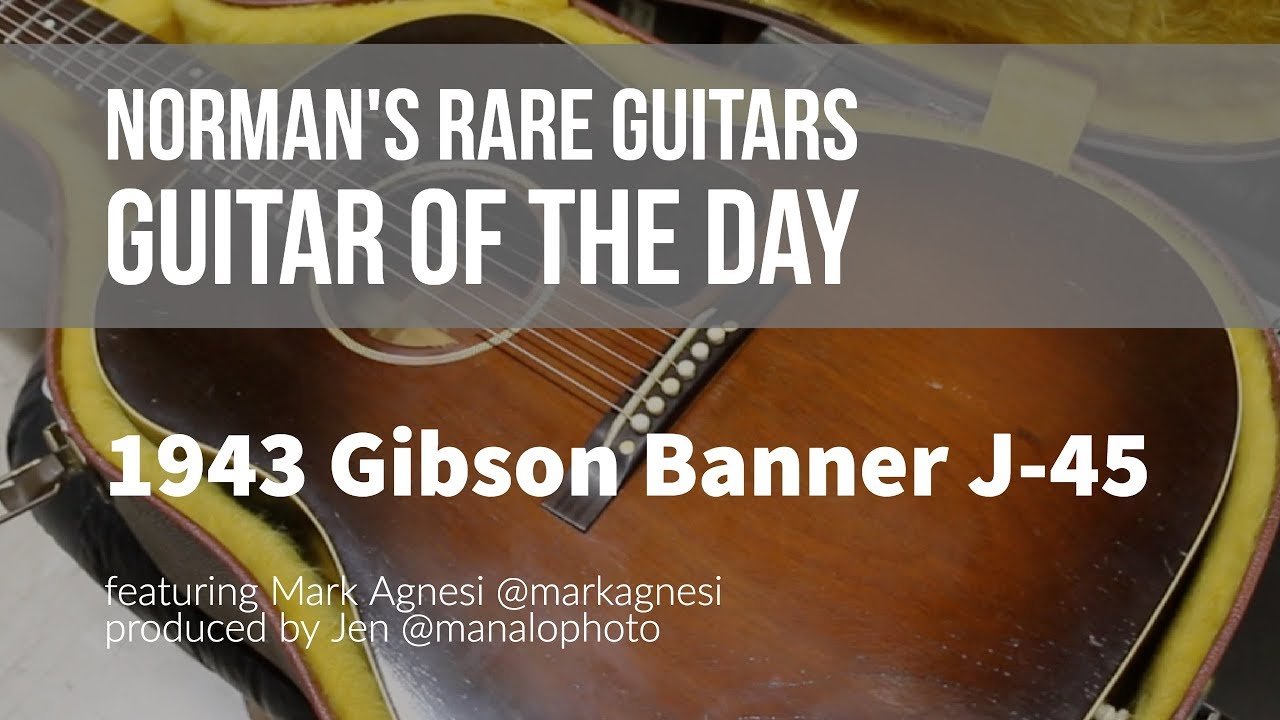
Probably the Jumbo, which debuted in 1934 and was the predecessor to the J-35 and then the J-45 after. [There was a 1936 transitional model that featured in the company ledger known as] the Gibson Trojan, and then it became a J-35 and the price was $35. But whatever we call that model, that’s the one that really stuck – and we are still producing it today.
There’s a common misconception that [the price-based naming convention] continued into the 1950s, but it was pretty unique to the 20s and 30s – and actually maybe just the ’30s and possibly during wartime. I honestly don’t know! But I know that it wasn’t around in the ’50s. So it was a short period.

Tell us about the invention of the L-00. Its quaint parlour-style looks and sound strongly evoke pre-war musical styles and yet it’s still a pillar of Gibson’s acoustic line-up today.
Yeah, to me, that is the perfection of those very first flat-tops: the L-0 and the L-1. Those were a little bit more crude and less refined because they had deeper bodies. And so the proportions – like the scale length and the bridge location – were great, but the body depth was the place to improve. So, basically, an L-00 is an improved L-1 with a shallower body depth.
The other key move there was the introduction of X-bracing. Early L-1 models did not have X-bracing, but that one evolution made for a really solid guitar that held up well. I mean, it held up good enough for Woody Guthrie to use it all through his early career. I have a 1930 L-00 12-fret, which is my go-to guitar.
It’s great because it’s super lightweight. And I think there’s something about the feel of that guitar in your lap and its light weight. It’s so resonant and you feel that in your body. So if I had to guess why they’ve remained so popular, it’s not just because of the size, it’s because of the experience.

We tried a vintage L-00 at Vintage Instruments in Philadelphia a few years back that almost seemed to defy physics in terms of how loud and resonant it was for its small size and feather weight.
Was that a 12-fret or a 14-fret L-00? Because the 12-fret and the 14-fret versions are so vastly different in terms of sound that if you get the chance to compare the two, you should – because they’re both good for different reasons.
You can play bluegrass on the 14-fret version; it’s going to be more focused, it’s going to bark. The 12-fret is more of a fingerstyle player’s guitar, but it’s also such a balanced, warm sound. And that kind of gets us into how we’re celebrating [Gibson’s acoustic heritage] today, which is the Century Collection – and that’s a collection of solely 12-fret instruments at entry-level prices.

Honestly, I think anniversary celebrations by guitar companies can be a little contrived, when it’s like the 65th anniversary or something – it’s like, “Okay, yeah, but it’s not the 75th anniversary or the 100th.” So we’re always looking for those opportunities to celebrate the 50th, 75th and 100th because those are real milestones, in my opinion, that are really worth celebrating – these quarter-century increments.
So 100 years [of Gibson flat-tops] is definitely an occasion we’re celebrating. And we also wanted to reassert ourselves and remind people that we’re the second-oldest acoustic company that exists and we have more shapes, more styles, more diversity of acoustic platforms than anybody else.
We literally have something for everybody in our range. And 100 years ago, those very first guitars seemed to get it right and resonate with artists on the first try.

Moving from small to large guitars, the J-200 is undoubtedly one of the most iconic flat-tops Gibson has produced. It was originally rosewood-bodied but famously changed to maple back and sides for most of its production life. Why the switch?
I don’t have the ‘why’ very well sorted out, other than I know that at least one maple-bodied J-200 was made pre-war. I think, again, there were lots of experiments happening. I also think World War II definitely played a part in that evolution – that’s why we have the pre-war style in our line-up, which is rosewood-bodied, but also the post-war model, which is maple.
In terms of how the model itself came about, we were talking before about the rim shapes [that Gibson had originally devised for archtops]. So you have archtops getting larger and larger at the same time that flat-tops are getting larger and larger. Basically, once you had the L-5 archtop, that rim shape was available to use in a flat-top.
A lot of people think it was a case of, ‘Well, the singing cowboys [a genre of Western-inspired popular music popularised by Gene Autry and others] needed bigger guitars to go on the horses.’ Well, yeah, they definitely wanted that. But it was definitely the available rim shape influencing the guitar design more than it was the singing cowboys requesting it.
So I think the ability to try something was, again, the determining factor in how the model was created. You know, if we went through our ledgers and logbooks, we’d probably see some of the very first entries, certainly in 1938 and I think at least one in 1937. At that time, it was not described as a J-200, or anything like that; it was called an ‘Advanced’ body shape flat-top guitar or ‘Experimental’.
So usually there was a customer on the other side of that, whether it was a custom order, or they had an artist in mind, or it was borne of a dealer discussion, or they wanted to experiment with it, and then they wanted to pre-sell it. Because in that time, post-Depression, that was the other side of experimentation – they weren’t going to waste materials.
Again, the proportions evolved. The very first J-200s were 12-fret models and had the bridge placement in the centre of the body. And, unfortunately, on that big, giant body, a 12-fret is a little less [than ideally proportioned]. They sound amazing, but I think it was the right move to go to 14 frets with that big jumbo body. So that’s another evolution point of that model.

How did the J-200’s beautiful ‘moustache’ bridge design first evolve?
We have the original blueprints for the moustache bridge – there were a few different designs – but [country singer] Ray Whitley personally influenced that bridge. So there was definitely an artist element there where he had custom-ordered a smaller-body guitar that actually we own now.
You may have seen it at Carter Vintage years ago, it’s a really cool guitar. Then the next one that he ordered was on that big, giant [J-200 size] platform.
He got that first customer-order, small-body guitar, and then for a second guitar, he was like, “Can you do it with this [bridge]?” And so that wasn’t the very first SJ-200, but it was among the first three and that was really the one that set the stage – plus, Ray Whitley was the biggest singing cowboy of the day.

The original bridge design for the J-200, with its delicate pattern of interlacing curves, looks really ornate. How was it made, back in the day?
Under Norlin ownership, those principles that were kind of in the ether as soon as Ted McCarty left in 1966 – simplification of processes and whatnot – those changes were well intentioned and some of those guitars are fantastic
Today, obviously, we can scan an original and CNC it, but I would have to think that it was all hand-shaped. I mean, even a rectangle bridge was hand-shaped back then. It probably was a template and it was cut out and then it was hand-shaped.
The apertures in the original J-200 bridge were later replaced by a ‘solid’ design with pearl inlays. Why did that come about?
That occurred much later, into the 1960s, and definitely aligned with Ted McCarty’s exit.
Then, under Norlin ownership, those principles that were kind of in the ether as soon as Ted McCarty left in 1966 – simplification of processes and whatnot – those changes were well intentioned and some of those guitars are fantastic.
But I think that is one thing that you see in that period: those really time-consuming processes were sacrificed in order to get the guitar complete sooner because there was a huge order book. I mean, this is like during The Beatles era, so the people wanted guitars.

People often assume that the mid-60s shift away from the more labour-intensive aspects of production – which occurred at Fender, Gibson and other major makers – was about maximising profit. But they forget that demand went wild for guitars in the 60s and firms couldn’t make guitars fast enough to keep up.
Nobody wants back-orders. If you build up a year of back-orders… you’re hearing about it from all of your dealers and customers constantly. We’ve been there, in modern history, and you definitely want to find a way to fulfill those orders.
But cutting corners was not really the mentality – it was more like, “Let’s find processes that are maybe needless and just aesthetic-based.” I would say that was probably one consideration.
There’s probably also someone there like [Gibson president from 1968] Stan Rendell who’d argue there was more surface area to glue the bridge on [with the later, solid J-200 bridges].

The round-shouldered dreadnought shape is indelibly associated with the J-45. How did it evolve?
Again, it was directly influenced by archtop shapes. Certainly the Sears catalogue archtops [made for the giant US mail order goods company and its compendious catalogue] were a little bit different to other Gibson shapes on purpose, but those shapes lent themselves perfectly to flat‑top guitars.
At the same time, historically, Ditson was ordering similar shapes through Martin, so there was something about the slope-shoulder shape that was considered intriguing and interesting at that point in time. But, fortunately for Gibson, it was the brand that made it famous.
Gibson’s Dove and Hummingbird acoustics, with their ornately decorated pickguards, are among its best-loved acoustic designs. How did they come about?
There was a gentleman called Hartford Snider who was a pattern-maker at Gibson but also a keen birdwatcher, and eventually his [interest in sketching birds] came to the attention of Ted McCarty and John Huis, who was Ted McCarty’s right-hand man, and they said, “Well, hey, you know you’re making these patterns, but we can see you’re sketching all these birds and stuff. Why don’t you make a pickguard design?”
So the very first one was the Hummingbird, and the next one was the Dove, and then came the Excellente, in the same year as the Dove, which had an eagle on a pickguard.

He created all those pickguard designs, and I think the success of the Hummingbird in 1960 allowed Gibson to go back to the well and introduce a couple of more bird pickguards. Which was kind of a wild idea in 1960 – to call a guitar a Hummingbird. Back then, it was as wild as calling your band The Beatles, because in that era band names were usually something very conventional like ‘Marty and the something-or-others’.
I think the success of the Hummingbird in 1960 allowed Gibson to go back to the well and introduce a couple of more bird pickguards. Which was kind of a wild idea in 1960 – to call a guitar a Hummingbird
And in the same way, guitar names were not typically words like ‘Hummingbird’, you know? So it was just such a cool move. And, again, it was testament to Ted McCarty and his team to empower the workforce and empower the talented folks within it, and they struck gold.
After 1957, Gibson also owned the Epiphone brand – and some great Epi flat-tops were produced, too. How did the Epiphone and Gibson flat-top ranges compare?
Now we’re getting to the fun stuff [laughs]. I love Epiphone history. Some of my absolute favourite flat-tops ever are really early wartime Epiphone flat-tops, like the FT-79, so before it was ever a Texan FT-110, which was a beautiful figured maple back-and-sides [design]. And those were dreadnought styles, so they were very early, late-30s Epiphone dreadnoughts. They are super-cool instruments.
But when Gibson purchased Epiphone in 1957, one of the first moves from Ted McCarty at the time was assembling a team – and we actually have the notes from the meeting – to create a whole unique line of instruments for Epiphone because they had all these parts, but they didn’t want to do the same thing [as Gibson models]. So they wanted to have this melding of Gibson forms and Epiphone parts to create a line of instruments.

One unique instrument to come about was, again, a dreadnought – a square-shoulder dreadnought – so that debuted with Epiphone as the Frontier, a continuation of the FT-110… The 1958 Frontier comes about immediately.
Ernest Tubb then popularised it and a lot of those Nashville and Bakersfield country artists were playing Epiphones, which is really a testament to a guy named Ward Arbanas really pushing the line at the time and helping to sell it.
Another awesome square-shoulder dread was the Excellente, one of my absolute favourites. Again, that was kind of a collaboration between Andy Nelson, who was a salesman for Gibson and some artists.
Those acoustic guitars – those Epiphone flat-top guitars – were managed like a unique product line because they were in different stores from Gibson. That was the whole strategy. It’s like, if you put Gibson in the mom and pop store across the street from the other brand, then you’re not going to be competing for the same hook share in the store. So that was the thinking.
Other really cool models then developed. Another awesome square-shoulder dread was the Excellente, one of my absolute favourites. Again, that was kind of a collaboration between Andy Nelson, who was a salesman for Gibson and some artists. It was adopted by many artists, including Ernest Tubb. It was cool to see that Epiphone had its moment in the sun, especially in the 60s, with really influential folk and country players.

What lessons from Gibson’s acoustic heritage does Gibson take most to heart today, 100 years on?
How we think about innovation today is similar to how we developed the line over 100 years, but it’s become refined [to an understanding] that the success of those guitars in our past are what makes us great today. And that’s kind of true on the electric side as well.
We know we don’t need to try to reinvent the wheel, but we are still focused on using those familiar shapes and the same iconic sounds that you’ve heard in records for the last 100 years, and improving them aesthetically, ergonomically and sonically: so basically working with those parameters of the shape and the basic principles of creating a great acoustic guitar, X-bracing, forward-shifted bracing and so on.
And you could be experimenting with new materials, but if you’re keeping to those platforms and shapes and paying tribute to the originals in your experimentations, you’re usually on the right track to finding something cool.