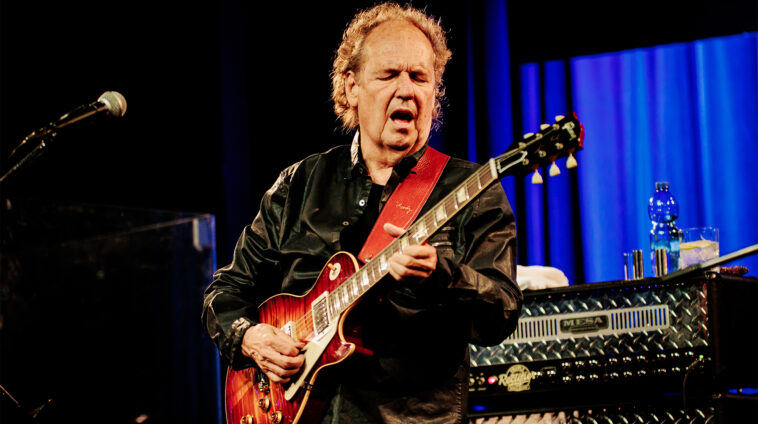
Time and age have not impaired Lee Ritenour’s chops — or the veteran guitarist’s memory.
“I remember the stories,” the 74-year-old tells us via Zoom from his home studio in Malibu. “I love that a lot of times I can remember who was on the sessions, what happened — all of it.”
And rest assured there are a lot of stories, considering Ritenour has some 58 albums of his own — dating back 50 years to his first solo set, First Course — along with legendary sessions for the likes of Steely Dan, George Benson, Pink Floyd, Aretha Franklin, Barbra Streisand, Neil Diamond, Quincy Jones, B.B. King and a great many more.
Ritenour is adding yet another album to his legacy with the new concert disc Live at Ronnie Scott’s, which comes out October 23. The album was drawn from an eight-night run at the storied London venue last March.
“I picked 20 songs,” Ritenour says. “Everybody got the list in advance and audio samples and PDFs if they needed the score, but everybody knew the music.” They did not, however, know exactly when or how they’d be playing them each night.
“I call it as we go,” Ritenour explains. “I never do a set list, and that way it keeps everybody on edge, and it also keeps it spontaneous. It’s almost like the improvisation that goes into a fusion tune or a rock tune or a jazz tune or a ballad; we’re performing at that moment, and everyone’s got to stay sharp.”
That includes Ritenour. But the legend says he’s energized by the youthful players in his group, which includes his son Wes on drums, keyboardist Giorgi Mikadze, bass guitarist-vocalist Munir Hossn, harmonica player Gregoire Maret and vocalist Tatiana Para.
“Everybody’s in their 30s, 40s at most,” he says. “They have that same fresh energy that I had when I was in my 30s, and that brings it back to me and gives me energy.
“This kind of music I do has to be reinvented. It has to feature the players and bring out the best of those players as well — and by extension, the best out of me. So having a young band play these songs at Ronnie Scott’s … it kind of keeps me on my toes.”
Ritenour will finish the year with a handful of performances on the West Coast during November and a four-night stand at the Blue Note Tokyo in December.
In the meantime, we asked him to share a few of those stories from his long career.

George Benson
One of Ritenour’s favorite stories involves Benson’s 1989 Platinum release Give Me the Night, for which Ritenour played on seven of the 10 tracks. In particular, he remembers a session for the title track, which became a number four hit on the Billboard Hot 100.
“I was on most of the tracks playing rhythm guitar and sometimes helping George with his amps and stuff like that, being an overall help to Quincy. But all of a sudden I got a call one night at almost midnight. The studio [Kendun Recorders in Burbank] was 15 minutes from my house, coincidentally.
“Quincy says, ‘Ritenour, you gotta come down here. We’ve got an emergency.’ Apparently, a second engineer on the session had accidentally erased part of Benson’s solo on the title track. I said, ‘Well, where’s George?’ Quincy said, ‘He’s back in Hawaii. We’ve got to finish the mix tonight, and the last four bars of the solo are missing now.’

“So I come down and George’s guitar is there. His rig is there. I knew that setup because I helped dial it in. They had a cassette of the original mix of the solo, so I learned the last four bars and we punched it in. We did it a few times; I made sure the sound was the same.
“And Quincy said to me, ‘You have to promise never to tell George about this.’ ‘Okay, I promise.’
“Time moves on, and 20 years later George and I are walking in the airport, just shooting the breeze, and I thought, I’ve got to tell George the story. So I tell him, and he starts laughing his ass off.
“He says, ‘Well, I didn’t notice, and it was a hit, right?’ So all good!”
“I probably wish, with Quincy, I had been on some of those Michael Jackson sessions. By that time I had moved on and was doing my own albums, and Steve Lukather, Ray Parker Jr. and a couple other people were doing those Jackson albums. But at the time you think, ‘Man, that track turned out so great. I wish I had been on it.’”
Steve Lukather
Steve Lukather often tells the story of how Lee Ritenour saved him on a session early in his career by switching guitar parts with him. The session took place in the 1970s, for an artist neither guitarist has identified. The two already knew each other: Ritenour had played with Lukather’s future Toto bandmate David Paich and Paich’s father, Marty, before meeting Lukather at the Baked Potato in Los Angeles. We asked Ritenour to recount the story from his perspective.
“We were on this session with this R&B arranger [Gene Page],” Ritenour says. “I was supposed to play guitar one, which had just chords, changes and fills around the melody. It was relatively easy. Guitar two was doubling the bass part, and it was Wilton Felder playing the bass, and Wilton was one of the few bass players back in the day who could read well because originally he was a saxophone player with the Jazz Crusaders. So Wilton was on, and this arranger wrote really funky, syncopated bass lines that were not easy to read.

“So Steve has this part doubling the bass, and he’s late to the session and was nervous to begin with, ’cause he was the new kid on the session. He sits down, and the sheet music was just black with notes. I saw Steve’s face just go white; we already knew each other a little, and I was famous for being a sight reader, whereas Steve was more of a player-player.
“So I said, ‘Hey, Luke, why don’t you take guitar one and do the fills? I kinda know the song already, a little bit. I’ll take guitar two.’ So we switched parts, and he’s said for decades that I saved his ass on that session.”
David Gilmour
Among Ritenour’s most notable credits is his work on The Wall, Pink Floyd’s chart-topping, 23-times Platinum opus released in 1979. Brought in at the suggestion of co-producer Bob Ezrin, he’s credited with acoustic guitar on “Young Lust” and rhythm guitar on “One of My Turns,” and there have been reports over the years that Ritenour offered suggestions for David Gilmour’s iconic solo at the end of “Another Brick in the Wall, Part 2.”
“That’s another one of those bands that, like Steely Dan, had huge budgets,” Ritenour says. “Budget was not a concern for Pink Floyd — rightfully so, considering they were one of the greatest bands in the world. They were one of the bands that made sure every part was right. That was one of the few times I entered into a band’s territory like that.

“Some people think I did the guitar solo on ‘Another Brick in the Wall.’ No, it was David. We did play double acoustic guitars together on another song, and they played me the solo on ‘Another Brick in the Wall,’ and I said, ‘That sounds cool.’ And, of course, the guitar sound is exquisite. They asked my opinion. I said it sounded great and left it at that.
“I’m very proud I’m on that record, and that I added some stuff to it. But it was still a Pink Floyd record. It’s like a player coming in and adding something to the Beatles; it was still the Beatles, come on.”