
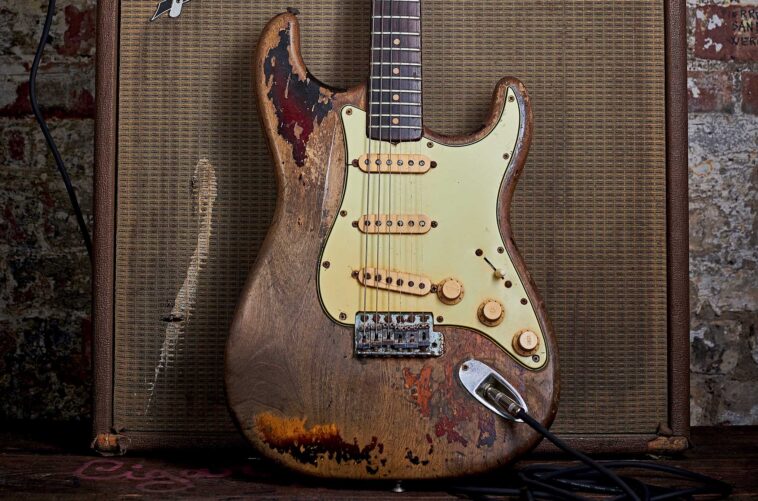
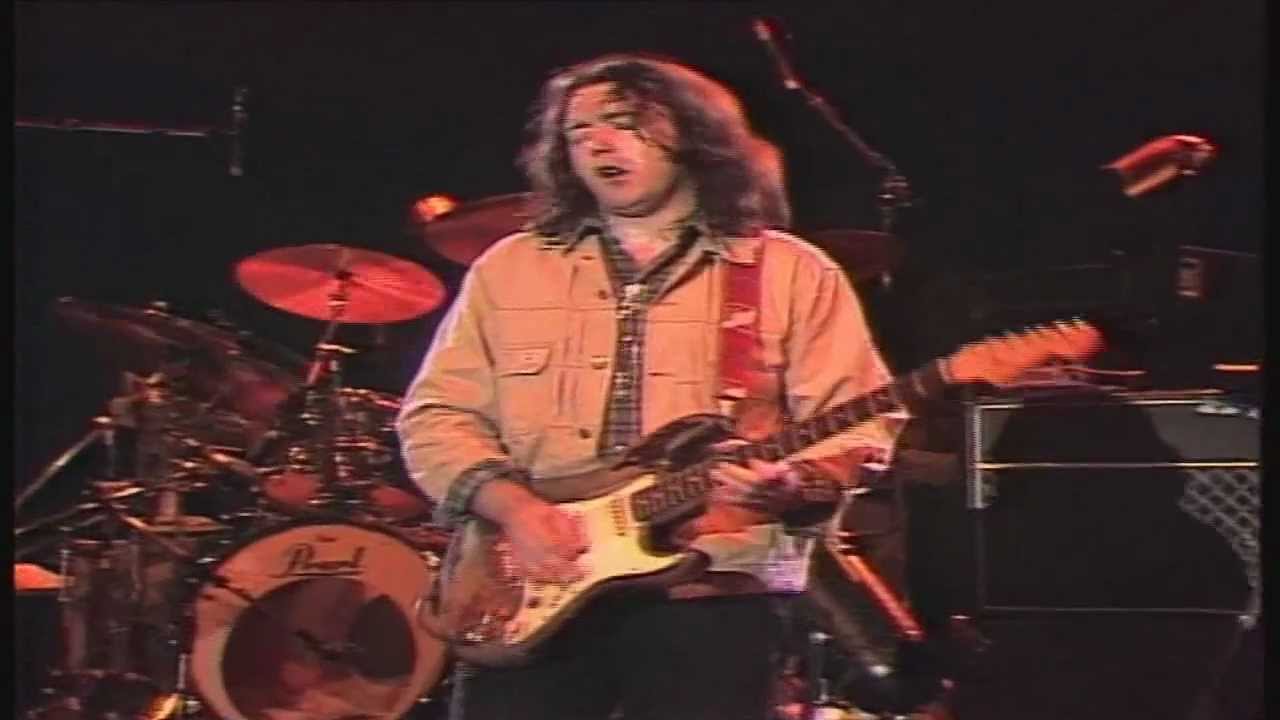
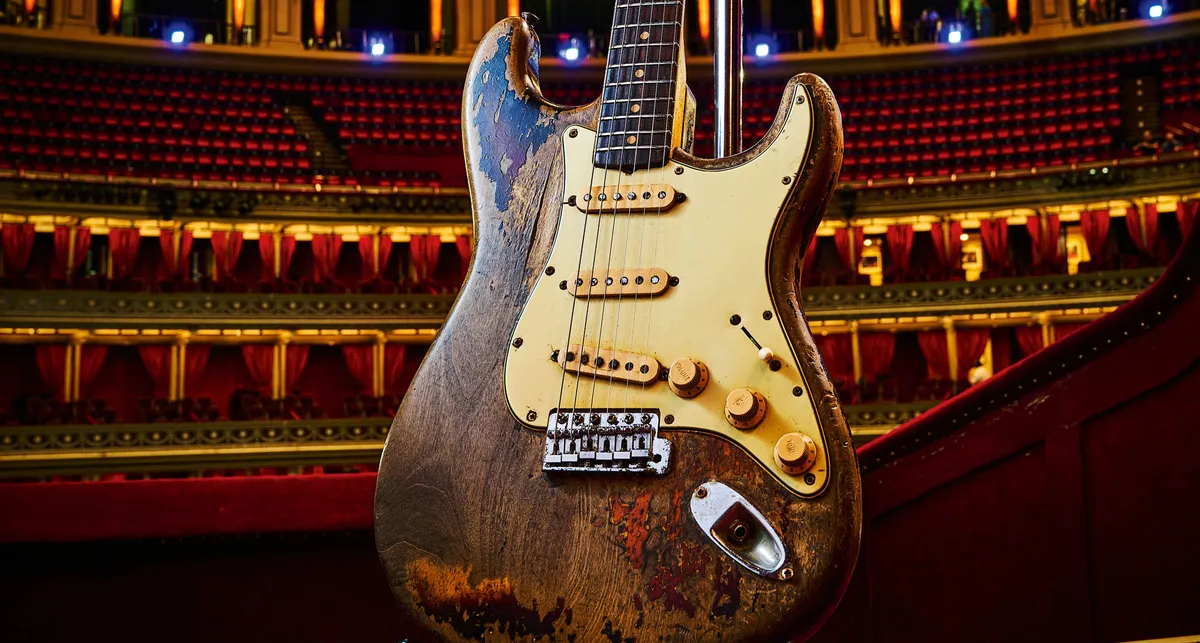
In this extract from new biography Edged in Blue: A Rock ’n’ Roll Odyssey with Rory Gallagher, Rory and Dónal Gallagher first encounter the ’61 Strat that would become Rory’s constant companion for thousands of gigs and an icon of his music – though not before landing in hot water with their mother, Mona, for secretly bringing the guitar home…
Who’s that coming?
‘Are you awake?’ Rory said, shaking my shoulder. Big brother was back late from a gig with news as urgent as if a spacecraft had landed in the city.
‘There’s a Buddy Holly guitar in the window of Crowley’s music shop,’ he exclaimed, ‘Can you believe it – a Fender Stratocaster in Cork? Will you come and look at it with me tomorrow? I might buy it – it’s only one hundred pounds.’
Latest Videos FromGuitar World
‘What?’ I said, rubbing my eyes and sitting up in bed. I felt like I was still dreaming. ‘And which bank do we rob? That’s the price of a car … for God’s sake, Rory.’
‘Don’t say anything to Mammy until I see if I can get a deal on it,’ my sibling warned.
Standing outside Crowley’s store at Merchants Quay the next day, my brother and I gazed at the contoured, sunburst-finished instrument displayed on a stand in the window. To me, it had all the serenity and presence of Our Lady’s statue in a grotto.
‘Come on, we’re going in,’ Rory ordered.
Reluctantly, I followed him into the small store, which had stringed instruments hanging from every wall like Christmas tree decorations. I tried to make myself as small as possible as Michael, the shop’s genial owner, retrieved the Stratocaster from the front window at my brother’s request.
Rory confidently caressed the guitar’s sleek contours and strummed it acoustically. Even unplugged, its voice was strong and distinctive, the fragrance of its polished lacquer adding to the instrument’s allure.
‘Do you want to plug it into that amp?’ Michael asked Rory.
Rory nodded and, moments later, my ears tingled with shimmering, mirage-like notes that magically filled the shop. The warmth of the amplified chords from the Fender seemed like something from another world.
‘Where did the guitar come from?’ asked Rory.
‘The Royal Showband,’ Michael replied in his soft-spoken way. ‘Their guitarist, Jim Conlon, is after a red one like Hank Marvin has, to suit the band’s new look or something. He only hung onto this one until he could get the red one shipped over from California.’
‘What kind of trade would you give me for my Solid 7 and the Selmer amp – and how would that work with the hire purchase scheme?’ my brother enquired coolly.
Michael did some calculations, his pencil moving quickly as he glanced at the hire purchase rate chart.
‘With the trade-in, it would work out at about £2 and 10 shillings over the next 36 months,’ he said. ‘Sure, why not take the instrument home, try it out at a gig. But obviously, you’ll have to have your mother’s consent and signature for extending the commitment you already have,’ Michael added.
We returned to my grandmother’s house full of glee and trepidation, carrying the guitar in its beautiful buff-coloured case, with stitched tan leather binding at both ends.
‘You’re not to say anything to Mammy or anyone. It’s a secret,’ big brother said gravely.
I nodded.
‘I want you to swear you won’t tell anybody for now. You can guard it when I’m not around in case someone sneaks up from the bar.’
‘Can I play it?’ I asked.
‘No. You can look at it, to make sure it’s safe, but you can’t take it out of the case’, he ordered. Rory also informed me that the guitar was to be hidden under my bed.
‘Mammy will never look there – you’re the pet,’ Rory explained.
During the following days, I’d return regularly to check on the guitar and admire its perfection, swaddled up in its reddish-gold lining and cradled by the case’s inner structure. But what started as a quick peek once a day became an hourly occurrence.
While I kept my word not to touch the guitar, I had a good look through the case during these inspections. I remember there was a blue bottle of Fender-branded polish inside that seemed more like a solvent.
Later, when Rory first began using the guitar in the band, I’d always ask him if he wanted the guitar polished – without quite realising, I was getting a bit addicted to the fumes from the stuff.

It wasn’t long before our cover was blown. One evening, my mother bumped into Michael Crowley in the street and he soon told her about the arrangement he’d made with Rory regarding the Strat. This was news to her, of course, so she came back with a face like thunder.
‘What’s this about another guitar?’ she demanded.
‘Oh, Michael’s just lent it to me,’ Rory replied, all innocence.
‘Well, you know we can’t afford that. You’ll have to take it back right away,’ she said.
Then she turned to me.
‘And what about you? The guitar’s under your bed.’
I explained that I was just minding it for Rory, but my mother shook her head again.
‘No, it goes back.’
Rory was so upset.
‘We won’t ever get to be professional if I don’t have a proper guitar,’ he protested.
But my mother wouldn’t budge.
‘We won’t be able to pay for it – you’ll never get the money,’ she said, with a note of finality.
To be fair to her, the whole situation raked up difficult feelings. On the one hand, she had unflagging support for her brood. But she also had painful memories of my father, Danny, falling into debt and having to pawn his piano accordion – and it was only the money she earned as a seamstress that had allowed him to get his instrument back again.
Rory kept at it, however.
‘Look, if I had that guitar, then we wouldn’t need a rhythm player and I could get paid twice as much because I could play rhythm and lead.’
This argument seemed to tip the scales a little and, after some careful thought, my mother said she could spare an hour to go to Crowley’s with us that Friday and talk things through with Michael.
And so, the big day finally came. We went back down to Michael, who set out terms for extending the hire purchase agreement that my mother already had with him for Rory’s earlier instruments.
This now went from an 18-month ‘jail sentence’ to a five-year extended contract. Michael had this wonderful look about him that used to make me think of the Beatles’ suave producer, George Martin: he was so cool and calm, and he was a very rational man.
Many years later, when Michael died, his daughter told me that Michael had inherited the shop at the age of just 14. Having built the business up from there, he knew how difficult it was to make your way as a young man getting started in music – and he had a kind heart. He reassured my mother that Rory had never missed a payment on the previous equipment he’d had.
‘Look, if he can’t pay for it, I’ll be taking it back off him and selling it to somebody else,’ he said.

So, with my mother’s help and Michael Crowley’s forbearance, Rory got his Strat. It was 1963 and he was just 15 years old. Getting that guitar was a huge moment for Rory and it would become his lifelong musical companion.
Having been granted my mother’s blessing, the guitar was now legitimate and I wanted to take a picture of Rory holding it. To do this, we had to climb out the window onto the roof because it was too dark to take pictures inside.
My mother said, ‘Stand beside the parapet. I’ll take a picture of you both with the guitar.’
But Rory protested.
‘No, you can’t take a picture of Dónal holding it. He doesn’t even play the guitar!’
‘Yeah, I can,’ I said, taking it off him and holding down a simple chord. This didn’t satisfy Rory, however, who begged my mother to take the guitar off me.
But she said, ‘Oh, go on. It’s only a photograph.’
Rory compromised and said I could hold his acoustic guitar instead and so, with a small ‘click’, the picture was taken, capturing us both smiling as Rory took possession of the guitar with which he would make his name.