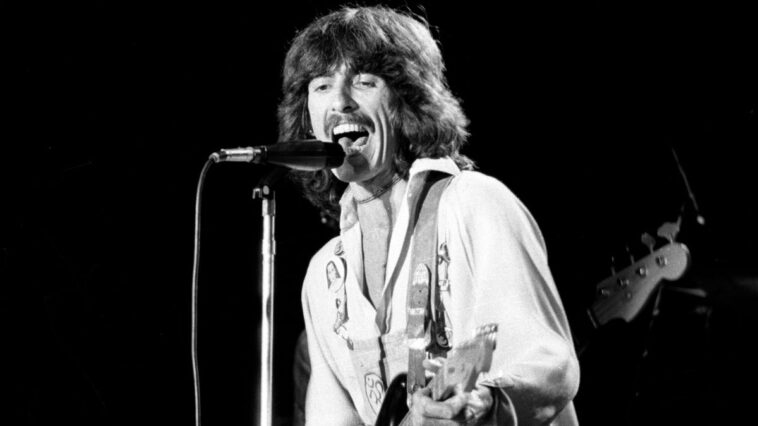
Phil Collins thought he’d been fired by George Harrison for more than 30 years — until the former Beatle finally let him in on the joke.
The two first met in 1970, when a 19-year-old Collins landed a £15 session (roughly $280 today) playing congas during the recording of Harrison’s first post-Beatles solo album, All Things Must Pass. Collins recorded parts for “Art of Dying,” but they never appeared on the finished album.
For decades, he thought little of it. Then, while Harrison was preparing the album’s 30th-anniversary reissue, he unearthed an old session tape and sent Collins a copy with a handwritten note.
“Dear Phil, could this be you? Love George.”
Collins later recalled to Mojo (via Guitar.com) that he eagerly listened to the tape, convinced he was finally hearing the performance he’d recorded as an unknown teenager.
Instead, he got a shock.
“The conga player sounded like a hyperactive toddler,” Collins said. “At the end, I heard George’s voice saying, ‘Can we try one without the conga player?’”
“I rewound it and played it again and again and thought, ‘Fuck… I was sacked, and I never knew!’”
He left the listening session feeling “angry, depressed and sad,” convinced he’d finally discovered why his contribution had disappeared from the album.

A few days later, Harrison called to see whether Collins had received the tape.
“I said, ‘You fucking bastard. You sent me this tape, and it turns out I was sacked!’”
Harrison burst out laughing.
When he finally caught his breath, he revealed the truth.
We eventually managed to have a laugh about it. And yeah, I swore at a Beatle.”
— Phil Collins
“Oh no, no, no — that was [famed percussionist] Ray Cooper on the congas. We made the tape as a joke for you!”
Collins admitted he eventually saw the funny side.
“We eventually managed to have a laugh about it,” he said.
“And yeah, I swore at a Beatle.”
Of course, Collins’ career — from Genesis to a string of chart-topping solo hits and even Disney film soundtracks — suggests he wasn’t too badly wounded by the experience.
He also wasn’t the only future star to appear on All Things Must Pass. Peter Frampton contributed electric guitar leads to Harrison’s landmark solo album years before either musician became an international superstar.
![Array]](https://backingtracksfullcollection.com/wp-content/uploads/2026/05/1779850244_Array.svg.svg+xml "\"This is is 1000% going on every single mix\": Baby Audio's SubCulture is a pitch-tracking bass enhancer designed for \"massive low-end\" 26")