Shoegaze guitar has never been bigger – and these 5 pedals are a shortcut to its otherworldly tones
Pedals Week 2026: Shoegaze is well and truly back. The return of legendary figures to the touring circuit – My Bloody Valentine chief amongst them – has been a heartening thing, demonstrating the continued, vibrant and powerful relevance of the blissed-out guitar as a mode of unreal expression.
These new upwellings of legacy acts are also a reflection of shoegaze’s long and aptly slow second act – newer artists like Glixen, Mo Dotti and They Are Gutting A Body Of Water woozily picking up the mantle left by the likes of Cocteau Twins, The Jesus And Mary Chain and Slowdive, spurred on by the runaway successes of their era.
Even outside of the nu-gaze scene, shoegaze tones have caught on with more mainstream indie and rock torch-bearers, from Wet Leg to Turnstile. But what makes the shoegaze tone? Well, in a nutshell: distortion, modulation, reverb – lots of each, and not quite in that order.
Shoegaze pedalboards are famously well-populated things, Kevin Shields’ small village of floor- and rack-based effects king amongst them. The typical shoegaze sound is heavily distorted guitars, pitch-modulated in some form or another, and smeared by large reverbs placed before them in the chain.
That placement is the defining aspect of a shoegaze tone, in that the huge trails from the reverb compound saturate and swell around the playing at its core – making for a febrile wall of untamed sound. Though the shoegaze tone is broadly easy to recognize, there are countless iterations of it and even more ways to achieve it.
Below you’ll find 5 pedals that’ll get you into the right spacey ballpark, from do-it-all multi-effects to lush reverbs, glitchy delays, and a must-have My Bloody Valentine signature pedal.
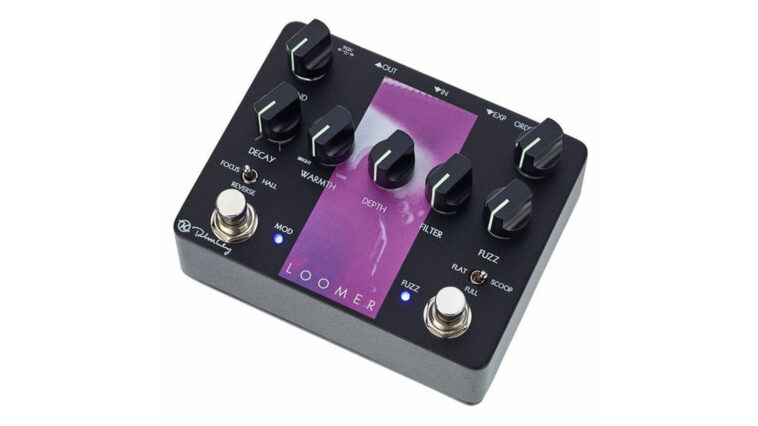
Keeley Loomer
(Image credit: Keeley)
Keeley Electronics’ Loomer is a dual-footswitch multi-effects pedal that combines fuzz, reverb, delay, and modulation into an extremely transparent love letter to everything that jangles, saturates, and otherwise overwhelms.
There are three core reverbs to choose from, each of which has a corresponding amuse-bouche of an effect: hall with shimmer; reverse with vibrato; soft-focus with parallel delays. The fuzz circuit is a Big Muff-of-sorts; big, beefy op-amp distortion with a powerful filter sweep for tone control. A push-button switch on the back lets you switch the order of fuzz and reverb, but for shoegaze, you want reverb first, always.
Fender Shields Blender
(Image credit: Fender)
What pedal could be better-equipped for shoegaze than one co-designed by Kevin Shields? The Fender Shields Blender is a contemporary remake of the gold-dust ‘70s fuzz-octaver, viewed through a My Bloody Valentine-y lens and tinkered with accordingly. It keeps the same core circuitry as traced from Shields’ own OG Blender but also adds some equally incredible and oblique modes of control.
The Fender Shields Blender contains multitudes, figuratively and literally – what with the two flavors of octave fuzz that run in parallel, the now-optional octave-up, and a whole new control surface just for voltage sag. With so many tonal differentiations at your feet, this is a real Swiss army knife for shoegazery.
Walrus Audio Melee
(Image credit: Walrus Audio)
Walrus Audio’s Melee pedal is another exceedingly swanky dual-effect distortion-and-reverb device, and another immensely handy shortcut to shoegaze. It’s a fuzz and a three-mode reverb, the three modes being Ambient, Octave Down and Reverse With Feedback (all, in one way or another, shoegaze in a box). The fuzz and verb can have their order swapped by a toggle switch, and a Sustain footswitch allows you to both latch reverb pads and swell your trails.
Even accounting for all of that goodness, the Melee’s key USP is something else entirely: that massive joystick on the top-right. It’s an XY controller that gives you precise and expressive control over the blend of fuzz and ‘verb. All the better for dialing in just the right volume of inscrutable trails….
Catalinbread’s FX40 Soft Focus reverb quite literally captures the sound of shoegaze history for pedalboard-friendly delivery to a new generation of ‘gazers. It’s a replication of the ‘Soft Focus’ reverb patch found on the Yamaha FX500 – a ‘90s studio rack processor used heavily on Slowdive’s Souvlaki, amongst other quintessentially dreamy ‘90s records.
The Soft Focus is a big plate-style reverb with some lush modulatory goodness stashed within. The plate reverb meets three parallel channels – one clean, one with an octave-up, and one with a multi-voice chorus – for a blended tone that shimmers and moves in highly idiosyncratic fashion.
Old Blood Noise Endeavors Parting
(Image credit: Old Blood Noise Endeavors)
Shoegaze has always been about tonal experimentation. And the second wave of shoegaze has coincided quite handily with what might be described as the second wave of glitch pedals, as evidenced by Old Blood Noise Endeavours’ pedal collab with harpist Emily Hopkins, Parting.
To make a long story short, Parting is glitchy, random ambiance via a delay/verb and Fun With Samples. It’s an inscrutable box of chance, incorporating downsampling, LFO-based modulation, delay, and reverb. It’s capable of everything from zippy reverse-sample soundscapes to smeared (there is literally a knob labeled ‘Smear’) verby beds. Three-dimensional lushness abounds.



![Array]](https://backingtracksfullcollection.com/wp-content/uploads/2026/05/1779850244_Array.svg.svg+xml "“It’s a piano chord, but I played it with my arse. I was singing and I just wanted a rest, and the piano lid was open. So I sat and I played that chord”: The Police’s classic breakthrough hit – with the ultimate bum note 29")
![Array]](https://backingtracksfullcollection.com/wp-content/uploads/2026/05/Array.svg.svg+xml "“When you feel like your hands aren’t doing well, and you’d like to take a day off, that’s the day you try and play more”: How Rik Emmett tackled the Triumph reunion tour, with added Phil X 30")